Science1 distinct publisher3 min readPublished
Five experiments on the DIII-D tokamak let learned models predict plasma behaviour and command the heating, while error checking, conflict resolution and hardware limits stayed in stages where nothing was learned.
The Scientist · Science desk

Compiled by The ScientistSomething wrong?How this is made
The authority boundary here is an ordering fact rather than a policy document. The learned components sit in the middle of the pipeline, reading whichever measurements they need, predicting what the plasma is doing or is about to do, and computing commands such as turning up a heating beam [10]. The stage that clips those commands to strict hardware limits comes after them, and nothing in it is learned [11]. So when a reinforcement-learning agent held the heating systems outright, that gate still stood between the agent and the coils [4].
About 20 milliseconds per pass is the figure the team quotes, and the loop does not run once [5]. It has two clocks to beat. A focused human operator responds on the order of seconds, which means roughly 50 PACMAN cycles fit inside one second of human reaction [6][16]. The physics codes fail the same test from the other direction: a simulation that takes a day runs about 4.3 million times longer than one control cycle, which is why those codes are good for designing next year's experiment and no use during this one [8][17]. Farre Kaga makes speed the basis of the case, calling machine learning the only available way to model plasma on millisecond scales [9].
What is missing here is any measure of how much better the plasma behaved. Five experiments is the denominator [2], and the account reports no comparison against a conventional non-learning controller, and no disruption or control-error statistics [18]. It also does not describe the limit stage ever refusing a command [19]. That would be the informative event: an envelope that has never been tested against a bad prediction has only been drawn, not demonstrated. A tokamak experiment that lasts minutes [8] is also a very different duty cycle from a machine that has to hold the same loop for weeks, and nothing in five shots speaks to the second case.
The arrangement is what travels to other hazardous machines; the plasma physics stays behind. Earlier machine-learning control attempts in fusion were mostly bespoke, built without shared design rules that would let separate models be combined, even though several models are needed to watch different parts of the system [13]. PACMAN's claim is that models and controllers can now be added without disturbing the rest [12], with the goals left to humans [14]. Modularity of that kind pushes risk downstream: the more learned components propose commands, the more the one non-learned stage that arbitrates and clips them carries. The safety case for this design lives in that arbitration stage, not in the models, and it is the first thing worth reading in any copy of the pattern. The account also mentions PACMAN predicting sudden bursts in the plasma as a further demonstration, though the description is incomplete in the copy supplied to us [15].
Ranked by verification strength, evidence, and original report placement.
PACMAN was successfully tested on a real fusion system in five experiments, and the framework's design and first results are detailed in a paper in the journal Nuclear Fusion.
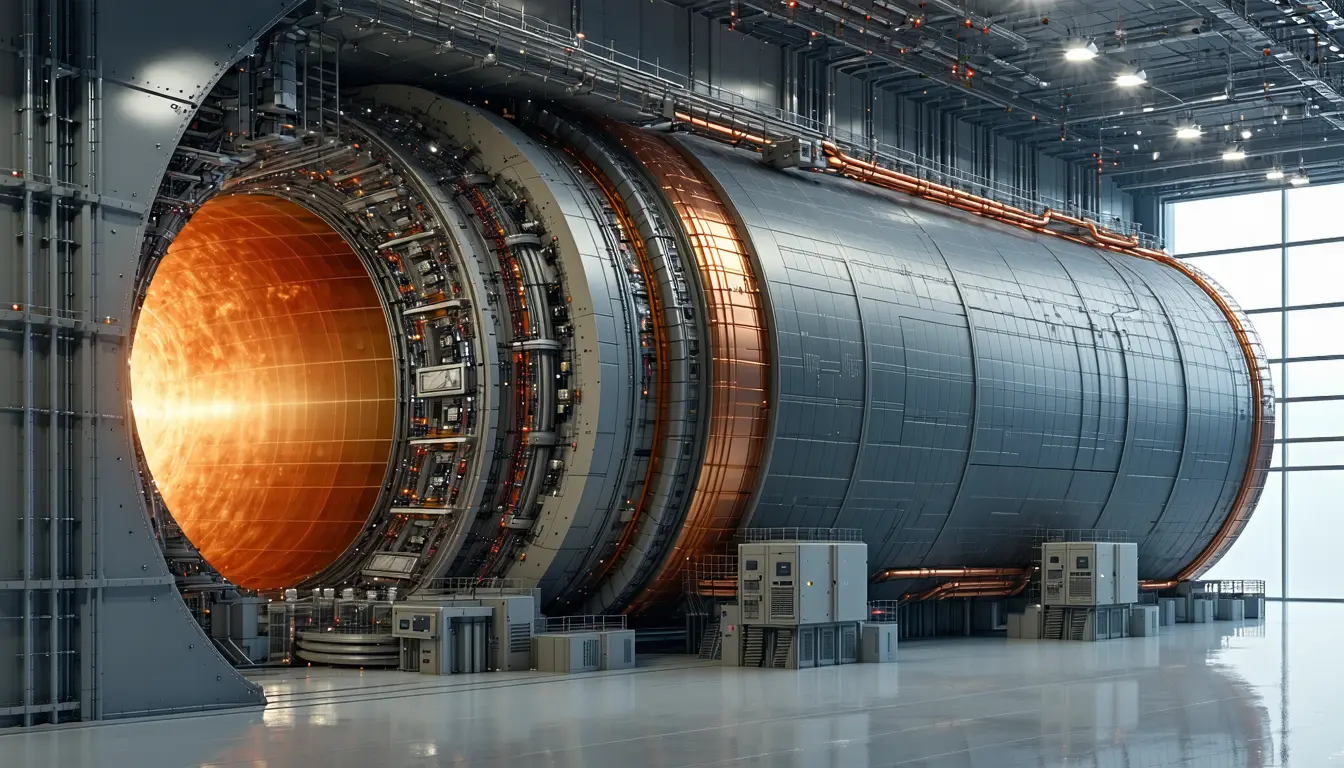
The five experiments were carried out on the DOE's DIII-D National Fusion Facility tokamak in San Diego.
During the experiments, PACMAN allowed an AI model trained through reinforcement learning to take complete control of the tokamak's heating systems.
Rothstein said a really focused human operator can respond on the order of seconds.
Because each model and controller works independently, researchers can add new ones without disturbing the rest.
Most previous attempts to use machine learning to control a fusion plasma were built from scratch, without overarching design principles ensuring the models could be easily combined, even though multiple models are needed to monitor and control different aspects of the fusion system.
Distinct publishers with included, body-backed reporting in this cluster.
phys.org
1 article · September 2, 2026
Follow any of these and your For You feed starts watching them — no settings page required.
science
PPPL says the fusion design problem is geometry. Its supplied numbers stop at 4 million amps.1 distinct publisher
science
Nature Perspective: autonomous agents need internal states they must keep in range1 distinct publisher
science
Deep Fission bets a mile of Kansas bedrock can replace a containment dome1 distinct publisher
product
TerraPower hires a builder: Hyundai E&C signed for up to eight Natrium units1 distinct publisher
Evidence-backed comparisons of source perspectives and observed adoption signals. Read the methodology
Which Builder, Operator, and Investor concerns the observed source mix emphasized—not a truth score.
Evidence, demonstrated adoption, hype gap, incentives, and confidence are assessed independently, each on its own current evidence. How these are measured.
One lab, telling it well
Every specific in this story — cycle time, shot count, warning lead time, gyrotron count — comes from a single PPPL announcement carried by phys.org, with the Nuclear Fusion paper cited rather than shown. The descriptive claims are internally consistent and precise, which is why this does not score lower. What is missing is the kind of evidence that would survive an unfriendly reading: a controller baseline, an error band, a hit rate on the tearing-mode predictions.
Five shots, one tokamak
This is real hardware, which counts for a great deal, and it is also exactly one machine on five occasions. No second facility, no other team running the framework, no indication anyone outside PPPL and Princeton can obtain it. The internal signal is more interesting than the external one: the second model went in within days of the first, which is what uptake would look like if it starts.
Restrained words, absent numbers
Slightly overstated, and mostly by omission. The prose is careful where it matters — 'humans firmly in charge of the goals' is a claim about goal-setting, not autonomy, and the release keeps it straight. But 'complete control of the heating systems' does heavy narrative work with no failure data behind it, the novelty case against prior work names no prior work, and the safety architecture is presented through its design rather than through any occasion on which it intervened. Five shots described without a baseline read stronger on the page than they measure.
Announcement economics
A national laboratory announcing a framework built by its own graduate students, on a facility whose continued funding depends on producing results like this, in a piece that quotes only the two co-lead authors. phys.org's role is distribution. None of that makes the 20-millisecond figure wrong; it does explain why the write-up leads with what worked five times and never reaches the run where something didn't.
Believable, unverified
We are confident about what was said and by whom; less so about what it amounts to. Single publisher, single origin, peer-reviewed paper cited but unread here, and the copy in front of us breaks off mid-sentence in its final section. A second account from outside the author team, or the paper's own numbers, would move this sharply in either direction.