Product1 publisher3 min readPublished
TerraPower hires a builder: Hyundai E&C signed for up to eight Natrium units
The August 14 deal names an EPC contractor and adds financing guarantees for up to eight 345MW reactors. Those are the items that decide whether a demo plant becomes a fleet.
The Product Desk · Product desk
Drafted by a language model from the sources cited here and checked against its claim ledger before publication. How we use AISend a correction
What happened
- On Friday, August 14, Washington-based TerraPower announced agreements with South Korean companies Hyundai Engineering & Construction (HDEC) and SK Innovation.
- HDEC was selected as the engineering, procurement and construction (EPC) contractor for up to eight future Natrium reactors, and the agreement includes guarantees to make the planned reactor fleet easier to finance.
- Natrium combines a 345-megawatt sodium-cooled fast reactor with a molten salt-based energy storage system, using sodium, molten salt and water/steam to transfer and store heat and generate electricity.
- According to the company, the reactor can run at full power 24 hours a day, seven days a week, storing heat in molten salt tanks during periods of low demand for later use by the turbine.
- The storage system can ramp output up to 500 MW at peak demand while maintaining a steady base output.
Compiled by The Product DeskSomething wrong?How this is made
Why it matters
TerraPower said on Friday, August 14 that it had selected Hyundai Engineering & Construction as the engineering, procurement and construction contractor for up to eight future Natrium reactors, and that the agreement includes guarantees intended to make the planned fleet easier to finance [1][2]. That is a different category of announcement from a design or licensing milestone: naming a builder and attaching credit support are the two things a lender asks about before a first-of-a-kind plant becomes a repeat purchase.
The unit itself is a 345MW sodium-cooled fast reactor paired with molten salt heat storage [3]. TerraPower says the reactor runs at full power continuously, banking heat in salt tanks when demand is low, and that the storage system can push turbine output to 500MW at peak [4][5]. Eight units would therefore be roughly 2,760MW of nameplate capacity and about 4,000MW at peak discharge [6] - the scale at which a data centre campus or an industrial cluster can plan around it rather than treat it as a pilot.
The gap between the paperwork and the concrete is still the story. TerraPower's first Natrium plant is under construction in Wyoming through the Department of Energy's Advanced Reactor Demonstration Program, with completion expected in 2030, at which point it would be the first commercial-scale advanced nuclear plant of its kind in the United States [7][8][9]. Earlier this year the company also reached a deal with Meta to support deployment of up to eight Natrium plants by 2035 [10]. If the demonstration unit finishes on schedule, that leaves five years for the rest of the fleet [11], which is precisely why an experienced EPC contractor matters more than another technology press release. Hyundai E&C brings Korean nuclear construction and operating practice to a US supply chain that has not repeated a reactor build in decades, and TerraPower's chief executive Chris Levesque framed the deal in those terms, calling it a pivotal moment and a new chapter of international collaboration with Korean organisations [12][13].
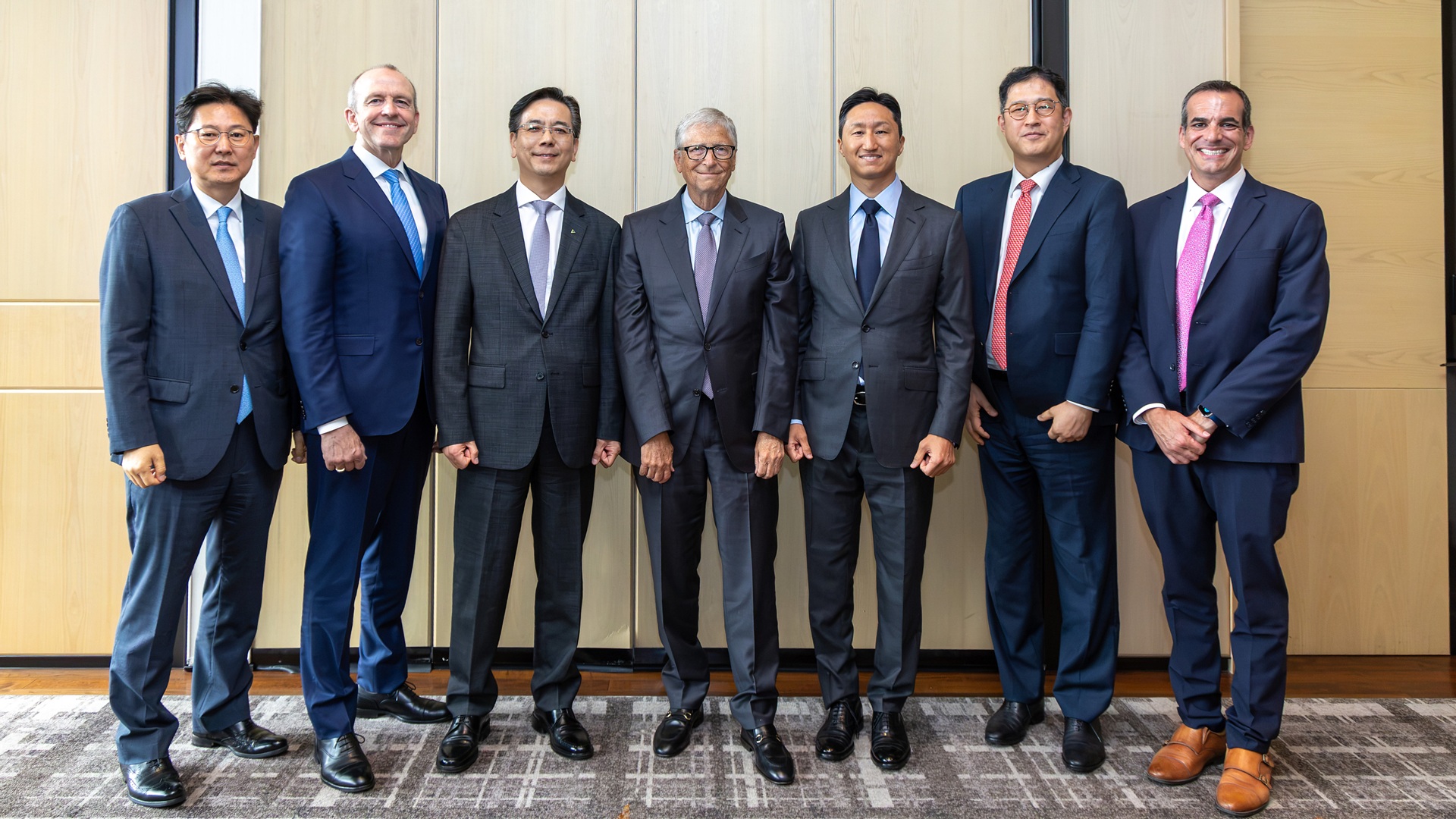
The second agreement is thinner. TerraPower and SK Innovation signed a term sheet, not a contract, covering plans for South Korea's first commercial Natrium plant and further international deployment, plus cooperation on AI and digital twins for plant operations and maintenance [14][15]. Both deals followed meetings in Seoul that, according to the report, involved Bill Gates, Levesque and South Korean Prime Minister Han Seong-sook [16].
Operators evaluating firm capacity should read the qualifiers. "Up to eight" is an option, not an order book; the reported announcement gives no contract value, no named guarantors, and no sites for the additional units beyond Wyoming [17]. TerraPower said only that work under the agreements would begin soon [18].
What to watch: whether the Hyundai E&C scope converts into a priced contract for a specific second site, and whether the financing guarantees are ever described in enough detail for a buyer to price the risk. Watch also for the first unit after Wyoming to acquire a named owner and offtaker, because the Meta arrangement is described as support for deployment rather than firm orders [10]. And watch the Korean plant's regulatory route, since a term sheet with SK Innovation is a long way from a construction permit [14].