Loading today’s stories
Science1 distinct publisher2 min readUpdated
Cryo-EM's interface problem gets a biochemical answer: put the protein in a crate
Encapsulating cargo inside hydrophilic protein shells sidesteps the air-water interface. The paper ships three proof-of-principle structures, five deposited maps, and no resolution figures in the abstract.
The Scientist · Science desk
What happened
- A paper published on nature.com, 'Overcoming air-water interface-induced artifacts in cryo-EM with protein nanocrates', describes the encapsulation method.
- Contact with the air-water interface can bias the orientation of macromolecules during cryo-EM sample preparation, leading to uneven sample distribution, preferred orientation and damage to the molecules of interest.
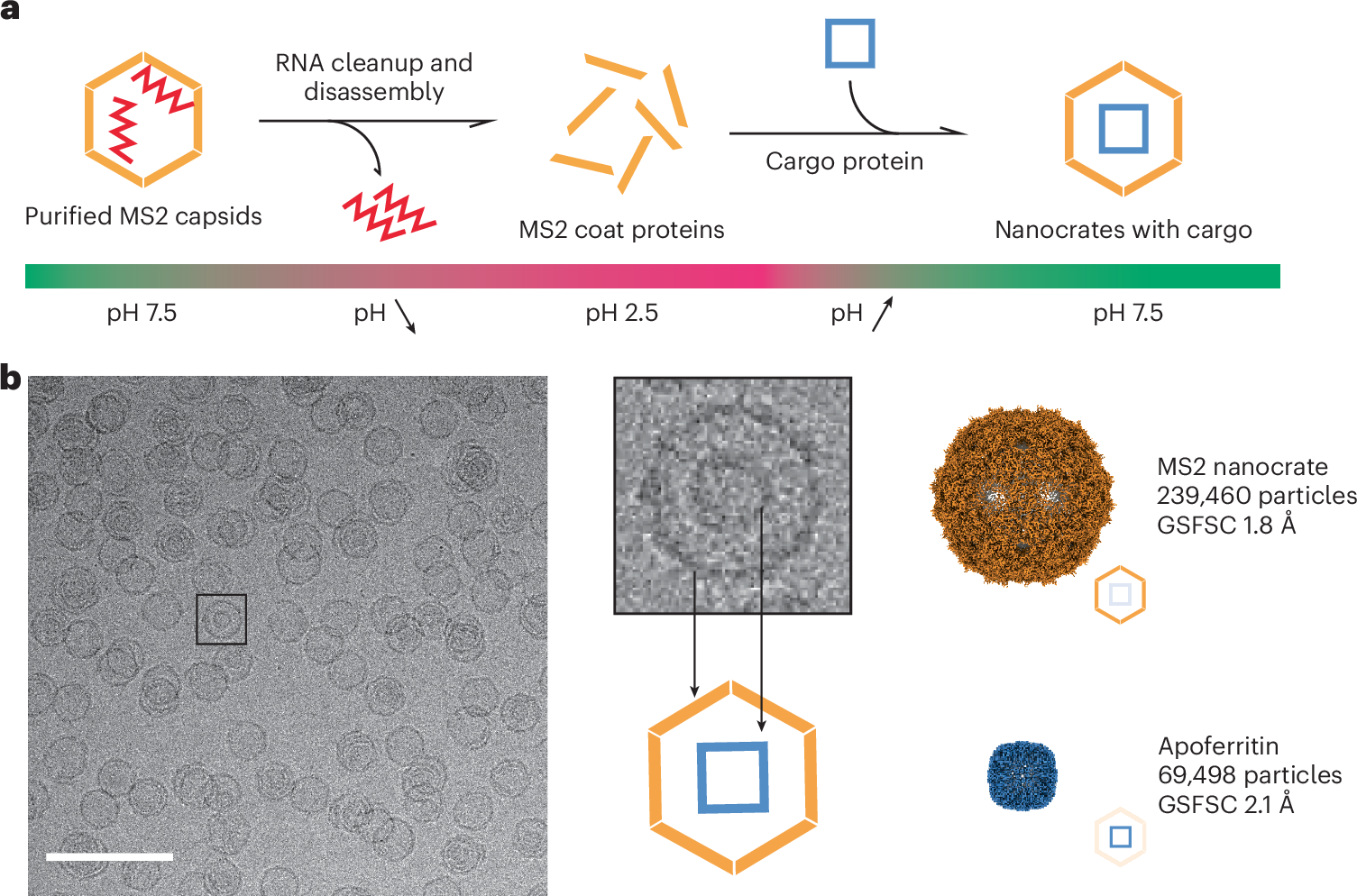
- The method encapsulates target proteins within highly hydrophilic, structurally homogeneous and stable protein shells, which the authors call 'nanocrates'.
- The paper reports packaging, data acquisition and reconstruction for three proof-of-principle examples: apoferritin (demonstrating high resolution), thyroglobulin (solving a known preferred orientation problem) and 7,8-dihydroneopterin aldolase (a structure previously uncharacterized by cryo-EM).
- Maps and models of the MS2 capsid were deposited as EMD-72124, EMD-72122, PDB 9Q1D and PDB 9Q1B.
Compiled by The ScientistSomething wrong?How this is made
Why it matters
Five EM maps and two sets of atomic coordinates went into the public archives with this work [7]. The split between them is the useful detail. Both coordinate entries are of the MS2 capsid, the shell [5]; apoferritin, thyroglobulin and 7,8-dihydroneopterin aldolase are each deposited as a map with no model attached [6][8]. The crate is documented to the atom. The cargo is documented to the level of density.
That has a practical upside. A group can pull EMD-72123, EMD-72176 and EMD-72177 and judge for itself how the packaged proteins resolved before spending $39.95 on the method text [6][9]. The abstract offers no resolutions and no particle counts [10], so the maps are the only free evidence on the question that decides whether this is worth a construct and a purification.
The authors ask three properties of the shell: highly hydrophilic, structurally homogeneous, stable [3]. Each answers a failure mode in the stated problem, which is that contact with the air-water interface biases orientation, distributes particles unevenly and damages the molecules of interest [2]. What the abstract does not settle is how the cargo sits inside. If it tumbles freely, alignment has to pull weak internal density out from under a strong, highly symmetric shell, and signal subtraction becomes part of the pipeline rather than an optional step.
Set that against the alternatives the paper's own reference list catalogues: stage tilt [11], functionalized graphene supports [12], streptavidin affinity grids [13], detergent additives such as CHAPSO [14], through-grid wicking [15], electrospray deposition [16], nanosecond hyperquenching [17]. Seven families of workaround [18], and every one of them asks a lab to change its grids, buy or build a device, or accept a different collection scheme. Nanocrates move the intervention upstream into expression and purification, which is the part of the operation most structural biology groups already staff and already control. Microscope time is the scarce resource; another construct is not.
The case that this is actionable rests mainly on the third cargo. Apoferritin is the field's resolution benchmark and thyroglobulin is a known orientation offender, but DHNA had not been characterised by cryo-EM at all before this [4]. That is the example that speaks to a shelved project rather than a demonstration.
Three cargoes is three, though, and the abstract quantifies nothing about how much thyroglobulin's orientation distribution actually improved [10]. The fair place for a nanocrate in a workflow right now is the rescue slot for a target that has already failed on the grid, not the default preparation for the next one.
Loading topic controls
Loading related stories