Invest1 publisher3 min readPublished
Nvidia and Microsoft bet nuclear's bottleneck is paperwork, not capital
The "AI for nuclear" toolkit aims to cut permitting time by over 90%. The unresolved question is whether any regulator will accept simulation output as licensing evidence.
The Investor · Invest desk
Drafted by a language model from the sources cited here and checked against its claim ledger before publication. How we use AISend a correction
What happened
- Nvidia and Microsoft announced a partnership called "AI for nuclear" at the CERAWeek conference, described as a full-stack AI toolkit targeting everything from reactor design to regulatory permitting.
- Microsoft Vice Chair Brad Smith introduced the AI for nuclear initiative.
- The toolkit combines Nvidia's PhysicsNeMo (open-source AI surrogate models for physics simulations), Omniverse (digital twins) and CUDA-X (GPU-accelerated computing libraries) with Microsoft's Azure, Copilot agents and Planetary Computer.
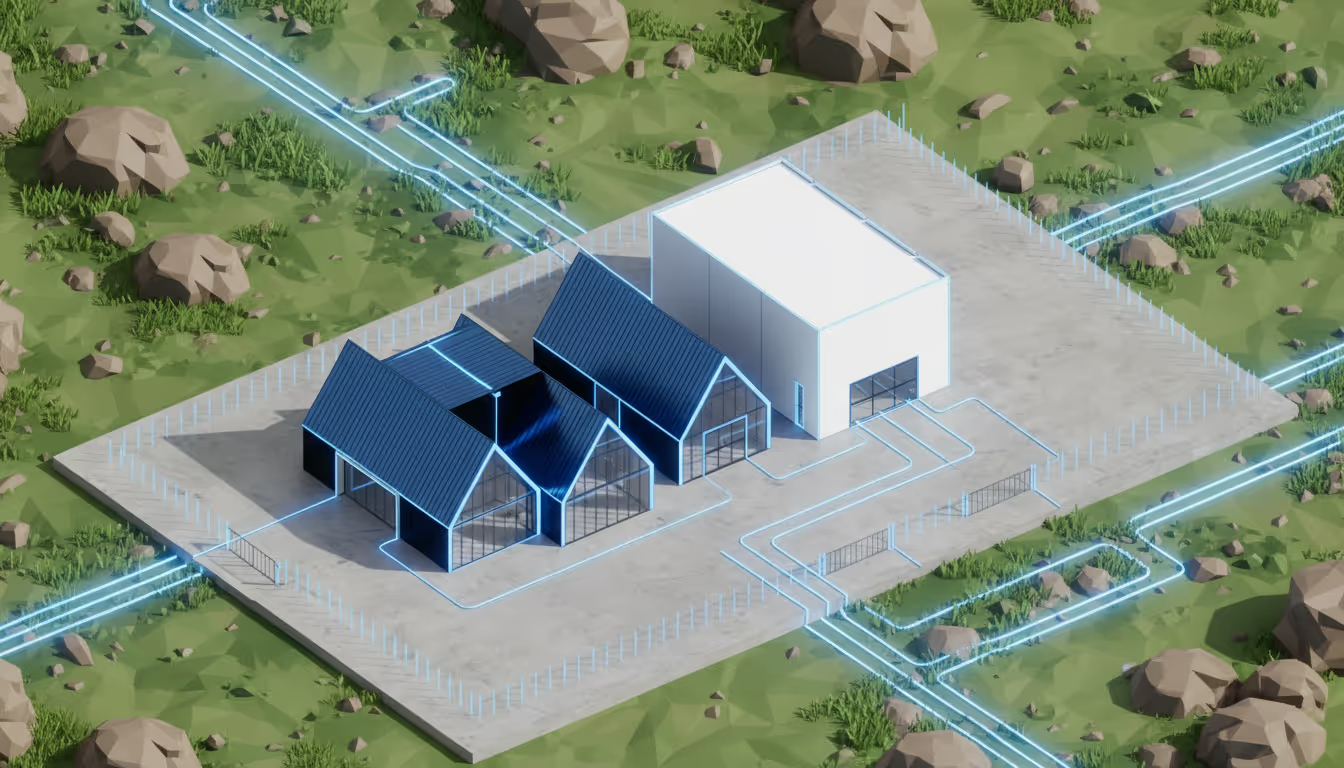
- The partnership lets nuclear developers build digital replicas of reactors before breaking ground, enabling real-time simulation of plant operations to catch problems virtually instead of during construction or after a plant goes live.
- Regulatory filings for a single nuclear plant can run into hundreds of thousands of pages.
Compiled by The InvestorSomething wrong?How this is made
Why it matters
Nvidia and Microsoft used CERAWeek to announce "AI for nuclear," a full-stack toolkit aimed at reactor design and, more pointedly, at regulatory permitting [1]. The framing is the interesting part: it treats nuclear's binding constraint as documentation and simulation rather than capital, which is a bet on regulator behaviour, not on software quality.
Microsoft Vice Chair Brad Smith introduced the initiative [2]. The stack combines Nvidia's PhysicsNeMo surrogate physics models, Omniverse for digital twins and the CUDA-X libraries with Microsoft's Azure, Copilot agents and Planetary Computer [3]. The pitch on the engineering side is familiar: build a digital replica of the plant, simulate operations, and find the problems before concrete rather than during construction or after startup [4]. The pitch on the paperwork side is newer. Regulatory filings for a single plant can run to hundreds of thousands of pages [5], and the companies say generative AI can comb those libraries for inconsistencies with over 90% accuracy [6]. The stated ambition is to cut permitting times by more than 90% and save developers tens of millions of dollars a year [7], moving the industry from bespoke one-off engineering to repeatable workflows [8].
The evidence offered is one customer. Aalo Atomics reported a 92% reduction in permitting times after adopting Microsoft's generative AI tools, and cited roughly $80m in annual savings from those improvements [9][10]. That is a self-reported figure from a single developer, and the source does not say whether the 92% measures the time Aalo spends preparing filings or the time a regulator spends reviewing them [11]. Those are different quantities with different owners. A vendor can compress the first; only a regulator can compress the second.
Which makes the participant list worth reading closely. Southern Nuclear and Atomic Canyon are named as implementation partners on Azure [12], Everstar is contributing nuclear-specific AI capabilities through Nvidia's Inception program [13], and Idaho National Laboratory has a parallel Nvidia collaboration called the Genesis Mission, announced in February 2026, focused on reactor design and deployment [14]. Every named party is a vendor, a utility, a startup or a national lab. No regulatory body appears among them [15]. Until one does, "90% faster permitting" describes a submission process, not an approval.
There is also a circularity here that neither company hides. Nvidia's GPUs are the primary driver of the AI demand surge straining electricity supply [16], and Microsoft has already signed nuclear power agreements for its data centres [17]. The two firms selling the licensing tooling are also the two firms most exposed to how quickly the resulting megawatts arrive. For Nvidia, this is consistent with a pattern: selling simulation platforms and digital twin infrastructure into automotive, healthcare and robotics, with nuclear as the latest addition [18].
What to watch: whether any licensing submission built substantially on digital-twin evidence is accepted, and on what terms. Whether Southern Nuclear or Atomic Canyon publish before-and-after cycle times that an outsider can check, rather than a vendor case study. Whether Aalo's $80m figure is corroborated by a second developer. And whether "over 90% accuracy" at inconsistency detection survives contact with a review process whose entire purpose is finding the residual, since a tool that misses a tenth of the discrepancies in a 300,000-page filing still leaves a human reviewer holding the risk.