Invest1 distinct publisher3 min readPublished Updated
The floor on Figure's compute commitment is about twice all the equity it has disclosed raising, and the vendor writing that contract now owns a piece of the customer owing it. Whether the $3.5bn is take-or-pay is undisclosed.
The Investor · Invest desk

build
Figure sizes its humanoid training run at up to 1,389 Vera Rubin racks1 distinct publisher
product
Nvidia's $120bn Ohio backstop puts the chip vendor on the hook for OpenAI's rent4 distinct publishers
build
Figure is buying its data moat by the minute, and it just published the price1 distinct publisher
invest
General Intuition's reported $6B ask reprices physical AI in weeks, not quarters1 distinct publisher
Compiled by The InvestorSomething wrong?How this is made
Figure has disclosed just over $1.6bn of equity across two rounds, a $675m Series B in 2024 whose investors included Microsoft, NVIDIA, Amazon's Industrial Innovation Fund and Bezos Expeditions [5], and a Series C exceeding $1bn at a $39bn valuation last September led by Parkway Venture Capital [4]. The floor on this compute commitment is therefore roughly twice everything the company has raised in public view [2]. The largest obligation on Figure's books is owed to a counterparty that is also now a shareholder [2].
Divide the floor by the reserved fleet and you get about $35,000 a card; divide the ceiling and you get $60,000 [3]. Those are numbers in the neighbourhood of buying the hardware outright, which suggests what is actually being sold: a reserved slice of a campus that does not exist yet, funded in part by the roughly $3bn of debt Nscale closed weeks before the deal for GPU sites in Texas and North Carolina [7]. The contract term is undisclosed, so the annual rate cannot be computed, and the per-card figure is a bound rather than a price.
On Nscale's side the arithmetic is about the listing. Figure's floor is about 6.9% of the contracted book Nscale has shown prospective investors, and the ceiling about 11.8% [1], which is a large share to have written with a counterparty whose shares you hold. Two terms decide how it reads, and neither is public: whether the strategic investment was cash at the $39bn mark or credit against the contract, and whether the $3.5bn is take-or-pay [2]. This structure, an infrastructure provider investing in the customer buying its compute, has drawn criticism on Wall Street as a way to make demand look bigger than it is [12]. Jensen Huang, whose chips sit underneath, calls it a flywheel: training on Vera Rubin through Nscale's cloud, validating in Isaac Sim, deploying on GPUs inside the robots [13].
The demand looks real. Figure's Index programme is ingesting 30 minutes of human training video every second from paid creators using a phone app [9], which is 1,800 times real time, or roughly 43,200 hours of footage a day [5], and Brett Adcock's stated logic is that Helix gets more capable with more data and compute [11]. Figure also says it has lacked the infrastructure to run sustained large-scale training at pace until now [19]. The claim that robot training runs can exceed large language model training appears without a number attached [15], so the case that robot foundation models are their own capex category rests on contract sizes rather than measured training scale.
Read against the field, the contract sizes are the pattern. Skild AI raised $1.4bn in January above a $14bn valuation [16], Apptronik's Series A extension pushed its round past $935m [17], and Physical Intelligence was reported in March to be discussing about $1bn above $11bn, still unconfirmed months later [18]; the sector total implies roughly $4.8bn in 2025 and about $3.8bn of net addition this year [4]. My read is that Nscale bought queue priority in reverse, paying with equity to lock a 2027 campus tenant, and Figure paid with cap-table room because it is short of compute, not cash [20]. That is wrong if Nscale discloses a cash purchase at the $39bn mark alongside an unconditional commitment, in which case this is one large customer at market rates. It is also wrong if Figure starts paying from robot revenue, and the source material shows no customer buying the output yet [21].
Ranked by verification strength, evidence, and original report placement.
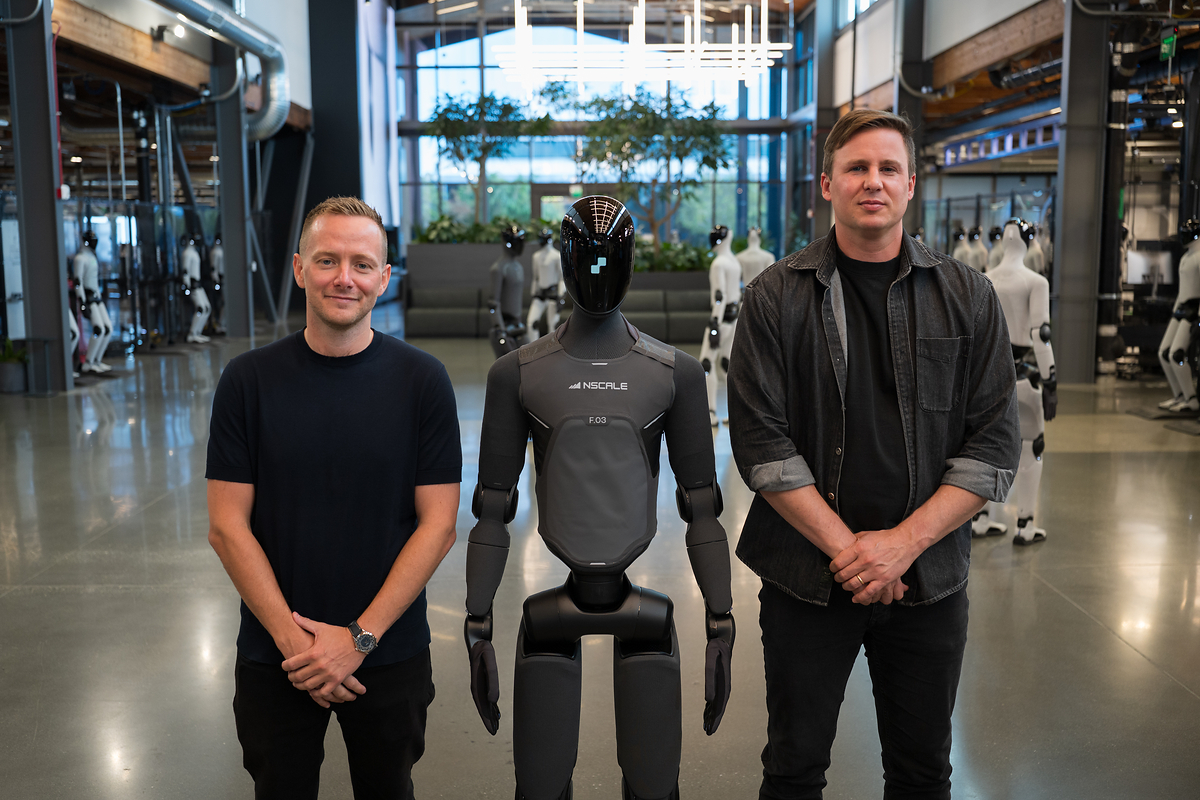
Nscale has signed a multi-year agreement to supply at least $3.5bn of AI cloud capacity to humanoid robotics company Figure, with room to grow past $6bn.
Nscale is also making an undisclosed strategic investment in Figure, becoming a shareholder and Figure's preferred compute provider.
Up to 100,000 NVIDIA GPUs are earmarked for the Nscale-Figure partnership, with the first systems targeted for the second half of 2027 at Nscale's Barstow, Texas site.
Figure closed a Series C exceeding $1bn at a $39bn valuation in September 2025, led by Parkway Venture Capital, with NVIDIA, Intel Capital, Salesforce and Qualcomm Ventures among backers.
Figure raised a $675m Series B in 2024, with Microsoft, NVIDIA, Amazon's Industrial Innovation Fund and Jeff Bezos, through Bezos Expeditions, among the investors.
Nscale closed a $2bn Series C at a $14.6bn valuation in March.
Distinct publishers with included, body-backed reporting in this cluster.
2 articles · September 4, 2026
Follow any of these and your For You feed starts watching them — no settings page required.
Evidence-backed comparisons of source perspectives and observed adoption signals. Read the methodology
Which Builder, Operator, and Investor concerns the observed source mix emphasized—not a truth score.
Evidence, demonstrated adoption, hype gap, incentives, and confidence are assessed independently, each on its own current evidence. How these are measured.
One newsroom, printed twice
Every figure here traces to a single Tech Funding News report, and the second item in our coverage is that same report under a different URL rather than a second confirmation. The three quotes come from the two chief executives signing the deal and the chip supplier sitting underneath it, in the register of a joint announcement. The details that would settle what the deal is worth — the contract term, whether the $3.5bn floor is take-or-pay, the size of Nscale's stake, any filing behind the $51bn backlog — are all absent, and the piece does not claim to have seen documents.
Signed for 2027, nothing running
No capacity under this agreement has been delivered or used: the first systems are targeted for the second half of 2027, on a Texas site that Nscale is still building with debt raised weeks earlier. What exists today is a signature and a preferred-provider label. The one operating number is Figure's Index pipeline pulling in 30 minutes of video a second, which is data collection rather than the training Figure says it has lacked the infrastructure to sustain.
Floor without a term
A $3.5bn floor over an unstated number of years is a number that can mean almost anything, and the flywheel Huang describes runs on chips that arrive in the second half of 2027. The premise that folding laundry can cost more compute than training a large language model carries the whole argument for 100,000 GPUs and arrives with no figure attached. Tech Funding News does claw some ground back by ending on who buys the robots rather than who funds the input, which is the question its own numbers provoke.
Seller owns a slice of the buyer
Nscale books revenue from a customer it has simultaneously invested in, while telling prospective IPO investors it holds roughly $51bn of contracted revenue that this deal helps fill. NVIDIA is on both sides of the loop, as the hardware underneath and as a shareholder in Figure through both disclosed rounds, and Huang's quote sells the circularity as a feature. Figure, defending a $39bn valuation, benefits from a large headline number as much as Nscale does, and neither party's interest is served by publishing the term or the take-or-pay terms.
Shape clear, size unchecked
Who gains and how the money moves is on the record from the participants, and the arithmetic against their own disclosed figures holds: the floor is about twice Figure's disclosed equity and about 7% of Nscale's stated backlog. What cannot be checked is whether the amounts mean what they appear to mean, because there is one source, no filing and no second newsroom. Our reading of the deal's structure is therefore firmer than any reading of its value.