Build1 distinct publisher3 min readPublished
Figure is buying compute the way a frontier lab buys it. The announcements skip the numbers that matter most: how much of the ceiling the initial money covers, and how many megawatts Barstow will draw.
The Engineer · Build desk
Compiled by The EngineerSomething wrong?How this is made
Follow any of these and your For You feed starts watching them — no settings page required.
build
Figure is buying its data moat by the minute, and it just published the price1 distinct publisher
build
Nscale's $3.05bn unlocks one qualifying project expense at a time1 distinct publisher
product
Nscale's IPO asks public markets to fund a 13x jump in megawatts2 distinct publishers
invest
Nvidia's August 26 print: 92% of the quarter rides on one segment1 distinct publisher
Trace what the agreement actually wires together. Helix trains in Nscale's cloud, gets validated in NVIDIA Isaac Sim, then runs on NVIDIA hardware inside the robot [5]. Figure says its binding constraint is the data and compute needed to train Helix, the vision-language-action system that drives its machines [4].
Then the rack math. Vera Rubin bundles Rubin GPUs with Vera CPUs, networking, storage processing and rack-scale systems [6], and NVIDIA puts 72 Rubin GPUs and 36 Vera CPUs in an NVL72 rack [7]. Divide the ceiling by the rack and you get about 1,389 racks [1]. Treat that as an upper bound on one robotics company's rack-scale demand and nothing more, because neither release says how many GPUs land in the initial phase or whether every system uses that configuration [8].
The per-GPU numbers are easy to compute and easy to misread. An initial $3.5 billion across 100,000 GPUs is $35,000 each [2]; the intended expansion past $6 billion is $60,000 each [3]. For either figure to describe a price, the money would have to cover the whole ceiling, and the covered share is not stated [13]. What the commitment does anchor is scale against Figure's own budget: roughly 3.5 times the more than $1 billion it said in August it would spend on data and compute over the following twelve months [10][7].
The data side is measurable in a way the compute side is not. Index has paid contributors $15 million against 16 million uploaded videos [9], about 94 cents a video [6]. At 35 minutes of uploaded video per second, ingest runs near 2,100 times real time [5]. Ninety-four cents a clip is cheap training data, assuming the clips show what the label says they show.
Power is where the public record thins out. Nscale said on August 31 it had closed approximately $3 billion in delayed draw term loan commitments for campuses in Ward County, Texas and Madison, North Carolina, allocating up to $1.85 billion to Ward County [14], roughly 62 percent of the total [8]. An Ionic Digital supplemental prospectus puts Nscale's Ward County lease at 234 megawatts with another 89 megawatts contractually obligated if that capacity becomes available [15], so up to 323 megawatts [4]. Nscale's financing release does not identify that campus as Figure's deployment site [16].
Which leaves the schedule carrying the whole argument. Runtimewire reads the GPU count as a ceiling and the installation as at least several quarters away [19]. For the rack arithmetic above to transfer into anyone else's capacity planning, the initial money would need to buy a stated fraction of the 100,000, the systems would need to ship as NVL72 racks, and the site would need interconnect for them. None of the three is on the record yet, which is the honest reason to hold the parties to the delivery date rather than the headline count.
Ranked by verification strength, evidence, and original report placement.
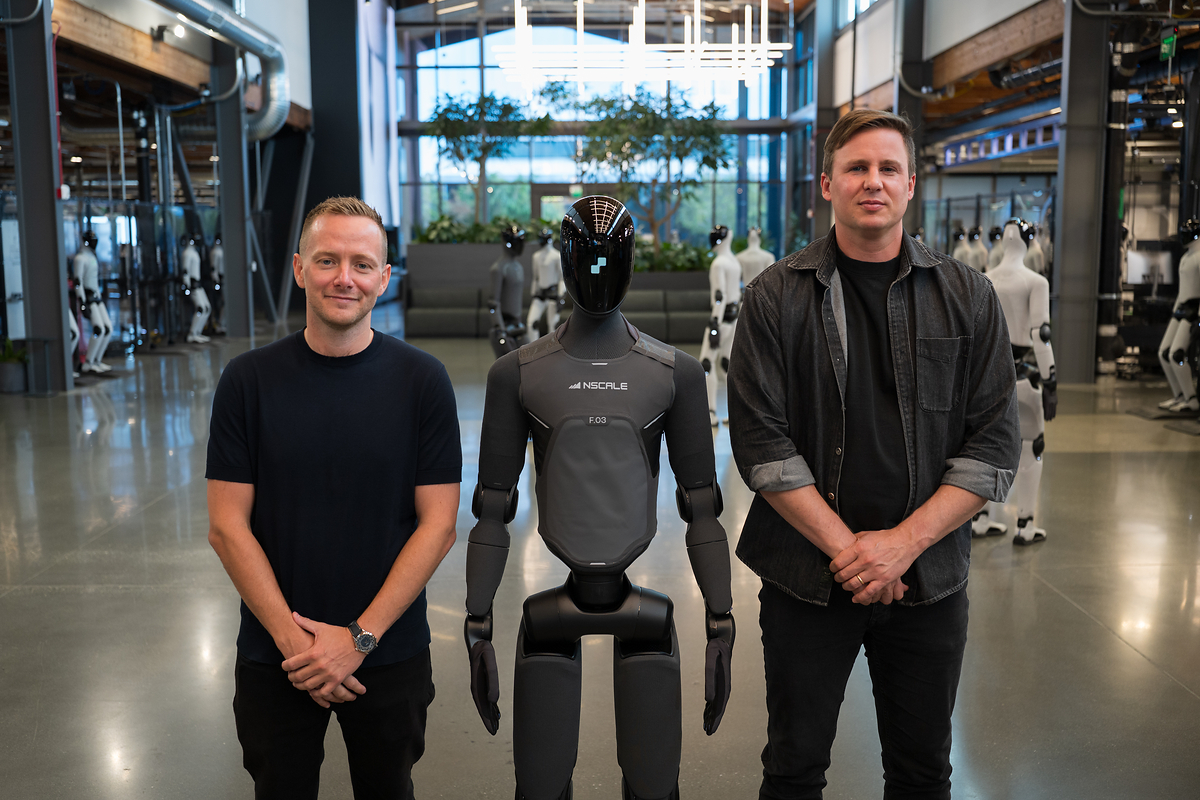
Brett Adcock has committed Figure to an initial $3.5 billion of compute from Nscale, the AI infrastructure provider, giving his humanoid robotics operation a path to as many as 100,000 NVIDIA Vera Rubin GPUs as he tries to scale its Helix AI models.
The companies said in their September 3 announcement that the first systems are targeted for deployment in Barstow, Texas, during the second half of 2027.
Figure and Nscale intend to expand the arrangement beyond $6 billion, and Nscale will make an investment of undisclosed size in Figure.
Figure says its immediate constraint is the data and compute required to train Helix, the vision-language-action system that controls Figure's robots.
The agreement would connect three layers: training Helix through Nscale's cloud, validating the models in NVIDIA Isaac Sim, and deploying the resulting software on NVIDIA hardware inside Figure robots.
NVIDIA's Vera Rubin platform combines Rubin GPUs with Vera CPUs, networking, storage processing and rack-scale systems.
Distinct publishers with included, body-backed reporting in this cluster.
runtimewire.com
1 article · September 3, 2026
Evidence-backed comparisons of source perspectives and observed adoption signals. Read the methodology
Which Builder, Operator, and Investor concerns the observed source mix emphasized—not a truth score.
Evidence, demonstrated adoption, hype gap, incentives, and confidence are assessed independently, each on its own current evidence. How these are measured.
Two press releases and one prospectus
Almost every number in this story was published by a party to the deal: the $3.5 billion, the 100,000-GPU ceiling, the Barstow window, the Index metrics, the financing totals. The single document nobody involved in the announcement controls is the Ionic Digital prospectus, and it is also the only place megawatts and an energization date appear. Runtimewire does the honest thing by naming what the releases omit, which is why this lands mid-scale rather than low: the reporting is careful about material it cannot verify.
Data engine live, silicon unpoured
What exists today is a crowdsourcing app with 44,000 weekly contributors and $15 million out the door, plus loan facilities that have closed. What does not exist is a single installed rack: the first systems are aimed at the second half of 2027, the initial phase's GPU count is unstated, and the power those systems would draw has not been allocated to Figure in any document here. Real activity, almost all of it upstream of the thing being announced.
A ceiling quoted as a plan
The number that travels is 100,000 GPUs, about 1,389 NVL72 racks. The number that binds is unknown, because neither company says what share of that ceiling the initial $3.5 billion buys, on what schedule, or with what exit. Set against a company that nine days earlier budgeted a shade over $1 billion for a year of data and compute, the announced figure is a direction of travel dressed as a procurement. The overstatement is in the framing, not in Runtimewire's handling of it, which repeatedly pulls the reader back to the ceiling caveat.
The vendor is also a shareholder
Nscale is about to own a piece of the customer it is invoicing for billions, an arrangement that gives both sides a reason to announce large and define little. Add a plan to explore putting Figure humanoids into Nscale's own supply chain, with no volume or date attached, and a preferred-provider label that is never called exclusive, and the announcement starts to look like mutual validation as much as procurement. Every figure in it was published by a party that benefits from the figure being big.
Solid on what was said, thin on what was checked
We can be fairly sure the announcements say what Runtimewire reports they say, and the prospectus detail is specific enough to be checkable. Beyond that the floor drops: one publisher, no second account, and the two mismatched video-throughput figures are a reminder that Figure's operating numbers are moving targets. Confidence here is about faithful relay, not about the deal's substance.