Product1 publisher3 min readPublished
A vendor says its sonar net caught every UUV at Lanternfish 26. The Navy has not said so.
ThayerMahan says ShorePicket and Outpost tracked everything from six-inch drones to XLUUVs. Port-security buyers should note which claims carry a Navy signature and which do not.
The Product Desk · Product desk
Drafted by a language model from the sources cited here and checked against its claim ledger before publication. How we use AISend a correction
What happened
- ThayerMahan said its ShorePicket and Outpost sensing systems detected, classified, localized, and tracked every class of UUV used during Exercise Lanternfish 26, ranging from a vehicle about six inches in diameter to extra-large unmanned underwater vehicles (XLUUVs).
- The performance claim comes from the company rather than the Navy.
- Lanternfish was designed specifically to bring together emerging undersea technologies and evaluate how they work in realistic operational environments.
- The exercise involved U.S., British and Australian personnel and industry partners, with demonstrations taking place across several locations in the United States.
- The U.S. Navy says Lanternfish involved 50 different technologies from 26 industry partners, with the broader goal of improving interoperability under AUKUS Pillar II.
Compiled by The Product DeskSomething wrong?How this is made
Why it matters
ThayerMahan said its ShorePicket and Outpost sensing systems detected, classified, localized and tracked every class of unmanned underwater vehicle used during Exercise Lanternfish 26, from a vehicle roughly six inches in diameter up to extra-large UUVs [1]. That matters less as a sonar result than as a positioning move: distributed passive acoustic sensing is now being sold as a deployable port-security line rather than a research topic, and the performance claim comes from the company rather than the Navy [2].
The venue gives the claim some weight. Lanternfish was designed to bring emerging undersea technologies together and evaluate how they behave in realistic operational environments [3], with U.S., British and Australian personnel and industry partners across several U.S. locations [4]. The U.S. Navy says the exercise involved 50 technologies from 26 industry partners, with the broader aim of improving interoperability under AUKUS Pillar II [5] - a little under two technologies per partner, which is the shape of a broad survey rather than a focused trial of one system [6].
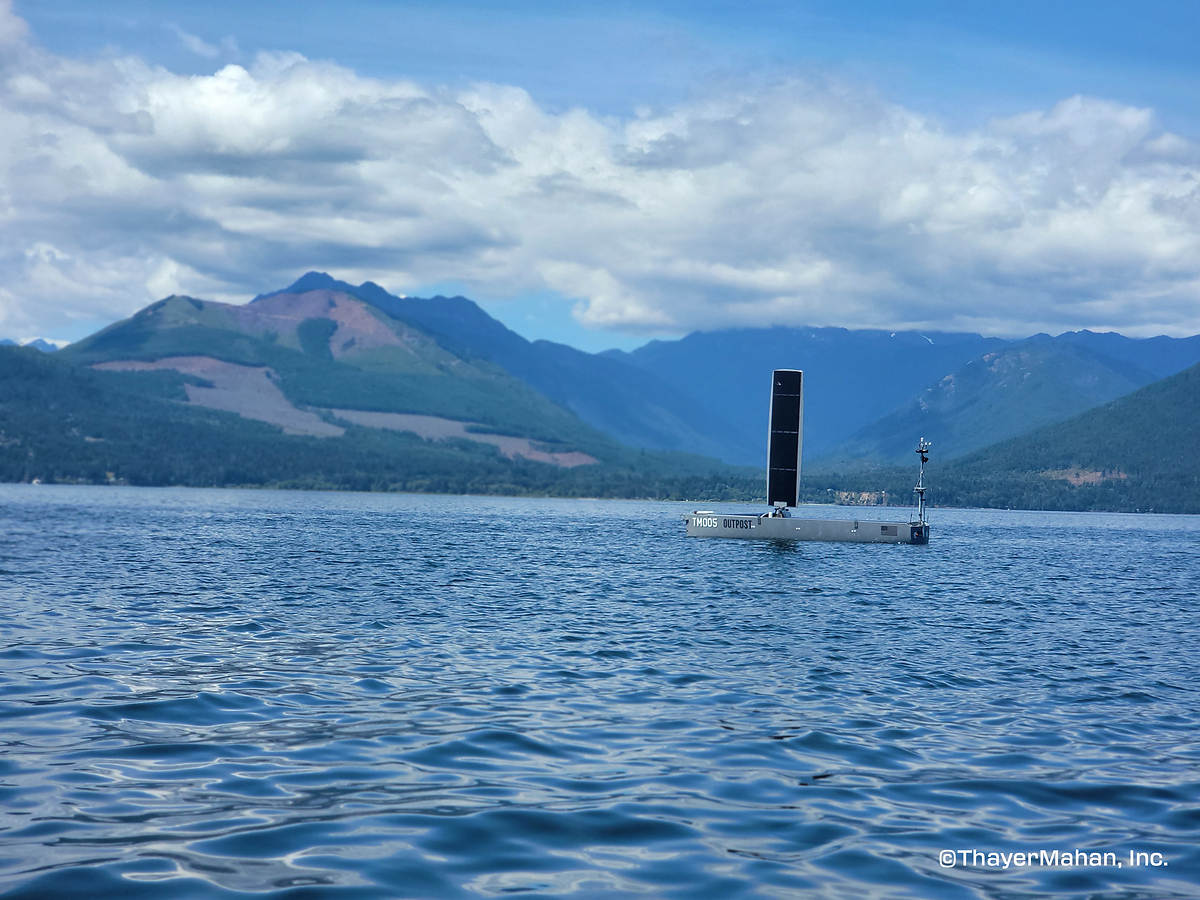
The product architecture is the part worth reading closely. Underwater, radio waves travel poorly, which leaves acoustics as one of the few practical ways to find objects beneath the surface [7], and ThayerMahan's systems listen passively rather than waiting for a target to announce itself [8]. ShorePicket supplied the fixed layer at the exercise and Outpost the mobile one [10]; Outpost is a large-aperture towed array deployed from an unmanned surface vessel that the company says can run for more than 90 days [9]. The stated logic is redundancy and coverage: several distributed sensors instead of one large sensor in one place [11].
Detection is the cheap part. The company says its TransparenSea software processes acoustic data at the edge, applies AI-assisted analysis, combines it with human acoustic expertise before contacts reach operators, and can push contact data out through APIs in near real time [12]. At Lanternfish, ThayerMahan says it exported tracks into Navy common operating pictures in real time [13]. For a harbour operator, that integration claim is the one with procurement consequences; an unexported track is a screen nobody is watching.
The demand side is not in dispute. Large military submarines are expensive and comparatively conspicuous, while small autonomous vehicles can be far harder to detect and may be commercially available or relatively cheap [14], which puts ports, naval bases, offshore installations, subsea cables and chokepoints in the frame for persistent surveillance [15]. ThayerMahan was not alone in working the problem: Ultra Maritime demonstrated its Sea Spear deployable sonar against medium- and large-diameter UUVs at the same exercise [16], and the Royal Navy confirmed that Lanternfish included remotely operated and autonomous underwater systems run by British, American and Australian personnel, including Teledyne Gavia vehicles [17].
Two limits on the headline. The claim covers the UUV classes present at the exercise, not UUVs in general [19]. And the reported account carries no detection ranges, no probability of detection, no false-alarm rate, no count of runs against each vehicle, and no Navy assessment of the result [18] - which are exactly the numbers a base commander would need before treating a picket line as coverage rather than a demonstration.
Watch for whether the Navy or the AUKUS Pillar II side publishes its own read on which of the 50 technologies performed [5], and whether ThayerMahan's next disclosure includes false-alarm behaviour against small vehicles in cluttered harbour noise.