Science1 publisher3 min readPublished
Nanjing's LightTok chip produces AI tokens inside the sensor pixel
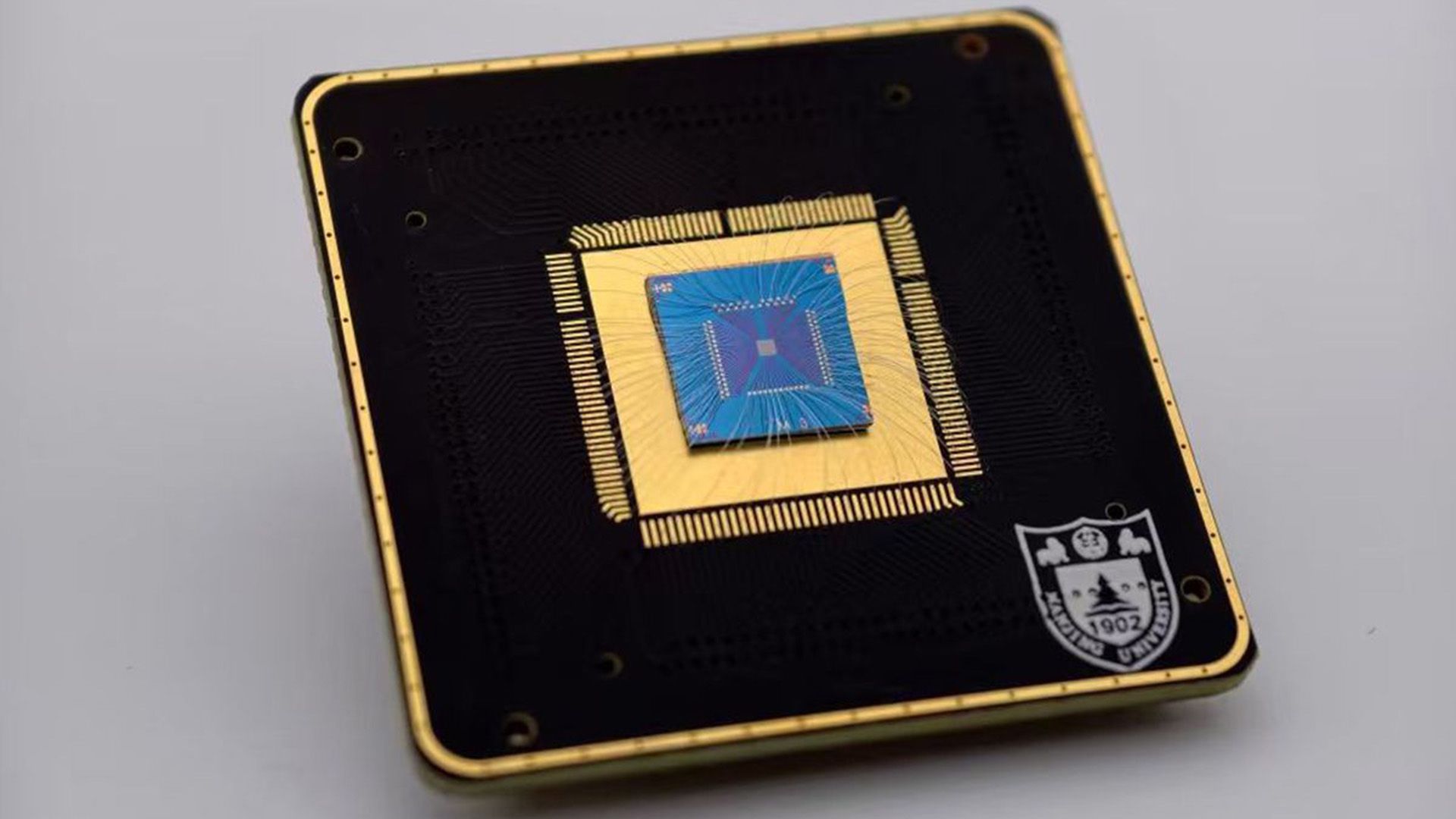
The LightTok chip senses, stores and computes in the same pixel, and its authors report 87.3% recognition accuracy with a tenfold energy gain on turning light into tokens across an array of 1,024 pixels.
The Scientist · Science desk
What happened
- Researchers in China published LightTok in Nature Sensors on Aug. 19, a two-dimensional chip whose pixel array produces the tokens an AI model reads as soon as light arrives.
- A conventional pipeline runs five stages: capture, digitisation into pixels, temporary storage, transfer to a separate chip, and tiling the image into tokens there.
- LightTok folds sensing, memory and computation into the same pixel, collapsing those five stages into one.
- In tests the chip reached 87.3% accuracy at image recognition and was ten times more energy efficient than the conventional route at converting light into tokens.
- The demonstrated array tops out at 32 by 32 photosensitive pixels, well below a current smartphone camera, and Miao Feng points to CMOS manufacturing as the route to scale it.
Compiled by The ScientistSomething wrong?How this is made
Why it matters
- capability Cutting the data-movement term is something a sensor designer can do before any model runs, and no amount of quantization or pruning on the model side reaches it.
- constraint Scaling up from 1,024 pixels means replicating a charge-trapping element in every pixel thousands of times over, so fabrication yield decides whether edge perception ever sees the saving.
- decision Anyone comparing edge perception hardware has to establish which slice of the power budget a tenfold claim covers, because this one covers tokenization and stops there.
- contradiction Sokka's reading of a small-scale demonstration and the authors' projection of longer drone flights are both consistent with a 32-by-32 array. The resolution figure is what decides how much weight the energy result carries.
The energy claim turns on where the power goes before a model sees anything. A study widely cited by other academics found that the analog-to-digital converter alone accounts for 66% of an image sensor's energy consumption on average [6]. Take the converter out completely and 34% of that budget remains, an improvement of about 2.9 times [18]. So the reported tenfold gain at converting light into tokens [8] cannot be the converter by itself. It also has to include the steps after digitisation that LightTok removes: the temporary buffering and the hop to a separate processor where the image is tiled [4]. Pushing that processing into the cloud instead raises total consumption [7].
The array is built from single-layer molybdenum disulfide floating-gate phototransistors, each of which senses light, remembers what it sensed, and factors that into a calculation [9]. Molybdenum disulfide is a 2D material that responds well to light and can be grown in sheets one atom thick [10]. The phototransistor converts photons into an electrical current, and the floating gate is an isolated component inside it that traps and holds charge instead of losing it once the light goes away [10].
"The chip physically eliminates data movement, which is the main source of energy waste," Liang Shi-Jun, a physics professor at Nanjing University, told the Chinese state news agency Xinhua [11]. "Light comes in, tokens come out," Liang said, which is where the name comes from [12]. Miao Feng, director of Nanjing University's Institute of Brain-Inspired Intelligence, said in a statement that the design idea "was to move token generation onto the sensor itself, allowing the chip to directly produce tokens that AI models can process once light reaches the sensor" [3].
The resolution is the weak spot in the claim. The array tops out at 32 by 32 photosensitive pixels, far short of a current smartphone camera, let alone a drone [13]. That is 1,024 pixels in total [17]. The 87.3% accuracy was measured against the conventional multi-step process, and the report does not print an accuracy figure for that process [19]. The tenfold number is also scoped narrowly, to the conversion of light into tokens [8]. The model that consumes those tokens, the radio and the airframe all sit outside it.
Miao said there is an opportunity to scale the technology using complementary metal-oxide-semiconductor manufacturing, the process behind smartphone and laptop chips and the sensors in drones [14]. The researchers believe that if the scaling works, a drone scanning a disaster zone could fly longer because less energy goes to visual processing [15]. Kumar Sokka, CEO of Acre Security, which provides real-world sensing for critical infrastructure and was not involved in the work, described it as a "small-scale demonstration" and said the direction of the research matters to anyone working in the physical world [16].
What to watch
- Whether a much larger array preserves the per-pixel floating gate once CMOS fabrication is involved.
- An accuracy comparison on a named dataset, with the conventional pipeline's number printed beside LightTok's 87.3%.
- Energy measured across a whole flying platform, including inference and telemetry alongside tokenization.