Science1 publisher2 min readPublished
Lenovo's fanless concept laptop clears 30 watts with four ultrasonic air-jet chips
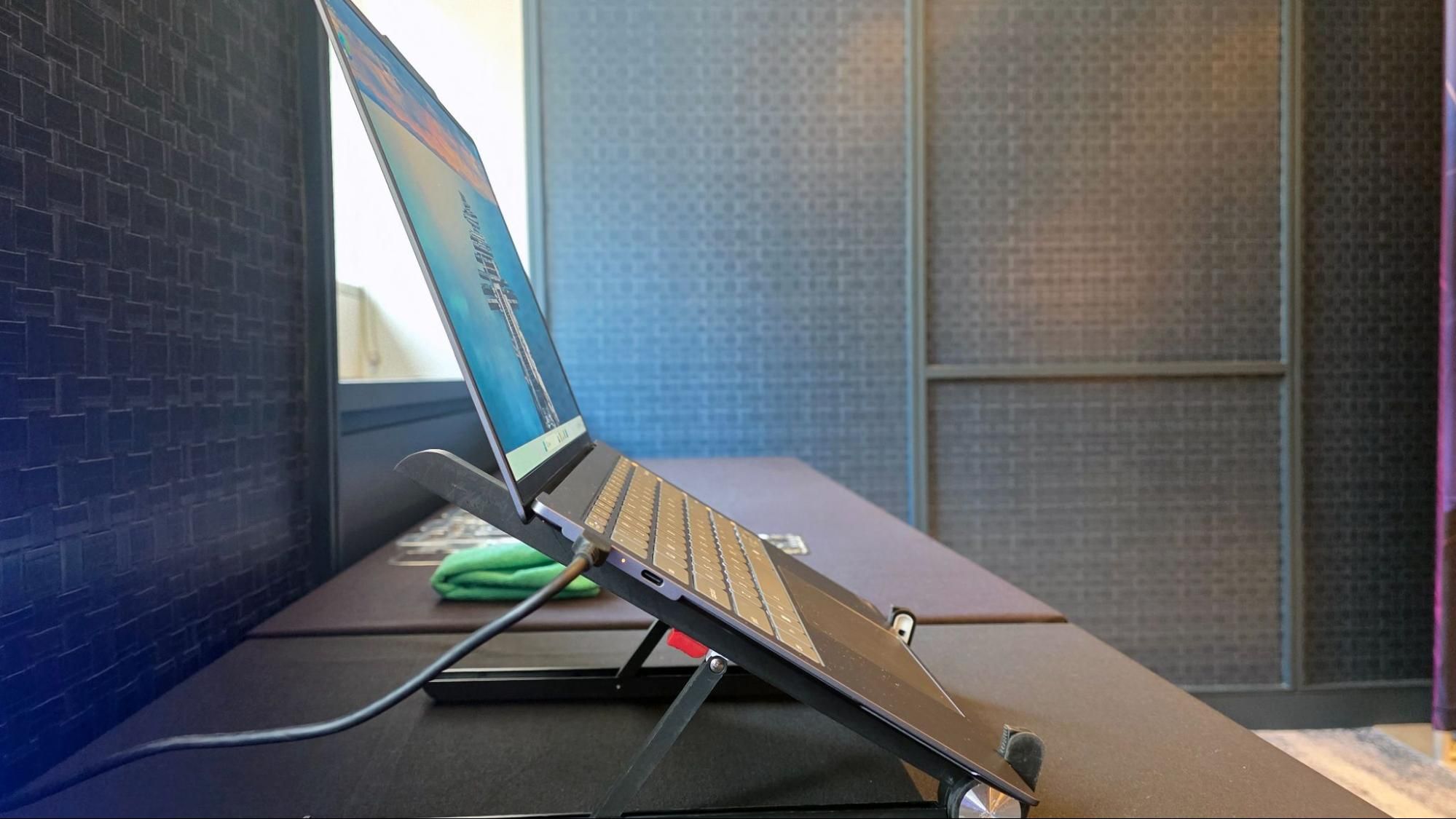
Frore Systems' AirJet Mini vibrates a membrane to drive ambient air at 200 km/h over a copper plate. Four of them cool Lenovo's 830-gram AeroBlade, removing about as much heat as the fan they replace.
The Scientist · Science desk
What happened
- Lenovo unveiled a concept laptop called AeroBlade at its Innovation World '26 event on September 3, held at IFA 2026 in Berlin, which itself ran from September 4 to 8.
- The machine drops conventional fans and heat sinks for four low-power cooling chips that have no moving parts and drive cooling actively instead of absorbing heat passively.
- Inside each chip, membranes vibrating at ultrasonic frequency build 2,000 pascals of back pressure, pushing ambient air onto a copper base layer at about 200 km/h and out through vents in the rear hinge.
- Frore Systems, which makes the 9-gram AirJet Mini, said the part removes 7.5 watts of heat and runs at 21 decibels at peak power, about the level of rustling leaves.
- The AeroBlade has a 14-inch OLED screen, comes in under 10 mm thick and weighs 830 g, where comparably sized laptops are 12 mm at their thinnest.
Compiled by The ScientistSomething wrong?How this is made
Why it matters
- constraint Capacity here adds up chip by chip, at 7.5 watts and 9 grams each, so a hotter machine needs more parts and more board area.
- decision Thin laptops have had two options: a fan that makes noise, or a passive heat sink that throttles. A 21-decibel active cooler with no rotor is a third one for that choice.
- capability The thermal system stops setting the floor on how thin a 14-inch chassis can be. At 2.65 mm per part, the limit moves to whatever else inside the machine is thickest.
- precedent The test for this cooling is a production laptop that still carries four AirJets after the bill-of-materials review; a trade-show chassis does not settle whether it survives cost engineering.
Four chips remove 30 watts, which Live Science puts in line with the heat expulsion of conventional laptop fans, with variation between models [8]. That puts the heat budget at roughly what the fans it displaces already handled. The cooling occupies less space and mass: four parts of 9 grams, 36 grams together, none thicker than 2.65 millimetres [3][16].
Back pressure, as Live Science defines it, is the opposing force pushing against the direction of airflow, and regular laptop fans typically manage 100 to 200 pascals [7]. The AirJet's membranes generate 2,000 [4]. The report calls that roughly ten times a fan, which compares it against the top of the fan range; against the bottom it is twenty times [15].
On weight, the useful comparison is the class band. Fourteen-inch laptops are normally called light between 1 and 1.3 kilograms [11], so 830 grams sits 170 grams under the bottom of that band [17]. Acer's Swift Blade 14 already reaches 799 grams, and Live Science says machines that light exist but are rare [12].
Lenovo and Frore both frame the technology as cooling for the next generation of high-end laptops that run AI on the device [13]. Most machines marketed as AI PCs today carry only a neural processing unit, good for light work such as enhancing a webcam feed in real time [22]. Running powerful local models usually demands significant power funnelled into professional-grade GPUs [14], and 30 watts is the envelope on the table. Removing 7.5 watts on a bench is one measurement; holding a sustained agent workload inside a sealed 10-millimetre chassis is another. The report gives no sustained-load results and no figure for the electrical power the AirJet chips themselves consume.
Frore announced the technology in December 2022, and the chip was in ZOTAC's ZBOX PI430AJ Pico mini PC in 2023 [1]. The AeroBlade is the first fully operational laptop to use it [2]. Forty-five months separate the announcement from that laptop [20].
What to watch
- Independent sustained-load testing: clock behaviour and skin temperature after an hour of continuous GPU work, not bench-rated watts per chip.
- Whether the Nvidia RTX Spark class of local-AI laptops adopts solid-state cooling, or whether their power envelopes rule it out.
- Published figures for the AirJet's own electrical draw: that number decides whether net power draw falls.