Product1 distinct publisher3 min readPublished
Nvidia confirmed the ship month at IFA 2026 and left the sizing to guesswork, which matters because the local-AI pitch only holds up in the 128GB configuration one reviewer expects to cost twice the base.
The Product Desk · Product desk

Compiled by The Product DeskSomething wrong?How this is made
The buyer this is aimed at already owns two computers. Tom's Guide describes the arrangement plainly: an M-series MacBook Pro for productivity and all-day battery, and a power-hungry Windows gaming rig that stays home [1]. Collapsing those two line items into one machine is a purchasing argument before it is a silicon argument, and it holds up whether or not local agentic AI becomes something people actually do.
Which is where the naming gets awkward. Until IFA the only known part was the top-of-the-line N1X; Nvidia has now disclosed a baseline option carrying the same name [4]. Tom's Guide puts that baseline at an 18-core CPU, 5,120 CUDA cores and 24GB of RAM [5], while the configuration that carries the local-model story has 128GB of unified memory [6]. That is 5.3 times the memory behind an identical product name [13]. Anyone writing a purchase order will be specifying by spec sheet, not by chip.
Nvidia said nothing about price [7]. Tom's Guide predicts $1,999 to $2,499 for the lower tier, aimed at the base MacBook Pro [8], and $4,000 to $5,000-plus for the maxed configuration, noting a maxed MacBook Pro already pushes past $4,500 [9]. Compare the two predicted floors and the top tier runs about twice the baseline for that 5.3x memory [14]. Those are one reviewer's estimates rather than a price list, so treat them as a sizing exercise: the memory you need decides which half of the range you live in.
Here is what the machine is being pitched as. Jensen Huang said at Computex 2026 that he wants to reinvent the PC with RTX Spark [17], and Nvidia's framing leans on local agentic AI [18]. Here is what the person who has used it says. The Tom's Guide tester calls the local AI impressive but still debatable as a way people will use their computers, and puts the real showcase on bridging serious productivity and high-end gaming, with all-day battery contingent on Nvidia's claims holding [19]. He also reports the same performance on and off the charger [15], and flags that a laptop at lower power will not match a desktop-class GPU despite the core count [16]. When the reviewer with hands-on time discounts the headline use case, plan the rollout around the part he did not discount: GPU-accelerated work through the Blender and Adobe integrations, plus games on the same chassis [20].
The forcing question for a fleet decision has two axes. Does one person need GPU-accelerated creative work and gaming on the same machine, and does the workload need more than 24GB resident in memory? Both yes means the expensive tier, budgeted against a $4,500-plus MacBook Pro. Yes and no means you are buying a gaming laptop with an Arm CPU, and your validation work is the app stack, not the model. No and yes means you want a workstation or rented compute, not a 14mm convertible. Both no means October changes nothing about your refresh.
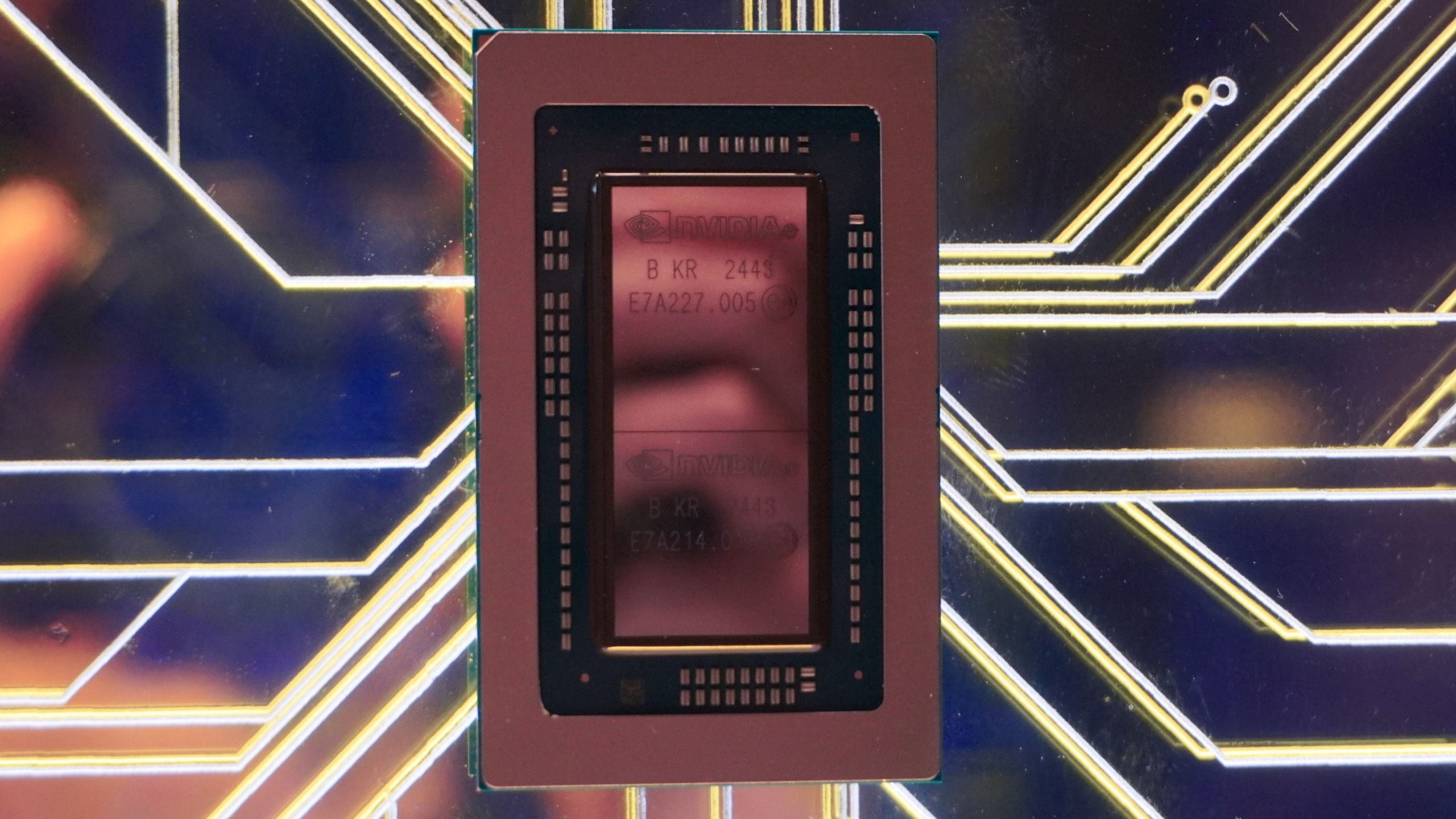
Ranked by verification strength, evidence, and original report placement.
Tom's Guide describes a long-standing two-device compromise for creatives and gamers: an M-series MacBook Pro for seamless productivity and all-day battery life, plus a power-hungry Windows gaming rig kept at home.
At IFA 2026, Nvidia confirmed that the RTX Spark N1X is coming this October.
The RTX Spark N1X pairs the Arm-based Grace CPU with Blackwell graphics of the kind in Nvidia's RTX 50-series GPUs, plus large pools of memory.
Until IFA 2026 only the top-of-the-line N1X chip was known; Nvidia has now disclosed a baseline option that is also called N1X.
Tom's Guide describes the lower-tier configuration as an 18-core CPU with 5,120 CUDA cores and 24GB of RAM.
The maxed-out configuration carries 128GB of unified memory for running large local AI models.
Distinct publishers with included, body-backed reporting in this cluster.
Follow any of these and your For You feed starts watching them — no settings page required.
product
Lenovo caps its 16-inch Spark laptop at half the memory of the 15-inch Pro1 distinct publisher
invest
Samsung Finally Has Foundry Pricing Power, and It Is Charging China For It3 distinct publishers
build
NVIDIA books $96.2bn at 75% margins and guides 74%: compute is not getting cheaper5 distinct publishers
leadership
Arm starts selling silicon, and its licensees inherit a supplier-risk problem1 distinct publisher
Evidence-backed comparisons of source perspectives and observed adoption signals. Read the methodology
Which Builder, Operator, and Investor concerns the observed source mix emphasized—not a truth score.
Evidence, demonstrated adoption, hype gap, incentives, and confidence are assessed independently, each on its own current evidence. How these are measured.
One reporter, one show floor
The ship month, the Grace-and-Blackwell pairing and both spec tiers trace to Nvidia's own IFA stage, relayed by a single outlet that was standing in front of it — first-hand, but vendor-supplied and unverified elsewhere. Tom's Guide's repeated hands-on time raises the floor on the performance impressions while adding no measurements to them. The gap is stark on price, where the reporting is explicit that Nvidia said nothing and the ranges that follow are the writer's own arithmetic.
Twelve designs, zero shipped
Nobody owns one of these yet. What is countable is manufacturer commitment: eight laptops already announced, mini PCs from Asus and MSI, and now Lenovo's Yoga 9n and an Acer small-form-factor desktop for October — at least twelve systems, enough to say Nvidia has won real board space at four OEMs. It is also a roster assembled by one reporter, with no SKUs, no volumes and no regions, so it measures intent to sell rather than anything sold.
Terrified Apple, unpriced hardware
A headline telling Apple Silicon to be terrified sits above a verdict that shrugs at the local-AI mission and hangs all-day battery on Nvidia's word. The overstatement is mostly economic rather than technical: the agentic pitch only works at 128GB, and the price of that configuration is invented in this coverage at roughly double the base, then repeated as if it were a specification. Credit where due — the same piece volunteers that a laptop power envelope will not deliver desktop-GPU performance, which is the sort of caveat launch coverage usually leaves out.
Vendor controls the disclosure
Nvidia chose what to release at IFA — core counts, memory pools, a month — and held back the single number that determines whether these are MacBook Pro alternatives or halo machines, while its CEO's reinvent-the-PC line supplies the frame. On the other side of the table sits a consumer computing desk with recurring pre-release access, whose response to the pricing vacuum is to publish a prediction and invite readers to hold it against him in the comments. Both incentives point the same direction: keep interest warm through October.
Firm month, soft everything else
Confidence splits cleanly by claim type. The October window and the architecture would be surprising to see contradicted; the spec tiers are plausible but come only from an Nvidia briefing; the pricing has no standing at all. With a single publisher and nothing shipped, this is a story to revisit at launch rather than build a purchase or a forecast on now.