Product1 publisher3 min readPublished
Dutch national AI factory slips to 2028 with its GPU count still out to tender
SURF has put the 201 million euro machine on Eurofiber's existing Groningen campus, where the grid connection and heat offtake are already built. Only 64 million of that is for the computer, and some components now cost twice what they did.
The Product Desk · Product desk
What happened
- SURF announced on Monday that the Netherlands' national AI supercomputer will be installed at Eurofiber's data centre complex on the Zernike Campus in Groningen, with a state secretary present for the news.
- The 201 million euro public contribution breaks down as 71 million from EuroHPC JU, 70 million from the Dutch government and 60 million from Nij Begun, the gas-earthquake reparation programme for Groningen and northern Drenthe.
- The European money was secured in October 2025, when EuroHPC selected six new AI factory sites, in Czechia, Lithuania, the Netherlands, Poland, Romania and Spain.
- RTV Noord reported that three sites competed for the contract, among them an annex of the former De Halm strawboard factory at Hoogkerk, which was not selected.
- How many GPUs Groningen will get is not known while the hardware tender is still running, so the size of the machine is not yet public.
Compiled by The Product DeskSomething wrong?How this is made
Why it matters
- constraint The computer's budget is locked at 64 million euros while component prices climb, so users end up with less compute for the money.
- decision Any Dutch team that wrote domestic training capacity into a 2027 plan has to find roughly twelve months of substitute compute or move the work.
- exposure Sixty million euros of earthquake reparation money for Groningen and northern Drenthe is now riding on a processor and memory market that has doubled some prices since the plans were drawn.
- precedent Campuses that already have a grid connection and a heat customer now have a live claim on national compute budgets, and brownfield conversions have to beat that starting position.
A Dutch team that needs GPU hours next year will not be using Groningen. The project's expertise centre, in the former Niemeyer tobacco factory, is already linking its first projects to other European AI factories that have unused computing power [15]. It routes work to hardware that sits in other countries. The pitch for the machine itself is domestic: SURF says startups, small and medium-sized firms, researchers and public organisations will be able to develop and train models in the Netherlands once it is running [16].
Of the 201 million euro public contribution, 64 million is set aside for the computer [3][9]. That leaves about 137 million for everything else in the programme [23]. In August, Axel Berg, who runs the tender for the supercomputer and the data centre at SURF, told RTV Noord that the 64 million no longer reaches as far as it did when the plans were drawn up roughly 18 months earlier [9]. "The situation in the world in which the supercomputer is being purchased is very different from the one that existed when the initial plans were drawn up," Berg told the broadcaster [10]. He said demand for processors, memory and storage has outrun supply, and that some of those components have become two or more times as expensive in a short period [11].
The consortium made the same point in an August update, saying hardware is getting scarcer and more expensive and delivery times are getting longer, with consequences for both the scale and the timetable of the system [12]. When the cabinet approved its 70 million share in June 2025, the machine was meant to be at full capacity in early 2027 [13]. SURF now expects full operation by early 2028, about a year later than that [2][24].
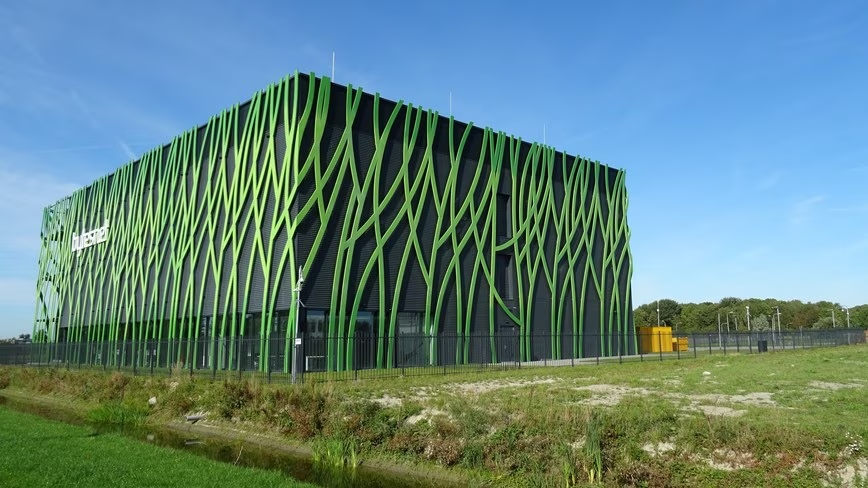
SURF's public case for the Eurofiber campus rests on the heat offtake and the grid connection. Almost all the data centre's waste heat is fed into WarmteStad, Groningen's district heating company, and no surface or drinking water is used for cooling [7]. Because the site is already connected, SURF said the supercomputer will not increase network congestion [8]. The report does not say how the competing bids were scored. RTV Noord noted that by picking Eurofiber, the government and the region chose to use an existing campus instead of building a new one [6].
Groningen sits at the modest end of European compute ambition. EuroHPC's call for AI gigafactories, built around far larger chip counts, closes on November 12, and French companies have lined up a multi-billion bid [20]. The Dutch government is not funding one of its own, because state secretary Willemijn Aerdts told parliament there was no room in the budget, IO+ reported [21].
What a Dutch team should do with this comes down to whether the workload has to run inside the country for legal or contractual reasons, and whether it can wait until 2028. Work that must stay onshore and can wait has a plan, with the size to be confirmed. Work that must stay onshore and cannot wait has to buy commercial capacity here, at commercial prices. A deadline with no residency requirement is what the expertise centre's routing into other European AI factories is for [15]. Work with neither constraint can wait and price Groningen against the market when the hardware tender closes [14]. Until it does, teams have 64 million euros to plan against, and it buys less than it did 18 months ago [9].
What to watch
- The result of the hardware tender, and the GPU count SURF publishes with it.
- Whether early 2028 holds, given the consortium's own warning about lengthening delivery times.
- Whether the expertise centre's brokering of spare capacity at other European AI factories becomes a standing service or stops when the machine arrives.