Invest1 publisher3 min readPublished
Private-placement life insurance gets pushed for its 'huge' commissions, says TwinFocus's counsel
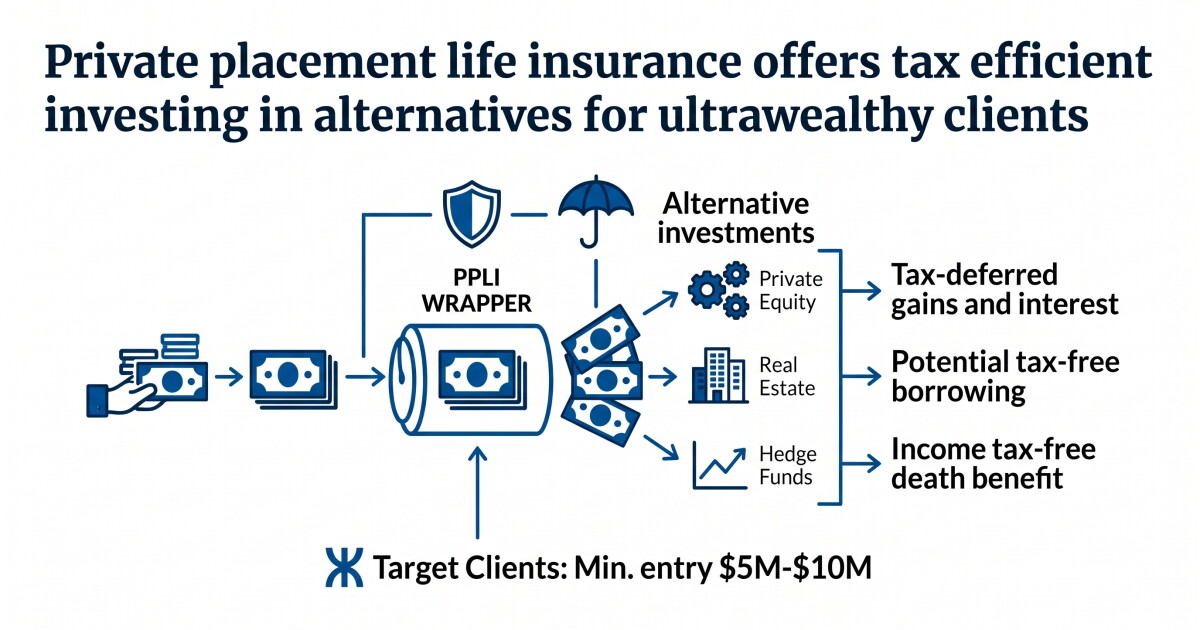
TwinFocus's John Pantekidis says 'huge' commissions drive sales of private-placement life insurance, a policy that generally takes $5 million or more to open. Its tax deferral on alternatives suits only clients with that much spare cash who will let a third party run the investments.
The Investor · Invest desk
What happened
- Owners cannot control those investments, because diversification rules apply and a third party must make the investment decisions, IRA Financial's Adam Bergman said.
- The policy can still face estate tax unless it is held in an irrevocable trust outside the owner's estate.
- Senate Finance Committee Democrats labelled PPLI a tax shelter in a 2024 report, though Bergman says the IRS has little room to act without a statute change.
Compiled by The InvestorSomething wrong?How this is made
Why it matters
- contradiction The article's $5 million net-worth floor equals its smallest policy ticket, so a client at the floor would put everything in; the real fit is clients whose spare cash alone clears $5 million.
- exposure An advisor paid a large commission to place a structure the client cannot direct or easily follow is the one exposed if the client later turns out to be the wrong buyer.
- decision A buyer must weigh tax deferral on alternatives against giving up choice of the funds and, to avoid estate tax, direct ownership of the policy.
"There's huge, huge commissions with a lot of these products, and that's why they're being pushed," said John Pantekidis, general counsel and a managing partner at TwinFocus, a Boston-based registered investment advisor [5][6]. American Banker's account does not put a rate on those commissions.
The client's side can be sized from the article, though. The policy is variable universal life. Excess premiums grow with the cash value, interest and gains are tax-deferred, and the owner directs allocation across a wider menu than a typical variable policy allows [1][2]. Beneficiaries are not taxed on income from the death benefit [3]. "The only thing that's different with PPLIs versus other whole life products is you can invest in alts, like private equity," said Adam Bergman, founder of IRA Financial [11][18]. Owners can also borrow against the policy. "The beauty is, 'OK, my kids or my surviving spouse may have less money when I die, but they're rich enough, so let me use the money now.' That's the play," Bergman said [12].
The deferral is paid for in control. Diversification rules apply, and "You need a third party that basically is in charge of making the investments. You can't be in charge of it," Bergman said [10]. The policy can still be subject to estate tax unless it sits in an irrevocable trust outside the estate [4]. So a buyer who wants private equity inside the wrapper gives up picking the funds, and may also have to hand the policy to a trust.
The article's two entry thresholds sit on top of each other. Clients generally need $5 million or $10 million to open a policy, and a net worth of at least $5 million is one test of fit [8][9]. A client at that floor who opens the smallest policy puts 100% of net worth into it, and the $10 million version is twice that client's entire net worth [1][2]. The article says the product suits clients with significant liquidity [8]. The real population is people whose idle cash, not total wealth, clears $5 million. Pantekidis said the situations where PPLI specifically makes sense are even narrower [7].
Congress could change the terms. Senate Finance Committee Democrats called PPLI a tax shelter in a 2024 report [13]. Bergman's view, as the article reports it, is that insurers follow the rules, the IRS has little room to act unless Congress changes the statute, and audit risk is low [14]. Advisors could instead keep the product to the narrow group Pantekidis describes, and the commission complaint would stay an anecdote. Or sales could outrun fit. Michael Leibowitz, founder of Tax Efficient Solutions, said "PPLI is a fantastic product, under the right set of circumstances for the right individual," and then that "it's not my go-to because it's complicated, and the average consumer doesn't like all the complicated features" [16][17][19].
I think the tax case holds under current law and the risk sits in distribution. The structure asks for $5 million of spare cash, a third-party manager and possibly a trust [8][10][4]. That takes a long time to explain, and a large commission gives the seller a reason to explain it to the wrong person [5]. The counter-thesis is Bergman's own. He calls it "an unbelievably tax efficient product" [15], and for a client who fits, years of deferred gains on private equity can outweigh the commission. Two things would prove the fiduciary worry overstated: a commission disclosed at sale that is small against that deferral, or clients who fit making up most buyers. The statute change Bergman says the IRS would need is the one development that would settle the tax question [14].
What to watch
- Whether Senate Finance Committee Democrats turn their 2024 tax-shelter report into a bill, the statute change Bergman says the IRS would need.
- Disclosure of PPLI commission rates at the point of sale; a figure small against the tax deferral would weaken the fiduciary case against the product.
- Any rise in IRS audits of PPLI policies, against Bergman's view that audit risk is low.