Invest1 distinct publisher3 min readPublished
A widely read post calls not worrying about $40 trillion of federal debt a contrarian position, and its own evidence lands the risk in Congress rather than in a Treasury auction, which is a different exposure to hedge.
The Investor · Invest desk
Compiled by The InvestorSomething wrong?How this is made
Follow any of these and your For You feed starts watching them — no settings page required.
invest
Druckenmiller calls his protege's doubled Treasury buybacks price management, not liquidity1 distinct publisher
invest
The 93% number to have ready when clients ask about selling at the top1 distinct publisher
product
AMD borrows $4.75bn while sitting on $13bn, and the number matches its Anthropic promise1 distinct publisher
invest
Wall Street's converging verdict on $40 trillion: the long bond will do what Congress won't1 distinct publisher
Divide the 40 by the 450 and you get 8.9 percent [1], which reads like comfort until you inspect the pile: Treasury securities are American financial assets, so the almost $450 trillion that Cullen Roche cites already includes the $40 trillion of debt [3][4], and the ratio therefore sets a liability against a total built partly out of claims on the entity that issued it. The version using non-financial assets, 6.7 percent [2], carries the same defect in smaller type. The arithmetic establishes capacity. Solvency is a separate question, and the more interesting one anyway.
The load-bearing chart here is not the asset total but the one the post takes from Morgan Housel: government and household debt combined, as a share of GDP, unchanged across twenty years while the federal line exploded [6]. The debt moved from households to government; it did not disappear, and the post is candid about the trade it represents [15], with JP Morgan's household debt service ratio falling off a cliff since the financial crisis [7]. A pristine sovereign balance sheet over that period would have come attached to a stressed household one.
Which is why the risk the post actually names is legislative: many people worried, no politician willing to act, and eventually meaningful pressure on Social Security or other programs [10]. Interest expense as a share of GDP has climbed alongside rates and debt through the 2020s [5], nobody in either party is proposing to lower the deficit [11], and the author's forecast is a candidate who runs on the number for attention [12].
The evidence is in tension with itself at one point worth pausing on. Part of the case rests on prices looking ordinary, long-term yields low relative to history and the term spread about average [9], while a few lines later the post objects that Scott Bessant is buying back Treasury bonds to bring rates down instead of pursuing policies that would bring inflation down [13]. A long end that officials are working on is weaker support for "no substitute for U.S. Treasury bonds at this time" [8] than a long end nobody is touching. And the premise doing the heaviest lifting, that you cannot fight the bond market, arrives with a stray second name attached to Stanley Druckenmiller and the quotation cut off mid-sentence at "the long-term Treasury yield is the most important" [14].
On positioning, the post offers a level and not a track record: there is no return series for the crisis trade anywhere in it, only the observation that long yields are low relative to the past [9]. This is probably wrong, but my read is that the no-crisis case is correct on mechanism and silent on price. A reserve-currency issuer settles its obligations in its own currency. The cost falls on holders of thirty-year paper, and it shows up as term premium, not as a headline. The falsification is specific: long-term yields ceasing to look low against their own history while the spread widens, with the Treasury still buying bonds back [13]. At that point the argument stands on politics alone; the price evidence has already been spent.
Ranked by verification strength, evidence, and original report placement.
A post published at awealthofcommonsense.com states as one of the author's most contrarian opinions: "I'm not worried about a U.S. government debt crisis."
Cullen Roche, quoted in the post: US government debt passed $40 trillion, total US financial assets are almost $450 trillion, and including non-financial assets the figure approaches $600 trillion.
The post says what worries the author about government debt is politics: many people are worried but no politicians are willing to do anything, and eventually it impacts Social Security or other important government programs in a meaningful way.
The post reads "I agree with Stanley Druckenmiller Claude that you can't fight the bond market", followed by a quotation beginning "I have spent five decades trading on a simple premise: Markets aggregate information no committee possesses, and prices are how that information reaches decision makers" that breaks off mid-sentence at "The long-term Treasury yield is the most important".
The $40 trillion of federal debt equals about 8.9 percent of the almost $450 trillion total of US financial assets.
The $40 trillion of federal debt equals about 6.7 percent of the roughly $600 trillion total including non-financial assets.
Distinct publishers with included, body-backed reporting in this cluster.
1 article · August 28, 2026
Evidence-backed comparisons of source perspectives and observed adoption signals. Read the methodology
Which Builder, Operator, and Investor concerns the observed source mix emphasized—not a truth score.
Evidence, demonstrated adoption, hype gap, incentives, and confidence are assessed independently, each on its own current evidence. How these are measured.
One post, charts described but never shown
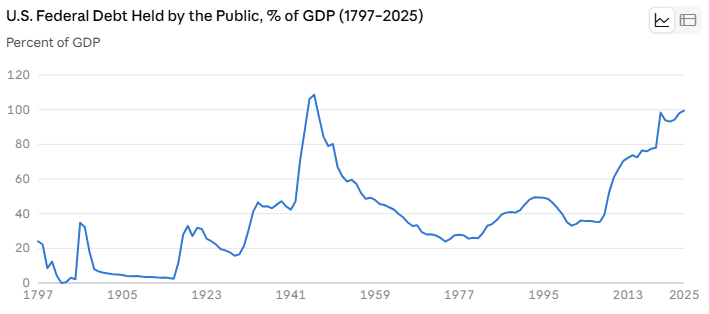
Every number in this story arrives through a single Friday-evening blog post, and the ones doing the heaviest lifting arrive secondhand: the $450 trillion and $600 trillion asset totals are a block quote from Cullen Roche with no series behind them. Four separate assertions — debt-to-GDP topped only by World War II, interest expense skyrocketing, the household debt-service ratio falling off a cliff, long yields low by historical standards — are the author's readings of charts a reader cannot see, and not one level or basis point is quoted anywhere in the piece. What survives verification is narrow: what the post says, and the arithmetic on the two figures it prints.
Nothing here is adopted by anyone
This is an argument, not a thing in use. No auction result, no fund flow, no position, no buyback tender actually documented — so there is no uptake to score, and dressing the post's chart list up as evidence of behaviour would be inventing a measurement.
Contrarian billing, circular comfort
The overstatement is in the framing and the finish, not in the author's temperament. Calling "I'm not worried" one of his most contrarian opinions raises the stakes of an argument whose best reassurance — $40 trillion sitting inside almost $450 trillion — includes Treasuries in the pile that is supposed to reassure us about Treasuries. Then the passage brought in to close the case credits "Stanley Druckenmiller Claude" and offers no link to anywhere Druckenmiller said it. Set against that, the post is genuinely modest in places: it concedes interest expense is climbing and never claims the risks are zero, which keeps the gap moderate rather than large.
House blog doing audience work
The piece ends by pointing readers at this week's Animal Spirits video and asking them to subscribe to The Compound, which tells you plainly that it is publishing to an audience it also monetises. That is ordinary and disclosed, not a conflict — but a reassuring take on debt is congenial content for a channel built on staying invested. Nothing in the post discloses holdings, client exposure, or any position in Treasuries, so we score only the promotional pull that is visible on the page.
Sure what was said, unsure of most of it
We can stand behind the account of the post's argument and the one piece of arithmetic it prints. Almost everything else — the historical debt-to-GDP ranking, the household charts, the buyback allegation against a name the piece misspells, the claim that neither party has a deficit proposal — has no second source and, in most cases, no first one beyond an unshown chart. A single opinion column, however widely read, cannot carry a confident verdict on federal debt sustainability.