Science1 distinct publisher3 min readPublished
A South Florida team ran 119 volunteers past Aedes aegypti, Aedes albopictus and Culex quinquefasciatus behind a mesh screen, and the three species did not want the same people. Which skin bacteria explain that is still the open question.
The Scientist · Science desk

Compiled by The ScientistSomething wrong?How this is made
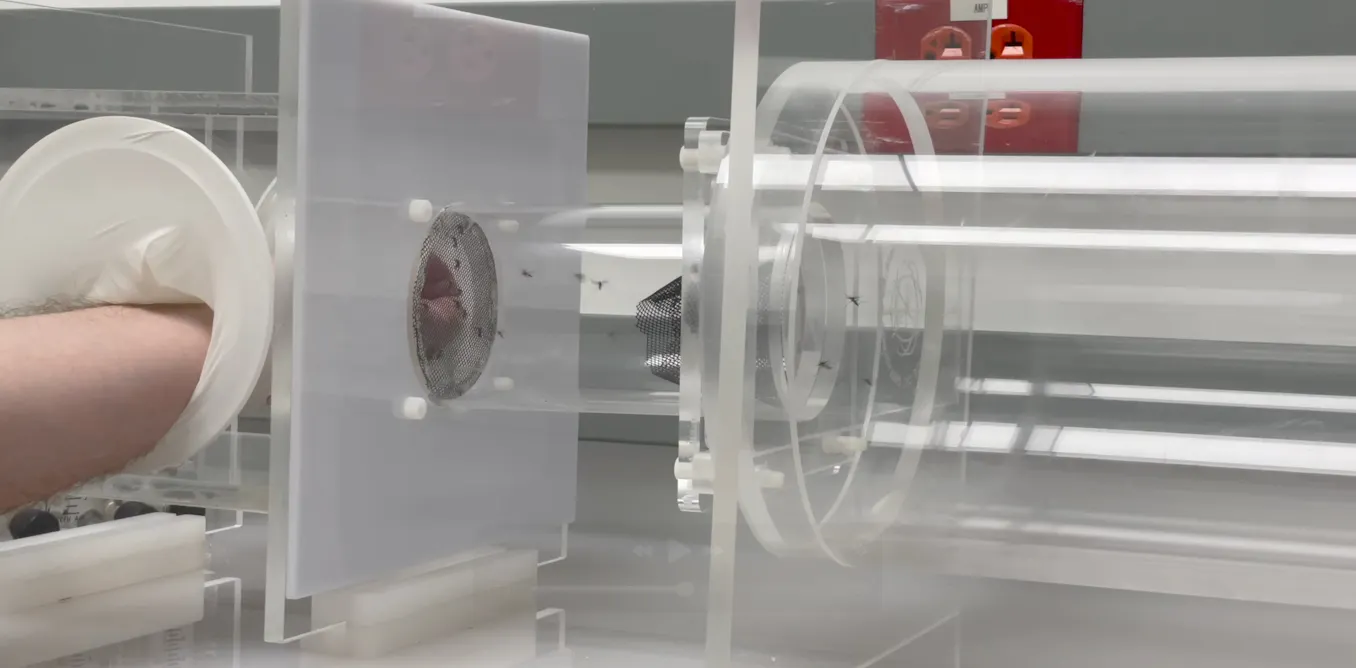
A uniport olfactometer is a no-choice assay, and that shapes what the word preference can mean here. Each volunteer's arm sat alone in the acrylic box, separated from the insects by mesh [4]. Mosquitoes released down the tube either committed to the attraction chamber or they did not [5]. Nobody competed against anybody. What the team gets out of it is a rate per person per species [6], and the comparison between people happens later, in the analysis, rather than in the insect's antennae.
The denominator is generous for host-preference work. Thirty mosquitoes per release, three releases per species, so 90 per species and 270 per participant [7], across 119 people [3]. That is about 32,130 mosquito exposures in total [16], 10,710 per species [17], spread across 1,071 runs of the box [18]. The resolution of any one person's score is coarser than those totals suggest: with 90 mosquitoes in the denominator, a single insect changing its mind moves that person's attraction rate by roughly 1.1 percentage points [19], so narrow gaps between two individuals are not worth reading.
The funnel matters too. Once a mosquito is inside the chamber, getting back out is difficult [5], which makes the score a cumulative capture over the trial rather than a snapshot of interest. That is a sensible trade for reproducibility, since it removes the observer's judgment about when a mosquito counts as approaching. It also means an insect that entered and then reconsidered is still scored as attracted.
The microbiome half is where the ambition sits and where the design's limits are sharpest. Arms went into a bag immediately after each trial to capture odor, and were swabbed to identify which bacteria were present [9]. Skin communities typically mix Staphylococcus, Corynebacterium and Cutibacterium in proportions that move with a person's diet and health [11]. What that yields is association: this arm carried these microbes and drew this many mosquitoes. The probiotic repellent the authors name as a goal [15] needs the causal step instead, which means adding or subtracting organisms on real skin and running the assay again. The account available reports that each of the three species had its own preferences [8]; the specific microbes or odor compounds that separated a popular arm from an ignored one are not identified in it [20].
Species-specific preference is the useful part. It is not surprising once you look at what these mosquitoes eat. Culex quinquefasciatus feeds mainly on birds and bites people as well, which is exactly what places it in the bird-to-human West Nile chain [14], while Aedes aegypti prefers humans to other animals [12] and Aedes albopictus will leave the city to find a meal [13]. Asking one formulation to deter both searches is asking a lot of one chemistry.
Whether the popular arms stay popular outdoors is the question this design leaves open. Volunteers arrived with no perfume or deodorant and at least 12 hours since their last shower [10], which is a clean baseline for odor chemistry and not the skin anyone actually walks around with. Entry into a chamber behind a mesh screen [4] is short-range host-seeking, measured without a bite, a landing, or a completed blood meal.
Ranked by verification strength, evidence, and original report placement.
Biology researchers studying mosquito behavior report that mosquitoes can be picky about human blood, preferring some people over others.
The study covered three mosquito species abundant in South Florida: Aedes aegypti, Aedes albopictus and Culex quinquefasciatus.
The researchers recruited 119 participants and tested each participant's attraction for each species using a uniport olfactometer.
The uniport olfactometer is an acrylic container in three parts: a box where the participant places an arm, a tube into which mosquitoes are released, and a connecting attraction chamber; a mesh screen divides the chamber from the arm so mosquitoes can get close but cannot bite.
Mosquitoes that traveled down the tube into the attraction chamber were classified as attracted, and a funnel inside the chamber made it difficult for them to leave once they entered.
The attraction rate for each participant was calculated by counting how many mosquitoes entered the attraction chamber.
Distinct publishers with included, body-backed reporting in this cluster.
Follow any of these and your For You feed starts watching them — no settings page required.
science
Three mosquito species picked three different favourite groups out of the same 119 volunteers1 distinct publisher
invest
Alaska's disappearing lakes make permafrost thaw an asset-level observable1 distinct publisher
science
HIPAA Covers Less Than You Think, And "Anonymized" Is Not A Legal Shield1 distinct publisher
science
Whale-watch footage catches 1,417 humpbacks feeding along a corridor theory calls a fast1 distinct publisher
Evidence-backed comparisons of source perspectives and observed adoption signals. Read the methodology
Which Builder, Operator, and Investor concerns the observed source mix emphasized—not a truth score.
Evidence, demonstrated adoption, hype gap, incentives, and confidence are assessed independently, each on its own current evidence. How these are measured.
One self-authored account, no numbers under the result
Every fact in this story traces to the research team's own article on The Conversation. The method is described precisely enough to audit, and the internal arithmetic holds up. The result does not get the same treatment: 'each species had its own preferences' arrives without an effect size, a spread or a significance test, and the piece never names the journal, paper or review status where those would live. That gap is what caps this score, not the plausibility of the finding.
Nothing fielded
There is no uptake to measure. The only use anyone names is the authors' hope that odour and microbiome profiling will feed repellent design and probiotic formulations, and no product, trial, vector-control programme or commercial partner appears in the reporting.
Written more modestly than its own contents
The framing stays inside the data. Picky eaters, three species, one lab, no cures promised. Our own summary went further in the cautious direction than the source warrants, treating the microbial explanation as unresolved when the authors do name candidates for each species, including more abundant Staphylococcus on the arms Aedes aegypti preferred and the ketone-heavy profiles Aedes albopictus went for. The one place the writing reaches past its measurements is the probiotic repellent line, which rests on no efficacy data at all.
The researchers are also the writers
The Conversation's model is transparent about authorship, and here the byline is the lab itself, which means the same people chose the result to lead with, the associations to highlight and the applied payoff to promise. Repellents you could formulate from skin bacteria is exactly the framing that keeps a vector-biology programme funded. No funder or competing-interest statement appears in the text, and no editor or reviewer stands between the finding and the reader.
Auditable protocol, unverifiable results
We can be confident about what was done. The design is stated in enough detail to reconstruct, and the derived figures reconcile: 119 participants at 270 mosquitoes each gives 32,130 exposures, nine runs per person gives 1,071 runs, and one insect out of 90 is about 1.1 percentage points. We cannot check anything the authors chose not to publish, no second party has examined the results, and the copy available to us breaks off partway through the Culex quinquefasciatus findings.