Product1 publisher3 min readPublished
Momentic's Mo offers a prompt and a URL in place of maintained test scripts
Momentic launched Mo, an agent swarm that tries thousands of edge cases on a live app so developers can stop maintaining test scripts. For a QA lead, the open decision is whether that exploration can replace the checks a team reruns after every change.
The Product Desk · Product desk
What happened
- Beyond a prompt, Mo can take a product requirements document, Jira issue, Linear ticket or Confluence page when a feature needs more context.
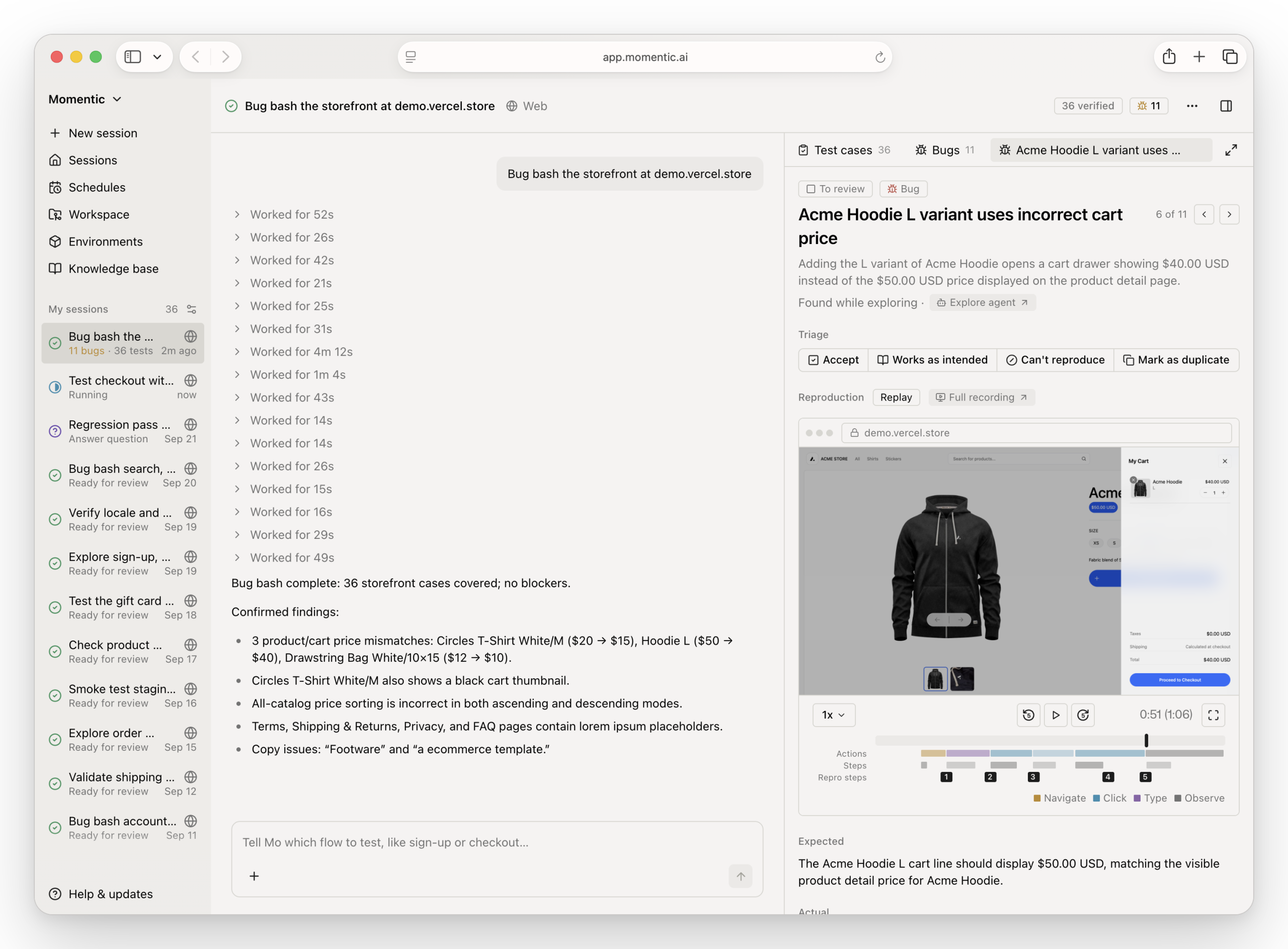
- Each run returns a report of what was tested, what failed and how to reproduce each bug, with video evidence for every failure.
- Wu said the findings are reproducible and fully described, so developers can convert them into the script format of their choosing.
- Momentic said Notion, Superpower, Iris, Committee for Children and Boundless have been using Mo over the past few weeks.
Compiled by The Product DeskSomething wrong?How this is made
Why it matters
- cost Script repair gives way to review work, because someone on the team has to read and triage the failure reports and videos each swarm run produces.
- constraint What Mo tests depends on the prompt and tickets it is handed, so a vague Jira or Linear ticket narrows a run the way a missing test used to.
- exposure The swarm works a live app with whatever credentials it is given, so teams need throwaway accounts and an environment where thousands of agent actions do no damage.
Wei-Wei Wu's demo prompt for Mo runs four short sentences: "Bug bash this app I just built. Here's the URL. Here are some test credentials. Go ham." [6] Wu, Momentic's co-founder and chief executive, told SiliconANGLE where the company expects that to lead. "Our bet is that there's no tests in the future," Wu said. "It's just agents verifying it themselves, based off of your instructions." [2]
The problem Mo targets is the one SiliconANGLE lays out. The more complex an app gets, the more tests it needs, and that pile has to be checked, modified and fixed every time the app changes or the scripts become a liability [13]. Momentic's first answer let developers describe browser tests in ordinary language. Wu said even that easier artifact still left something for somebody to maintain [4]. "As long as you have scripts somewhere in your codebase, someone has to maintain it," Wu said [3]. Wu also said: "With agents, the economics of scale can actually work." [12]
The interface shows who it is for. Mo is built to look like the coding tools developers already run, such as Claude Code, with a chat box and URL field on the web and a command line for automation [14][5]. The worker SiliconANGLE describes is a developer overseeing a coding agent, correcting its obvious errors and passing the result along for testing [15]. I think Mo fits that person best: someone shipping agent-written code with no suite yet, for whom a bug bash from a URL costs little to try.
Here's what the pitch says: no tests. Here's what the product does, by Momentic's account: an on-demand swarm run against a live app [8], with findings a team can turn into scripts when it wants them kept [10]. Finding bugs nobody thought to script is one job, and a swarm trying thousands of permutations suits it. Confirming that a fixed bug stays fixed after every change is another job, the one a regression suite exists for, and Wu's export path puts a script back in the repo to do it. The launch coverage does not include pricing, run times, or a count of bugs Mo caught that an existing suite missed.
Momentic's named customers have had Mo for a few weeks [11]. That is enough time to run bug bashes. It is too short to show whether any of them deleted a suite afterwards, and a deleted suite is the result Wu's bet depends on.
For a team that already owns a suite, I'd sort flows on two axes before a pilot. One is how often a flow's interface changes. The other is what a regression in that flow costs once it ships.
Flows that change often and are cheap to break, such as settings pages or internal admin screens, are where Mo can replace scripts outright. Those are the scripts that get fixed most often for the least protection. Flows that change often and are expensive to break, like SiliconANGLE's example of a shopper adding carrots to a cart and checking out [16], get Mo for discovery plus a short exported script set for the paths that must pass every release. The tradeoff there is that someone still maintains those scripts, the cost Wu says Mo removes. Stable, expensive flows keep their current suite, because a flow that rarely changes rarely breaks its scripts. Stable, cheap flows need only an occasional bug bash, from Mo or from a person.
Checkout belongs in the first group only once Mo's reports catch, run after run, the regressions its scripts were written to catch.
What to watch
- Momentic publishing pricing, run times, or a count of bugs Mo found that a customer's existing suite missed.
- A named customer such as Notion saying it retired part of its script suite after the pilot, or kept it.
- Whether Mo runs repeat consistently enough to gate a release without first exporting findings into scripts.