Science1 publisher3 min readPublished
ICP55's one-amino-acid trim holds mitochondrial protein complexes together in human cells
Heidelberg and Freiburg researchers report that the enzyme ICP55 trims one amino acid from 107 imported mitochondrial proteins and keeps large complexes intact. The evidence comes from engineered human cells and a test tube, so the disease link the authors suggest is still untested.
The Scientist · Science desk
What happened
- Once another enzyme strips the address sequence from an imported mitochondrial protein, the enzyme ICP55 cuts exactly one more amino acid from its starting end.
- Human cells engineered to lack ICP55 showed proteins shifting out of large assemblies into smaller complexes or lone subunits, including the respiratory chain, HSP60 and mitochondrial ribosomes.
- In a test tube, one extra amino acid on HSP60 was enough to break apart complexes that had already formed.
Compiled by The ScientistSomething wrong?How this is made
Why it matters
- capability Researchers chasing an unexplained unstable mitochondrial complex now have a list of 107 proteins whose final one-residue trim can be checked as a cause.
- constraint Direct proof that the trim alone matters exists for HSP60, so claims about the respiratory chain or ribosomes still rest on knockout cells where knock-on effects through a weakened folding chaperone are possible.
- precedent Studies of protein import that treat maturation as finished once the address sequence is gone will miss a second cut that, for roughly a quarter of mapped proteins, affects whether complexes hold together.
The paper's title claims a lot for one residue: "A single-amino-acid cleavage controls global mitochondrial complex integrity" [16]. The evidence comes in three parts, and each does a different job.
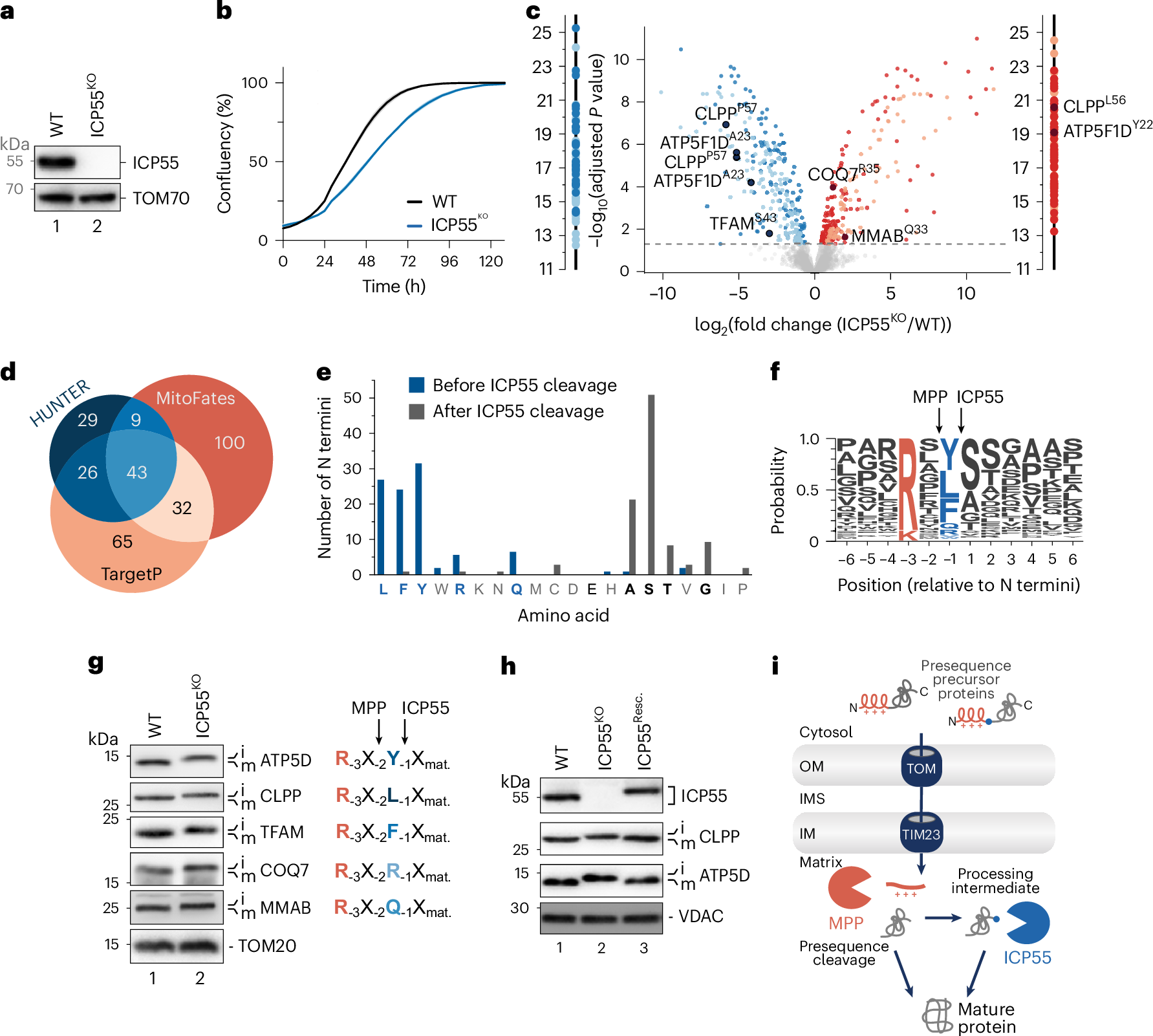
The first part is a census. Most mitochondrial proteins are built outside the organelle and arrive carrying an address sequence at their N-terminus, which enzymes remove after import [2]. Which proteins then receive ICP55's second, one-residue cut, and why, had not been worked out [4]. The team read the mature N-termini of 446 mitochondrial proteins and found 107 that ICP55 processes [5][6]. That is about 24 percent [7]. The denominator is the set of proteins whose ends the method could map, so the 24 percent describes that set and not every protein in mitochondria.
The second part tests necessity. Vögtle's group made human cells lacking ICP55 [8]. Complexome profiling, a survey of how the organelle's proteins are organised into complexes, showed proteins turning up less often in fully assembled large complexes and more often in smaller complexes or as lone subunits [10]. The respiratory chain, the HSP60 folding complex, mitochondrial ribosomes and metabolic complexes were all affected [10].
A knockout on its own leaves room for doubt. Deleting an enzyme can change a cell in more than one way. So the team moved HSP60 into a test tube and showed that a single extra amino acid is enough to destabilise it [11]. I find this the most persuasive part of the work, because the rest of the cell is out of the picture. Complexes that had already formed broke down, and the number of free HSP60 subunits rose [11].
The thing this doesn't tell you is whether the other complexes fail for the same direct reason. HSP60 helps newly imported or stress-damaged proteins fold correctly [9]. In cells without ICP55, a weakened HSP60 could add to the trouble seen in the respiratory chain or the ribosomes. According to the published account, the direct one-residue test was run on HSP60 [11].
"We were surprised to find that removing a single amino acid has such a fundamental impact on the stability of mitochondrial protein complexes," Vögtle said [12]. She leads a group on mitochondrial proteostasis at Heidelberg University's Center for Molecular Biology, and Huesgen does proteomics research at the University of Freiburg's Faculty of Biology [19]. "The exact sequence of processing by ICP55 has been shown to be a fundamental prerequisite for the formation of stable functional units," Huesgen said [13]. Researchers from Heidelberg's Biochemistry Center, the Jülich Research Center and the University of Fribourg in Switzerland also took part [15].
The team describes the result as a previously unknown mechanism by which human cells keep the proteins in their mitochondria in balance [18]. According to the two scientists, it offers a potential molecular starting point for understanding how faulty protein maturation impairs mitochondria, and could help explain mitochondrial diseases [14]. The evidence behind that suggestion is engineered human cells and purified protein [8][11].
What to watch
- A direct test like the HSP60 one showing whether respiratory chain complexes or mitochondrial ribosomes fall apart from the untrimmed residue alone.
- Evidence from animal models or patient-derived cells that ICP55 loss produces the same complex breakdown, the step the authors' proposed disease link would need.