Product1 publisher2 min readPublished
MIT gives a nanoscale switch a memory by cushioning its electrodes with soft polymer
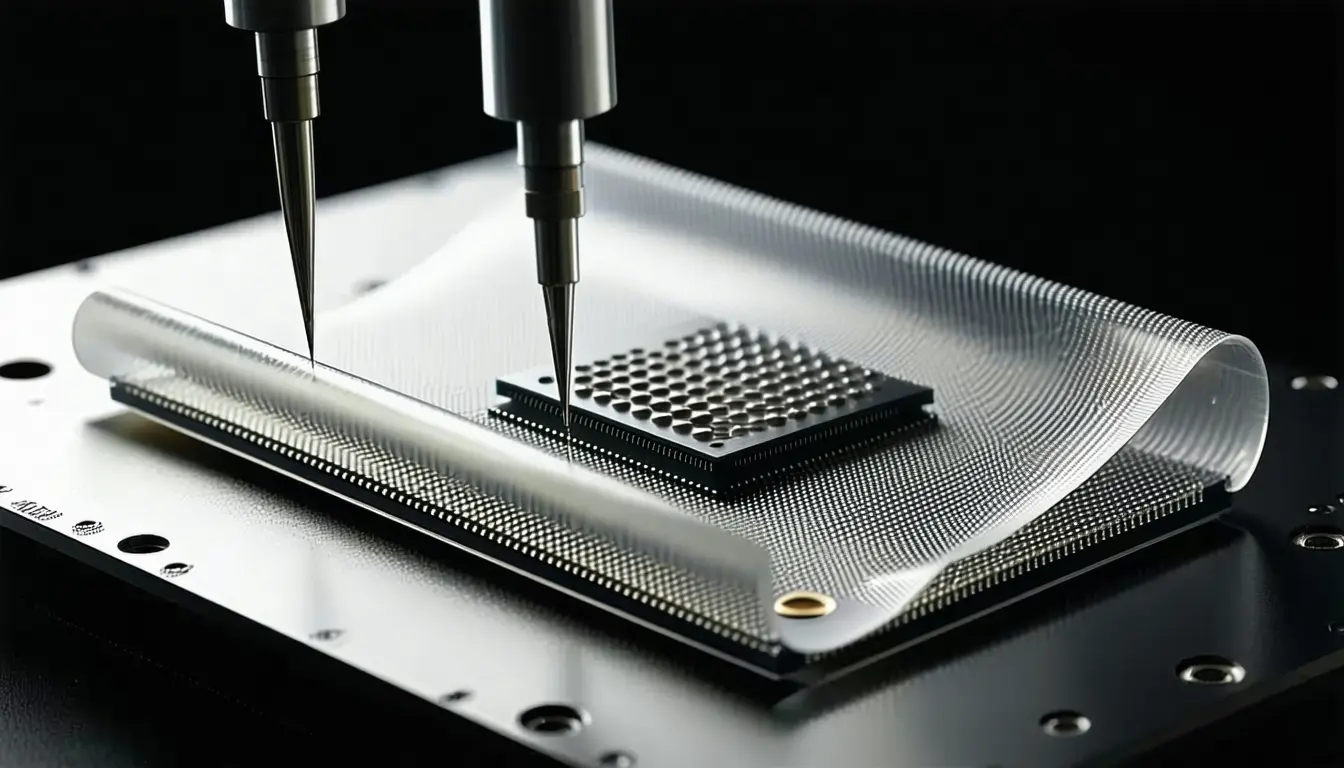
A thin viscoelastic layer of PDMS keeps two metal electrodes from snapping together and holds the history of voltages applied to them. Integrating a sensor with that memory is the team's next project.
The Product Desk · Product desk
What happened
- MIT researchers have built a nanoscale device that processes information inside a single microscopic unit made of soft polymers, in work published in the journal Science Advances.
- Earlier nanoscale mechanical computers broke because intermolecular adhesive forces snapped two metal surfaces together permanently once they came close enough.
- The team's answer was a thin layer of PDMS between two metal electrodes, acting as a viscoelastic nano-spring that balances adhesion so the electrodes can move reversibly.
- Because the polymer rebounds slowly, the device retains a history of the forces and voltages applied to it, accumulating charge until it crosses a threshold, firing, then relaxing to reset.
Compiled by The Product DeskSomething wrong?How this is made
Why it matters
- capability A single component that both stores the history of applied force and fires at a threshold gives edge-sensing designers a memory element sitting where the measurement happens.
- constraint The offer is a reduction in surrounding circuitry and power supply, so a team costing a wearable patch keeps the capacitor and the supply in its bill of materials.
- contradiction The same write-up says sensing already happens alongside memory and logic and that sensing integration is the next project, and only the second version supports a schedule.
A result like this has to show up on the parts list. The account in Interesting Engineering names bulky external circuits and heavy power supplies as what building these functions into the material makes less necessary [3], and extra circuitry and capacitors as what integrating memory with computation makes less necessary [11]. In both places the verb is "reduces" [15]. A wearable team costing a patch still budgets for a power supply and for the circuits around the device.
The memory itself is mechanical, and it comes from the polymer being slow to spring back [7]. Peter Satterthwaite, a co-lead author, said: "PDMS is viscoelastic, which means that after being compressed, it takes time to return to its original state. This allows the devices to dynamically remember the history of forces and voltages applied to them, and convert that history into an electrical response" [8].
The neuron-style behaviour follows from that. Charge builds up, crosses a threshold, the device fires, and then it relaxes to reset [9]. The energy argument in the write-up is about data movement: AI hardware burns electricity shuttling data between separate memory banks and processor units, and this platform is described as keeping memory, sensing and logic in one spot [10].
The account says memory, sensing and logic happen in the same place [10]. It also says the team's next step is to integrate sensing directly with memory and computing to build fully adaptive nanomechanical systems [13]. Those two sentences do not agree [14]. For anyone reading this as a wearable roadmap, the second one is the one to plan against.
The write-up reaches for the octopus, whose tentacles process locally instead of routing every decision to a central brain [17]. Decentralisation is a claim about many units working together, and the report does not include switching speed, energy per operation, device lifetime, or how many of these units have been operated at once [16]. The applications named are areas: smart robotics, wearable medical patches, smart prosthetics, wearable health monitors, autonomous environmental sensors and low-power edge computing [12].
Which makes this useful to a narrow reader. That reader is the group deciding which physical approach to spend the next three years on, where the adhesion failure that broke earlier nanoscale mechanical computers [4] has been a hard stop and a thin PDMS interlayer is now one answer to it [5]. Here, sensing is in the next paper [13].
What to watch
- Whether the promised sensing-plus-memory device keeps the reversible electrode motion at the same voltages once a sensor is added.
- Whether any group outside MIT reproduces the PDMS interlayer, and at what yield.
- Whether a device maker in wearables or prosthetics publicly picks up the approach.