Invest1 publisher2 min readPublished
Nadella's superintelligence post sells enterprises on owning their own model weights
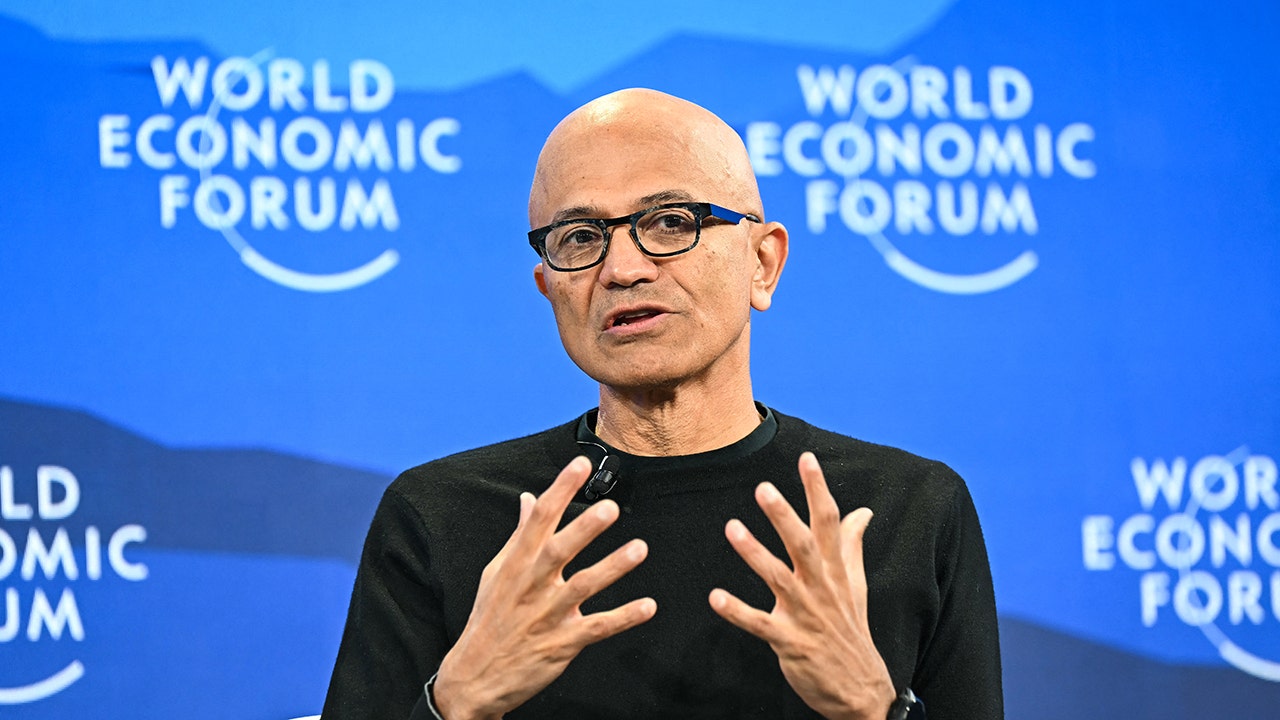
Satya Nadella used a Sunday post about superintelligence to tell firms they should be able to run their own learning loops without depending on any one model provider. Microsoft publishes the code of conduct behind its MAI models on Monday.
The Investor · Invest desk
What happened
- Nadella used a Sunday post on X to call for a "frontier ecosystem" in which closed and open-source models both thrive across countries, communities and businesses.
- He wrote that any pursuit of superintelligence has to be grounded in AI that helps humanity and stays under human control, and that anything else is not worth pursuing.
- Anthropic CEO Dario Amodei told CBS News there are real dangers in the technology and that the industry lied to people for too long about its risks.
Compiled by The InvestorSomething wrong?How this is made
Why it matters
- decision A firm that accepts the multi-provider argument has to budget for holding weights and running its own evaluation, costs it currently buys inside one vendor's service.
- constraint The document going out for consultation covers Microsoft's own models, so a buyer mixing suppliers has to ask each of the others for its equivalent.
- precedent A platform CEO arguing against single-provider dependence makes asking to keep the weights an ordinary question in AI procurement, and an awkward one for any supplier to refuse.
- contradiction Amodei talks about dangers the industry hid and Coxon puts extinction odds above 10% within a decade. Nadella's remedy is broader access and enterprise control; it does not address those odds.
A buyer who takes Nadella's enterprise line literally ends up owning work that a single-provider contract outsources. He wrote that every organization should be able to build "its own continuous learning loop/hill climbing machine, without becoming dependent on any one model provider." It should also have "the ability to embed its own knowledge into models and weights they control" [3]. Running that loop means holding weights and funding your own evaluation, and keeping the tacit knowledge he says firms must retain full control over [4]. All of it sits on somebody's platform. Microsoft describes its own approach as "broad access and choice at every layer of the AI stack" [5].
That sentence lists three things Microsoft says it is doing: choice at every layer, enterprise control of learning loops and models, and the code of conduct behind its first-party MAI models. That code goes out for public consultation on Monday [5]. Only the third is scoped to Microsoft's own models [11].
Fox Business placed the post inside a louder argument. Anthropic's Dario Amodei told CBS News that "for too long the industry lied to people about the fact that this technology had risks" [8]. Last week a former Anthropic researcher, Jacob Coxon, warned on social media that Anthropic and OpenAI are "gambling with our lives" by pursuing self-improving superintelligence. He put the chance of AI "kill[ing] all humans" within "the next decade" above 10% [9]. Nadella's answer is structural. Development "cannot be controlled by a handful of entities, but must have broad representation across the ecosystem, countries, and fields, including academia," he wrote [6]. Microsoft welcomes ideas like "embedded evaluators" [7].
Three readings fit the same post. It is a safety statement, in which case the test is what Monday's document commits Microsoft to. It is a distribution argument, and the company selling access at every layer of the stack gains when buyers refuse to standardise on one lab [5]. Or it changes nothing, because dependence on a provider is written into contracts and pricing, and the Fox Business account does not include either.
I lean to the second, with the caveat that a post on X binds nobody. If the code of conduct published Monday commits Microsoft to letting customers leave with fine-tuned weights, then the post describes terms the company already offers, and the procurement reading is wrong.
What to watch
- Comments filed in the MAI code of conduct consultation, and whether Microsoft changes the published document in response.
- Whether other lab heads answer the "frontier ecosystem" framing with their own position on open weights.
- Whether "embedded evaluators" acquires a definition specific enough for Microsoft to be measured against.