Build1 publisher3 min readPublished
Microsoft makes ecological landscaping standard on every new US data center project
Microsoft says ecological landscaping, already used at more than 20 data center sites, is now standard on every new US project. Public Citizen's Texas director says no amount of it makes a gas plant a good neighbor, and points to Microsoft's 20-year Chevron power deal.
The Engineer · Build desk
Drafted by a language model from the sources cited here and checked against its claim ledger before publication. How we use AISend a correction
What happened
- At Microsoft's Mount Pleasant, Wisconsin campus, site of its Fairwater AI data center, 100 acres of prairie and forest are part of a restoration of Lamparek Creek carried out with a local watershed group.
- In San Antonio, a Microsoft plan approved in 2022 called for removing 2,642 trees from a 33-acre tract to make room for a data center.
- Chevron says the planned West Texas gas plant would supply about 2.67 gigawatts if it goes ahead, with first power expected in 2028.
- Microsoft's July sustainability report puts its total emissions up 25% in fiscal 2025, citing data center expansion and a pause in buying unbundled renewable energy certificates.
Compiled by The EngineerSomething wrong?How this is made
Why it matters
- constraint The planning tool scores features of the site, so the program can answer local complaints about noise, views and runoff but cannot touch emissions from the power Microsoft buys.
- contradiction Giordano's praise and Shelley's dismissal are about different places: the creek beside the data center and the gas plant that supplies its power.
- precedent Restoration is now standard on every new US project, so councils drafting data center zoning rules can treat it as the minimum Microsoft brings to a site.
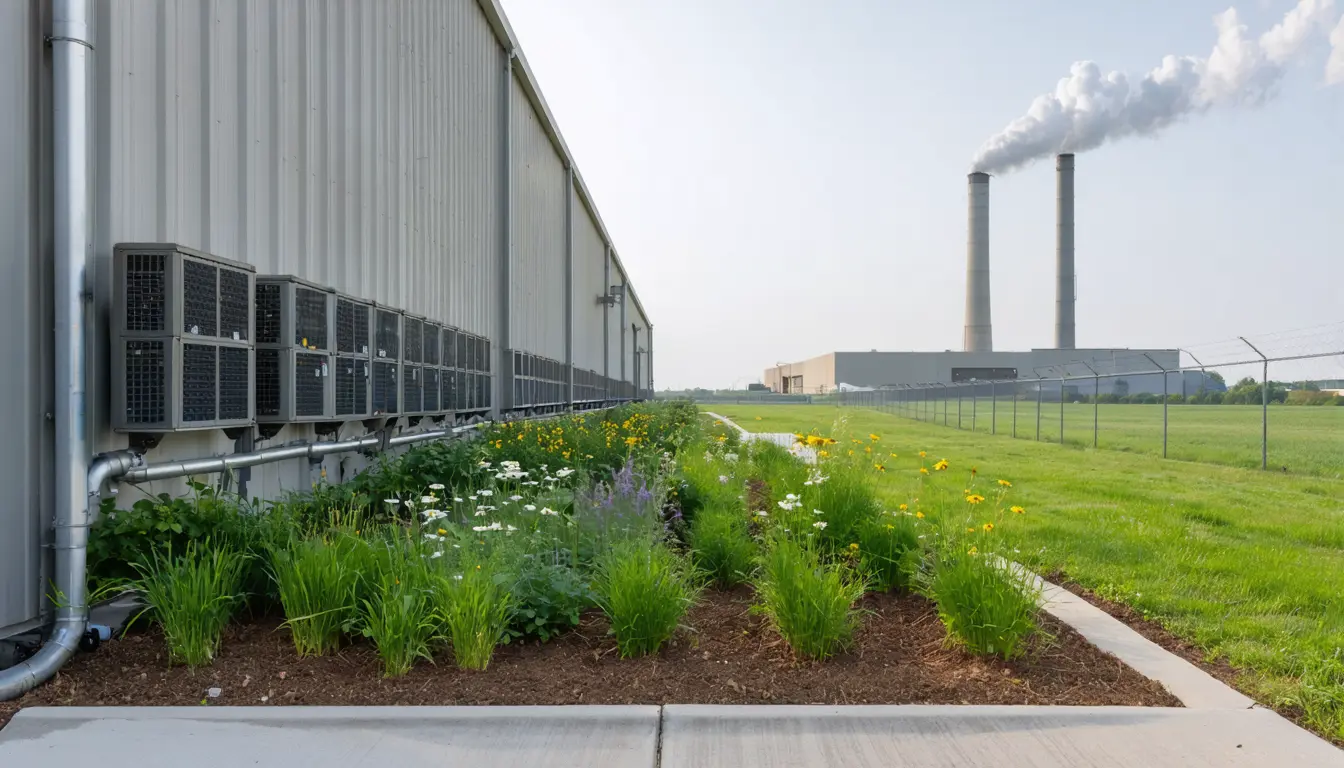
Microsoft plans the land with Ecosystem Intelligence, a tool that runs on Azure. It scores features of each site, including water quality, biodiversity and noise abatement [3]. Kaitlin Chuzi, Microsoft's director of global land strategy, said the designs are customized to the local habitat and should restore what was lost [4]. Plant buffers also quiet the hum of the buildings [4]. Chuzi said they help "minimize the visual impact on communities near our data centers" [5].
Two of the three aims Chuzi listed are about what neighbors hear and see [4][5]. The community-acceptance motive is written into Microsoft's own description of the program [5]. For a building that hums, I think that is a legitimate design goal. Every feature the tool is reported to score is a property of the site itself [3].
Adrian Shelley, Texas director of Public Citizen, aimed his objection at the power supply. "I cannot really see any level of biomimicry investment that makes a gas plant a desirable neighbor," he said [16]. The plant in Microsoft's 20-year deal is planned for West Texas [2]. The restoration work happens at the data center sites, in places such as Mecklenburg County, Virginia and Mount Pleasant, Wisconsin [7].
The same boundary runs through Microsoft's 2030 targets: carbon negative and water positive. By its own measure, the company met the water target in fiscal 2025 [20]. Water quality is the one scored feature tied to either target, and that is the target Microsoft says it has met [3][20]. Its own report says data center expansion is pushing the carbon number the wrong way [19].
Some of the site work is careful civil engineering. Dave Giordano is executive director of the Root-Pike Watershed Initiative Network. He said Microsoft built its stormwater ponds with forebays to retain sediment [9]. "Not all data center companies are the same," Giordano said [10].
San Antonio shows what Microsoft offers where a site has already cost something. Spokesperson Jennifer Lyons said the company's investment covers restoration of woodland and pollinator prairie on more than 400 acres in the city, and that it intends to leave the "land more productive than we received it" [15]. That is more than 12 times the area of the 33-acre tract in the 2022 tree-removal plan [1]. Councilmember Ric Galvan's district already has more than a dozen data centers, and more are proposed [12]. He said Microsoft may be "covering their bases" [13]. He said that is fine if residents' concerns are addressed [13].
Holly Alpine led ecosystem restoration and climate resilience work near Microsoft's data centers until she left in 2024. According to the report, she still sees a gap between the buildouts and the company's sustainability goals [21].
What to watch
- San Antonio's council votes Oct. 15 on data center zoning rules, after declining the blanket moratorium Galvan proposed in August with Public Citizen's backing.
- Texas regulators' audit of data centers, which under Governor Greg Abbott's orders now holds up both main-grid connection approvals and new state environmental permits.