Science1 publisher2 min readPublished
CNPEM built a microfluidic chip that gives the spheroid back after the assay
The Brazilian group's platform grows 3D cell models under continuous flow and opens afterward so the tissue can be recovered intact, with plans to offer it to outside labs as shared infrastructure early next year.
The Scientist · Science desk
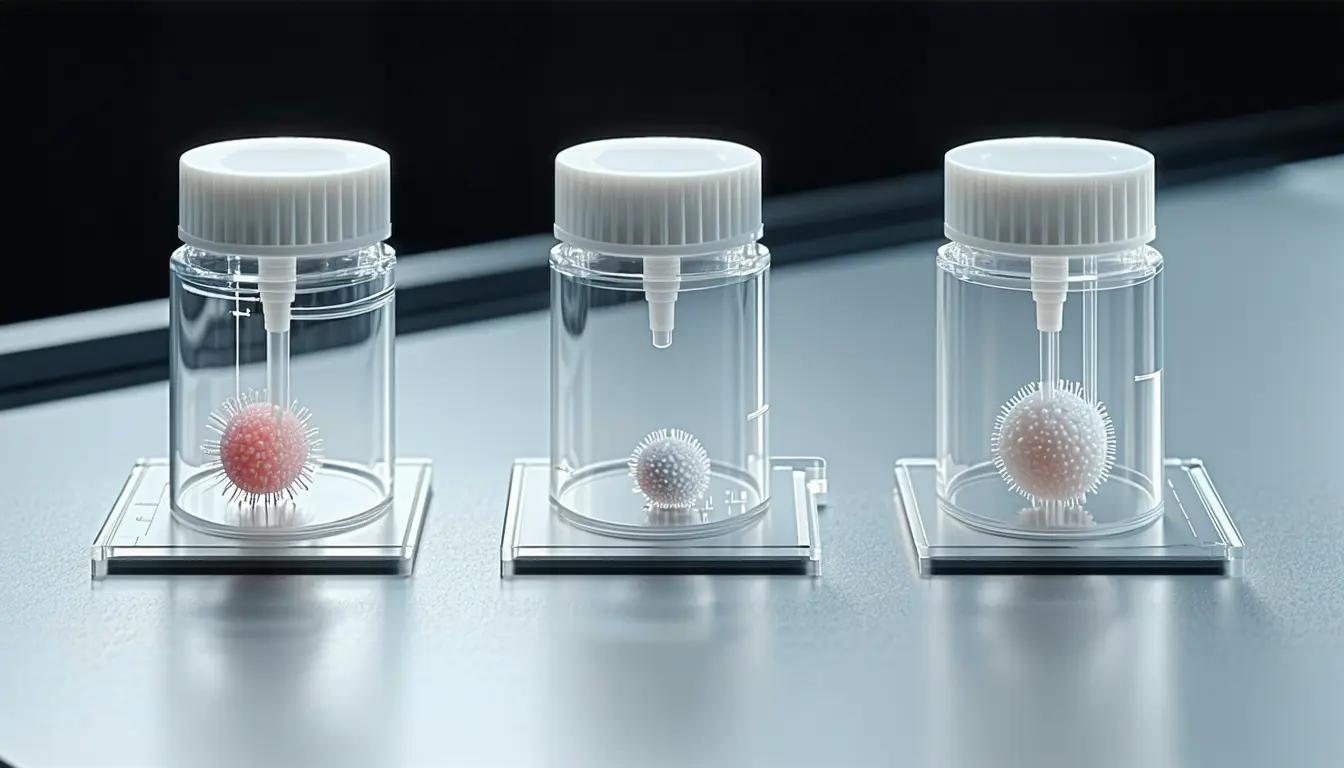
What happened
- Researchers at the Brazilian Center for Research in Energy and Materials built a microfluidic platform that grows cells in three dimensions, aimed at toxicity testing that better simulates living organisms.
- The device is made from PDMS, a malleable, transparent, biocompatible and low-cost silicone, and CNPEM says it enables the automated performance of multiple experiments.
- Its reversible design allows the chip to be opened after a test so intact cellular models can be retrieved for further analysis.
- The team also published a standardized protocol intended to let researchers new to microfluidics run routine cell assays on the platform.
- The work appeared in ACS Measurement Science Au and was done within the Research Center for Molecular Engineering of Advanced Materials, a Research, Innovation and Dissemination Center.
Compiled by The ScientistSomething wrong?How this is made
Why it matters
- capability One run can now yield both the assay reading and a physical specimen, so a lab no longer has to choose between measuring the spheroid and keeping it for downstream characterization.
- constraint A safety assessor needs published agreement between chip results and animal results on the same compounds before substituting one for the other, whatever the biological realism arguments.
- decision For a pharmacology or ecotoxicology group without a microfluidics engineer on staff, the question becomes whether to adopt someone else's protocol or stay with flat-surface culture.
- precedent Handing the platform to outside institutions puts the reproducibility claim in other labs' hands.
Recovering a cell model after the assay is uncommon in microfluidic platforms, according to the CNPEM account, and it changes what a single experiment yields [5]. The chip opens after the run. The spheroid that produced the reading comes out intact, and the group says that widens what can be investigated about how the tested substances act on cells [4].
The demonstrated assay is narrower than the language around it. The paper, in ACS Measurement Science Au, is titled "Reversible Microfluidic Platform for Spheroid Culturing, Downstream Characterization, and Dynamic Anticancer Susceptibility Testing" [7]. Cancer-drug response measured under flow is what was tested. Drug development more broadly, material safety assessment and ecotoxicology appear in CNPEM's description as fields the platform is meant to serve [15].
Flow is the design argument. Continuous-flow conditions replicate the circulation of nutrients and molecules seen in the body more closely than a static culture, CNPEM says [9], and the group holds that 3D models give better insight into drugs, nanomaterials and environmental pollutants than cells grown on flat surfaces [16]. Those are arguments about biological realism. The account does not report how the platform's results compare with animal-test results for the same compounds [17]. Settling that would mean running known substances through the device and publishing the agreement.
"We've developed a simple and reproducible protocol that will allow researchers from different fields to use the platform. Furthermore, the ability to recover the cell models after the assays significantly expands the range of analyses that can be performed," said Iris Renata Sousa Ribeiro, a postdoctoral researcher at the Brazilian Nanotechnology Laboratory at CNPEM and the study's first author [10][11].
That claim of reproducibility is about protocol design. Outside labs will test it. The team is working to make the platform available as open infrastructure for researchers at universities, research institutes and companies by early next year [12]. "We want researchers from across the country to be able to use this technology to develop more accurate toxicity assays that closely resemble actual conditions in living organisms," Ribeiro said [13]. The named target fields are pharmacology, nanotechnology, materials science, biotechnology and ecotoxicology [14].
What to watch
- Whether the platform opens to outside users on the stated early-next-year timeline, and whether groups new to microfluidics run the protocol unaided.
- Whether a follow-up reports how many parallel replicates the automated mode runs and how much results vary between runs and operators.
- Whether reference compounds are put through the device alongside existing animal or clinical data to produce agreement figures.