Science1 distinct publisher3 min readPublished
An NC State-led team tracked enzymes and living and dead microbial mass under layered regenerative practices in pine and pecan agroforestry, where the biology answers years before a stock measurement could. Calibrating those signals against tonnes is still outstanding.
The Scientist · Science desk

Compiled by The ScientistSomething wrong?How this is made
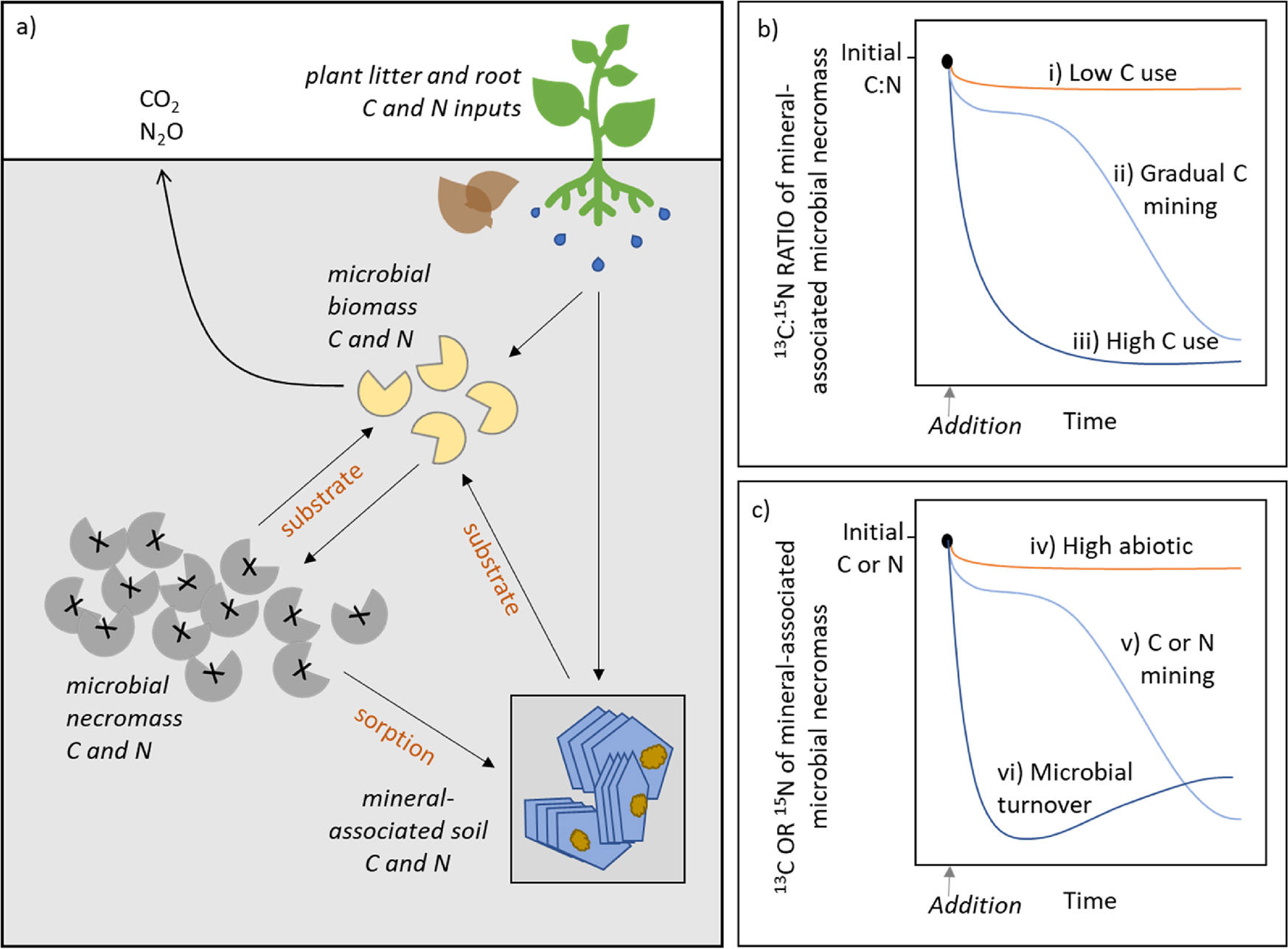
Start with why the dead cells are the interesting half. When microbes eat soil carbon they release enzymes to break it down, consume some of what they liberate, and respire some of it back into the atmosphere, building tissue along the way that becomes necromass when they die [5]. Debjani Sihi of NC State, the paper's corresponding author, says necromass carbon holds up over the long term because it forms strong chemical bonds with soil minerals more readily, which is what turns a flux into a reservoir [6]. So of the two mass measurements, necromass sits closest to the pool that soil carbon programs are actually trying to count.
The design puts the treatments on a non-blank baseline. Tillage levels and cover crop mixes were layered onto loblolly pine and pecan agroforestry systems already standing on the NC A&T research farm [7]. Read the results in that light, because the sharpest reported contrast is between the trees rather than between the tillage regimes: pecan plots showed higher total biomass and moved microbial respiration differently, which the authors attribute to broadleaf foliage being easier for microbes to degrade than pine needles [8]. Enzyme activity likewise responded to both tree species and cover crop treatment [9].
Between minimum tillage and no tillage, the study found no significant carbon differences [10]. That finding falls short of equivalence, and the public account of the work carries no plot counts or effect sizes that would let a reader tell which of the two is on offer [14]. Sihi's reading is operational: keep minimum tillage, since it reduces weed pressure without holding back carbon buildup [10]. For those plots that is a reasonable agronomic call, and it is a narrower claim than the two practices being interchangeable.
The timing advantage is real and worth stating plainly. Biomass and necromass can be measured years before conventional soil carbon measurement becomes detectable [4], which is the difference between learning something in a few seasons and learning it in a decade. But the property that makes these markers fast also makes them ambiguous about direction: the same parameters mark carbon formation and carbon loss [4], and the enzyme step is precisely the one that precedes respiration back to the atmosphere [5]. Enzyme activity measures a rate; a stock change is a balance [15].
A verification claim needs mass per hectare with an uncertainty band, and that figure is what these proxies stop short of supplying [1]. What the team has demonstrated is a set of proxies, not a regression linking a necromass reading on these plots to a stock change later confirmed on the same ground. Until that curve exists, biological indicators are a management instrument: good for asking whether a practice is doing anything, short of the evidence needed to settle a payment. The paper, "Soil Carbon Cycle Proxies in a Regenerative Land Management System," ran in the Journal of Natural Resources and Agricultural Ecosystems, co-first-authored by Murray Sternberg of Emory and Biswanath Dari of NC A&T [11][13].
Ranked by verification strength, evidence, and original report placement.
Researchers demonstrated a series of biological tests that could serve as proxies for measuring how different regenerative agriculture practices could improve soil carbon, years before it would be possible to measure the carbon directly.
The study comes from North Carolina State University in collaboration with North Carolina A&T State University and Emory University.
The researchers layered multiple regenerative practices on top of one another and measured biological parameters including enzyme activity, microbial biomass (living microbes) and microbial necromass (dead microbes), all of which serve as proxies for the amount of carbon stored in soil.
Biomass and necromass serve as early markers of soil carbon formation and loss and can be measured years before traditional soil carbon measurements become detectable.
Debjani Sihi, corresponding author and an assistant professor of plant and microbial biology and crop and soil sciences at NC State, said microbes release enzymes to break down carbon, consume some of it, respire some of it back into the atmosphere, and build biomass and necromass when they die.
Sihi said microbial necromass stores soil carbon effectively over the long term because necromass carbon can more easily create strong chemical bonds with minerals in the soil, creating a carbon reservoir.
Distinct publishers with included, body-backed reporting in this cluster.
phys.org
1 article · September 3, 2026
Follow any of these and your For You feed starts watching them — no settings page required.
science
Ten daily doses of venetoclax at ART start shrank the intact SIV reservoir in macaques1 distinct publisher
science
A 54-person vitamin D association is not a dementia dosing plan2 distinct publishers
science
Intimate partner violence recurs across all three homicide types in 115,873 NVDRS deaths1 distinct publisher
invest
Taxpayers Just Joined the College Sports Payroll Race, and No One Capped Their Share1 distinct publisher
Evidence-backed comparisons of source perspectives and observed adoption signals. Read the methodology
Which Builder, Operator, and Investor concerns the observed source mix emphasized—not a truth score.
Evidence, demonstrated adoption, hype gap, incentives, and confidence are assessed independently, each on its own current evidence. How these are measured.
One institutional account, no numbers in it
A named paper with a DOI sits behind this, which is more than many soil-health stories offer, and the mechanism Sihi describes is textbook soil biology rather than a novel assertion. But every finding reaches us through phys.org's rendering of the university's own announcement, and that rendering reports results only in words: higher biomass, responded to treatment, no significant difference. Nobody outside the author group has examined the effect sizes, and we cannot examine them either.
A research farm is not a field
We can see a paper appear and a trial run on NC A&T's own farm. We cannot see a grower, an agronomy service, a registry or a credit buyer making a decision from an enzyme or necromass reading, and turning a publication date into evidence of uptake would be inventing the part that matters.
The time saving is promised, not yet demonstrated in tonnes
Skip the decade-long wait for stock change and read the microbes instead — that is the promise carrying this story, and it runs ahead of what is shown. No necromass reading here is tied to a measured quantity of carbon, and since enzymes both build and burn carbon, more activity is not automatically more storage. The overstatement is real but contained: the piece keeps the unflattering tillage null, which promotional framing usually drops.
Short chain: authors' announcement to aggregator
Both ends of the pipeline have a reason to like this result. Universities publicise their own grant-supported work in the language of breakthrough, and phys.org republishes such announcements at volume with little friction added. What is absent matters here: no sponsor, carbon-market client or funding source is disclosed in the account, so this reads as ordinary institutional promotion rather than anything with a commercial edge.
Consistent story, single voice
Nothing here looks doubtful on its face — the mechanism is standard, the reported results are modest, and the internal logic holds. The ceiling is arithmetic: one publisher, one originating account, no independent replication or outside reading of the data. That is enough to report the finding and not enough to lean on any specific magnitude.