Science1 distinct publisher3 min readPublished
Emory researchers report in Nature Microbiology that ten days of an approved blood-cancer drug, given as antiretroviral therapy began, left the intact SIV reservoir smaller nine months later. No animal was taken off ART to test rebound.
The Scientist · Science desk

Compiled by The ScientistSomething wrong?How this is made
The mechanism here is borrowed from oncology with little modification. Cells that overexpress BCL-2 survive signals that should kill them, which is why the protein is a cancer target, and the same advantage appears to keep SIV-infected CD4+ T cells alive inside the reservoir that can restart replication whenever therapy is interrupted [13]. Venetoclax removes some of that protection [2]. Giving it at the moment suppression begins tests whether you can change what survives the transition onto therapy, rather than trying to purge a reservoir that has already settled [1].
The interval is what makes the finding worth reading. Therapy started on day 14 and the treated arm got ten daily doses [3], so dosing ended around day 24, which puts the day-294 measurement roughly 270 days, about nine months, after the last dose [17]. A drug with no pharmacological presence left cannot be holding an assay down; the difference between arms has to sit in the cell population itself. First author Tomas Raul Wiche Salinas said the level of infected cells stayed lower for months after dosing stopped while animals remained on therapy [12]. The effect was not confined to blood: lymph node reservoir levels were lower as well [7], and once the team combined infected-cell frequency with total CD4+ T-cell counts, the absolute number of circulating infected cells was lower too [8], which rules out the dull explanation that the frequency fell only because the denominator of CD4 cells grew.
Now the boundaries. Twenty-four animals across three arms [3] leaves eight per arm on an even split, and the write-up does not report the actual allocation [16]. It gives direction and duration without a magnitude, so there is no fold-change or log reduction to argue about [19], and it says nothing about what the arm receiving CD8-alpha depletion showed [20]. Cells that came through the ten days were partly resistant to apoptosis in ex vivo testing, carrying more BCL-2 and BCL-xL and less PUMA [9], which is the compensatory-pathway result you would expect if a single-target drug had cleared the easiest cells and left the rest better armed.
The thing this does not tell you is whether a smaller intact reservoir buys any clinical time, because the study included no analytical treatment interruption and therefore never observed rebound [10]. Senior author Mirko Paiardini frames the work as a way to accelerate the cure timeline by using an approved medication [11]. That is a fair reading of the development path, in the model that is the standard nonhuman-primate proxy for HIV persistence [14]: a licensed molecule means the argument in humans would be about dose, duration and combination rather than about whether the compound can be given to people at all. The authors themselves point to longer dosing and to working out how infected cells survive BCL-2 blockade as the next questions [15]. On the evidence supplied, one claim is earned and it is narrow: reservoir size at establishment moved, durably, in response to a short course of an existing drug [6]. Everything a clinician would want to know about it comes after that.
Ranked by verification strength, evidence, and original report placement.
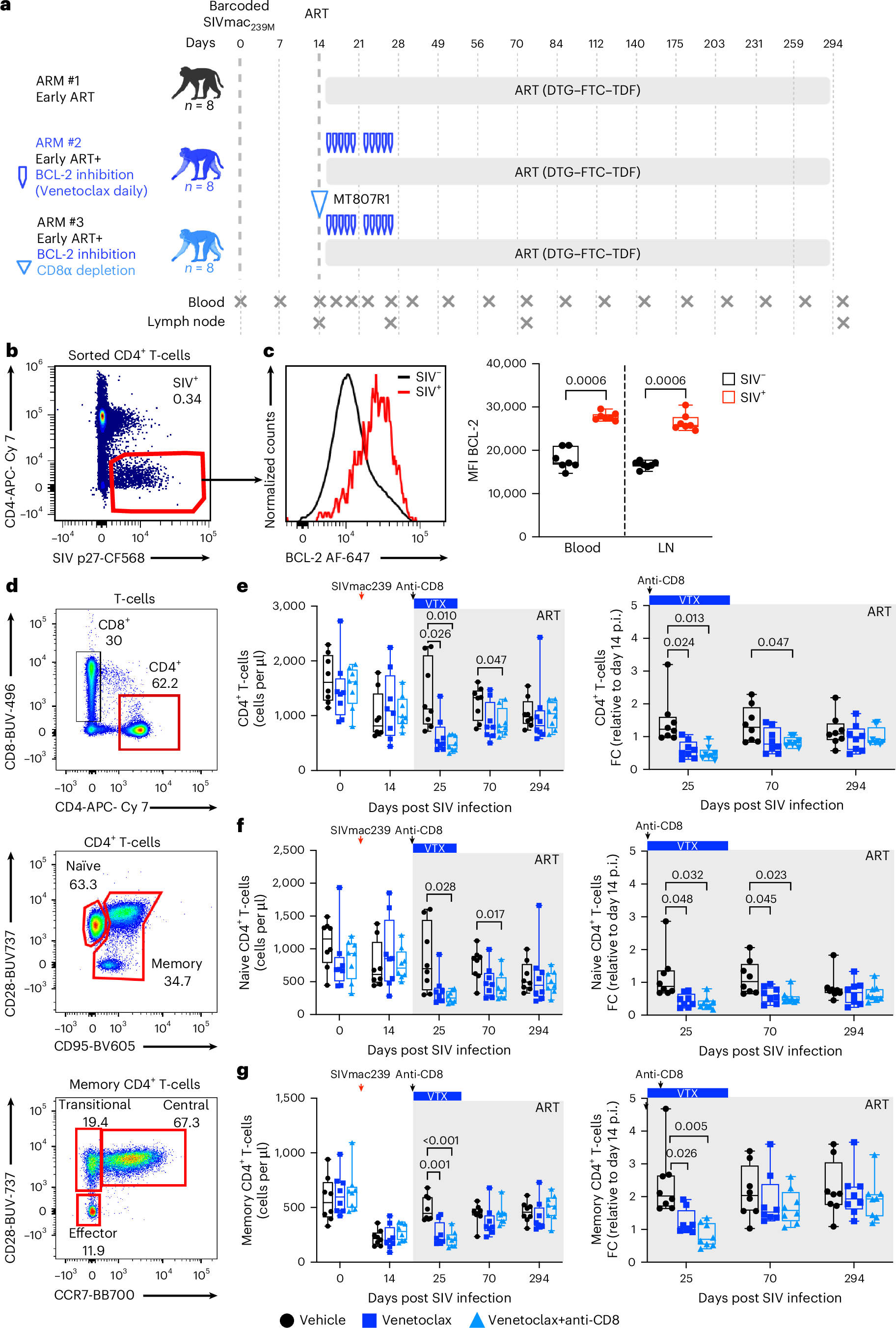
The investigators infected 24 rhesus macaques with SIV and initiated ART 14 days later. Animals were assigned to receive ART alone, ART plus 10 daily doses of venetoclax, or ART plus venetoclax and CD8-alpha depletion. Animals were followed for nearly 10 months after infection.
Venetoclax-treated macaques showed a rapid reduction in intact SIV DNA in CD4+ T cells in blood compared with ART-only controls, and the reduction was sustained through day 294 post-infection.
First author Tomas Raul Wiche Salinas said the combination reduced the number of SIV-infected CD4+ T cells more rapidly than ART alone, and that the level of infected cells remained lower in venetoclax-treated animals for months after dosing stopped while ART continued.
A study titled "BCL-2 inhibition at antiretroviral therapy initiation reduces the intact SIV reservoir in macaques", published in Nature Microbiology by researchers at Emory University, reported that a short course of venetoclax reduced the intact SIV reservoir in rhesus macaques when given at the start of antiretroviral therapy (ART).
Venetoclax is a BCL-2 inhibitor approved for certain blood cancers, designed to push malignant cells toward death.
The researchers also observed reduced reservoir levels in lymph nodes, an important tissue site for viral persistence.
Distinct publishers with included, body-backed reporting in this cluster.
1 article · September 3, 2026
Follow any of these and your For You feed starts watching them — no settings page required.
product
Half of severe alopecia patients on upadacitinib hit 80% scalp coverage by week 241 distinct publisher
science
Dead microbes register soil carbon change years before the stock is measurable1 distinct publisher
science
A rare neuron-like cell may spare dogs a jaw resection1 distinct publisher
science
Hollings researchers turn chemoresistance into a target by blocking LOX first1 distinct publisher
Evidence-backed comparisons of source perspectives and observed adoption signals. Read the methodology
Which Builder, Operator, and Investor concerns the observed source mix emphasized—not a truth score.
Evidence, demonstrated adoption, hype gap, incentives, and confidence are assessed independently, each on its own current evidence. How these are measured.
One outlet relaying one paper
Every fact in this story — the animal count, the day-294 reading, the lymph-node result, the apoptosis-resistance signature — comes through a single trade write-up of a Nature Microbiology paper, with the only human voices being the paper's senior and first authors. The underlying work is peer-reviewed and the write-up flags its own limits, which is worth real credit. Against that: no group sizes, no effect size, a described third arm with no result attached, and a conclusion sentence that misnames the target as BCL-3, which suggests the copy was not closely checked against the paper.
Twenty-four macaques, no people
Uptake amounts to a single animal experiment and its publication. Venetoclax is in clinical use, but for blood cancers; nothing in this reporting describes an HIV trial, a sponsor, a registered protocol, or even a plan beyond the authors' stated wish for longer dosing. The most decision-relevant test — stopping ART to watch for rebound — was not attempted.
Cautious copy, hopeful quote
The headline hedges with "may inform" and the limitations are in the text, not buried. The stretch is in the quotation: "accelerating the timeline to cure by using an approved medication" is the line that will travel, and it is doing work that 24 macaques with no treatment interruption cannot support. With no magnitude published, a reader cannot tell whether the sustained difference is dramatic or marginal — and absent numbers reliably get read generously.
Only the authors speak
The two quotes, the framing and the forward agenda all belong to the team whose next grant depends on this line of work, delivered through the kind of institutional announcement that trade outlets run close to source. No independent reservoir researcher appears. Note also what the piece does not say: it discloses no funder and never names who makes venetoclax, so a reader cannot judge commercial interest either way.
Direction firm, magnitude blank
That the treated animals held a lower intact reservoir out to day 294 is about as solid as one paper relayed by one outlet gets — it is peer-reviewed, it is specific about timing, and the escape mechanism is reported rather than smoothed over. How much lower, in how many animals per arm, and whether it survives contact with a treatment interruption are all open, so confidence sits at the level of a credible early signal.