Science1 distinct publisher3 min readPublished
Eric Harshbarger and a loose network of collaborators spent 15 years on a set that stays fair whether two people roll or five, and the wall they kept hitting was manufacturability rather than proof.
The Scientist · Science desk

Compiled by The ScientistSomething wrong?How this is made
Ties are the easy half. Give 300 faces 300 different numbers and no two players can roll the same value [7]. The hard half is that the odds have to hold for whichever dice come out of the bag, not only for the full set [7][8], and with five dice that is 26 separate groups to satisfy at once: ten pairs, ten triples, five foursomes, and the whole set [2]. A numbering that balances a five-way roll can be quietly lopsided in one of those ten pairs, and one lopsided pair sinks the set.
The engraving is a clean partition. Five dice with 60 faces each is 300 faces, one for each integer from 1 to 300, nothing left over and nothing used twice [1].
What the group noticed along the way interests me more than the object does. The arrangements do not merely pick a leader; they make every finishing order equally likely, a property the team calls permutation fairness [13]. Harshbarger's own verdict is that "go first dice" is a misnomer [14]. Held to that standard, which the team adopted for every set afterward [15], a five-player roll spreads probability 1 in 120 across all 5! = 120 orders [3].
Ford did the four-player set with pencil and paper [10]. Five was a different kind of object. Harshbarger told Live Science the arrangements number something like 10^128, more than the atoms in the universe by his description, and that no amount of computing time would reach it [17]. The route was therefore symmetry and pattern to shrink the search [18], and even then the surviving candidates failed on physical grounds rather than mathematical ones [18], which is why the target was stated as a five-player set that could actually be made [19].
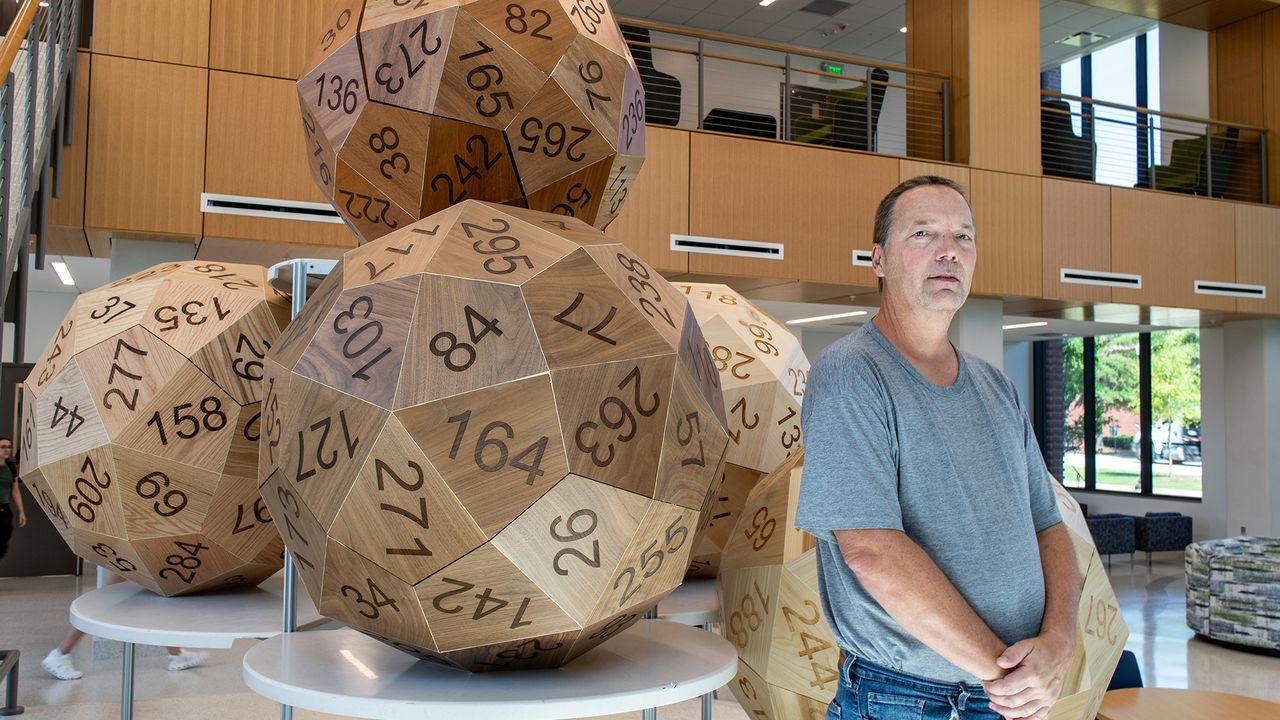
What this leaves open is whether the hexecontahedron in your hand is fair. The guarantee is about labels, and it assumes each of the 60 faces comes up one time in 60. The reported account describes no rolling test, and the five objects Harshbarger built to mark the result are wooden display pieces, each from a different wood, now in Auburn's new mathematics building [6]. The earlier commercial sets were 12-sided blanks he laser-etched and inked at home, shipped 30 envelopes at a time [12], so balance is a workshop question, separate from the combinatorics.
The scope is bounded too. The request as first posed reached toward any number of players, eight included [1][8]; what exists is a set of five dice, which covers tables of two through five [5][2]. What was delivered here is a five-player set, and on the evidence of how that one came together, a six-player set of the same shape would need another symmetry breakthrough, since compute alone did not get five there.
Ranked by verification strength, evidence, and original report placement.
The answer they arrived at is a set of five 60-sided dice, collectively engraved with every number between 1 and 300, with no repeats.
The team knew mathematically that a five-player same-shape set was feasible, but finding it meant searching an extremely large space of possible number arrangements.
Harshbarger said the five-player search space is more than the number of atoms in the universe, on the order of 10 to the 128th power combinations, and that even with a billion billion years and all the computers and AI they could not do it today.
Because brute force was impossible, the team needed mathematical shortcuts, symmetries and patterns, to shrink the search space; even then years passed without a practical solution, and every path they found hit the same wall of dice too large to hold or with too many sides to manufacture.
Harshbarger's stated goal was a set for five players that could actually be manufactured.
Around 2010, over dinner at a gaming convention, board game designer James Ernest asked his friend Eric Harshbarger whether a set of dice could be designed so that each player in a group, whether two people or any number, could grab one, roll, and have a perfectly equal shot at going first.
Distinct publishers with included, body-backed reporting in this cluster.
1 article · September 5, 2026
Follow any of these and your For You feed starts watching them — no settings page required.
invest
CNN's editorial-board trial balloon is settlement currency, not governance1 distinct publisher
product
AEMO now plans for data centres at 13% of the grid, which changes where they can go1 distinct publisher
leadership
Small firms let big companies' AI mistakes pay for their shortlist of what works1 distinct publisher
build
Three services you can delete: queue, cache and search in one Postgres1 distinct publisher
Evidence-backed comparisons of source perspectives and observed adoption signals. Read the methodology
Which Builder, Operator, and Investor concerns the observed source mix emphasized—not a truth score.
Evidence, demonstrated adoption, hype gap, incentives, and confidence are assessed independently, each on its own current evidence. How these are measured.
One interview, no numbers on the faces
Harshbarger is the only voice in this account, and a sceptic would most want the actual numbering of the five dice and an outside check of the work, and the story supplies neither. The reporting is careful about what he said and vague about what was proved. What holds up without him is thin but real — two retailers stocking the four-player set and five wooden shapes bolted into an Auburn building.
Two hobby shops and a lobby installation
The earlier four-player set has a genuine distribution trail, from a one-man laser-etching operation to shelves at Maths Gear and Math Art Fun. The set this story is about has none of that. It exists as a configuration, a claim that 60 faces can be manufactured, and five pieces of furniture in a mathematics building — a maker, a price, and anyone actually rolling them at a table are all absent.
The headline outruns its own source
The phrase 'fairest in the world' belongs to the publication; Harshbarger's own language is different. He calls the problem silly and pointless for actual gameplay and frames the achievement as making something you can hold. Set against that, a superlative headline and an atoms-in-the-universe comparison push a tidy combinatorial result further than the evidence on offer, which is one collaborator's unpublished program and one co-author's double-check.
The narrator used to sell the earlier set
Harshbarger has a commercial history in exactly this product line: he sold four-player sets from his workshop until Maths Gear and Math Art Fun took them over, and his stated goal was a five-player set gamers could buy. He is also the sculptor of the pieces now in Auburn's mathematics building. None of that makes the result wrong, and the story reports no payment or stake in the new dice, but the only person vouching for the maths is the person whose craft business and campus artwork the result validates.
Solid on the story, thin on the maths
Names, affiliations, dates, retailers and an installation are the kind of detail a single interview carries safely, and we would be surprised to see them corrected. The mathematical core sits differently: 10^128, "satisfied every condition", and the reliability of Meyer's program all reach us second-hand from within the group, so our reading of the result is only as good as his account of it.