Science1 distinct publisher3 min readPublished
Direct RNA sequencing turned up a library of hybrid transcripts in mammalian cells, almost 400 of them responsive to inflammatory signals. The one-gene-one-protein reference list has no slot for any of them.
The Scientist · Science desk

Compiled by The ScientistSomething wrong?How this is made
"Observed at least once" is the load-bearing phrase in that library. More than 30,000 chimeric mRNAs [5] against roughly 20,000 protein-coding genes [1] makes a list about one and a half times as long as the canonical one [18], and that arithmetic says nothing about abundance. A transcript seen once in one cell type could be a rare regulated event or a rare mistake, and the team's own account notes that older sequencing methods struggled to find these and sometimes generated them artificially [9]. Almost 400 entries have been profiled for regulation by inflammatory signals [6], roughly 1.3 percent of the catalogue [19]. The rest are sightings.
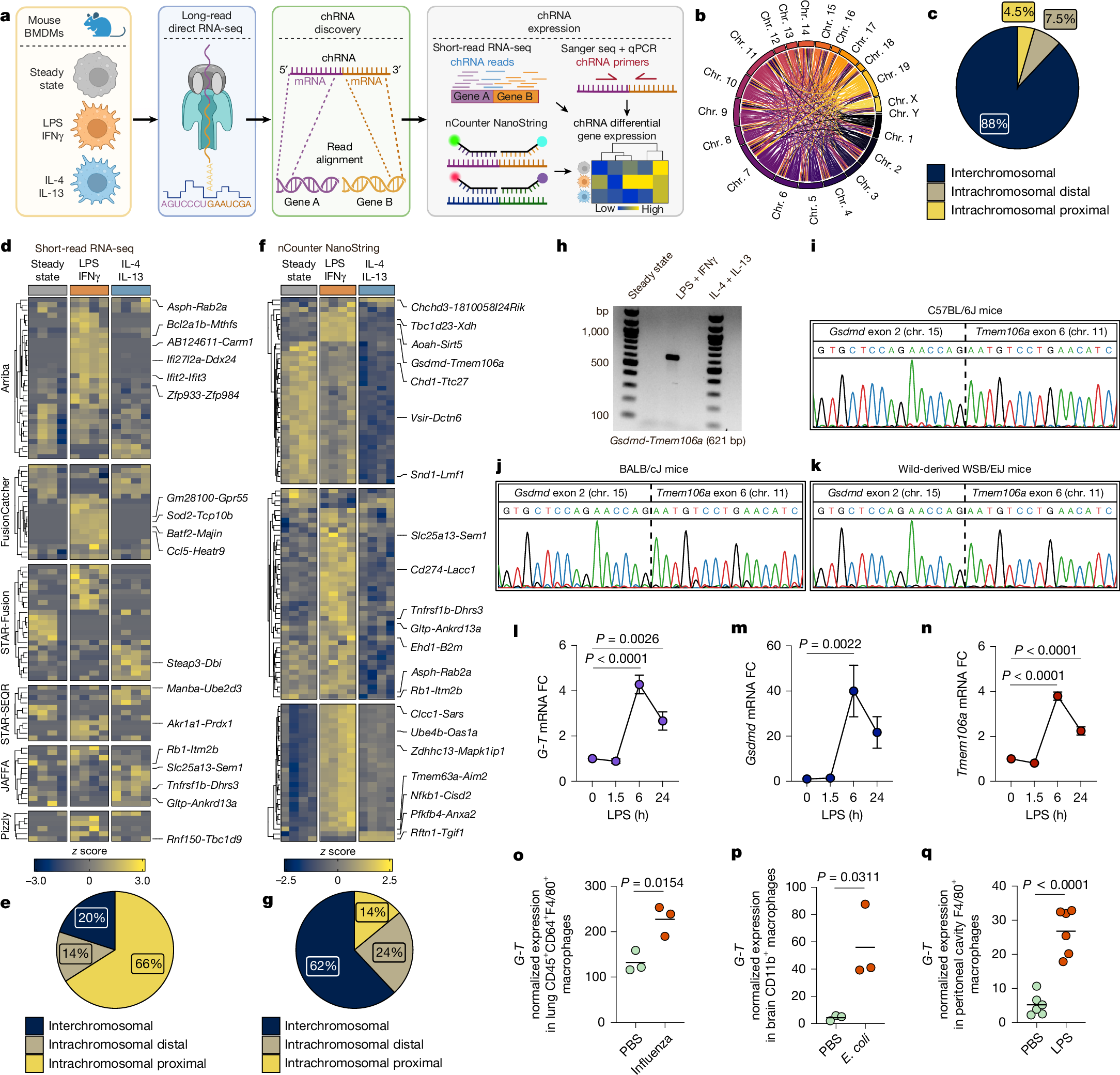
What lifts this above a sightings list is a single mouse experiment whose design is the reason to take it seriously. The team picked a chimera of GSDMD and TMEM106A; GSDMD on its own is the protein that opens cell membranes during pyroptosis [11]. Delete the GSDMD gene and you lose the canonical protein and any hybrid built from it at the same time, so the team instead built a genetic tool that stops production of the chimera while leaving both standard proteins intact [13]. That is the control that separates "the hybrid does something" from "the famous parent does something," and nothing cheaper substitutes for it. They also confirmed the chimeric protein arises naturally in cells from two laboratory mouse strains and a wild-derived strain [12], which is a reasonable check against an inbred-line quirk. The account I am working from breaks off mid-sentence at what mice lacking the protein actually showed [22], so I cannot report the phenotype.
The route matters as much as the result. In mouse cells, healthy chromosomes loop together during the immune response, bringing normally distant genes into proximity, and the newly adjacent pair is transcribed into one mRNA that takes part of its sequence from each gene [7]. The best-known human chimeras before this came from cancer, where DNA breaks and scattered fragments fuse [8]. Here the DNA stays whole and the combining happens at transcription, on an inflammatory cue. Trypanosomes and nematodes do something adjacent for regulatory purposes, but those systems have not been seen to make proteins and had not been found in mammals [10].
The detection problem follows from the architecture rather than from any measurement. If a hybrid protein's distinguishing stretch spans the junction of two genes [7], it has no entry in a protein database assembled one gene at a time [1]. That is an inference, and a testable one: junction-spanning peptides in human tissue would settle it.
Ruaidhri Jackson, the senior author, says the field thought it had a blueprint of every mRNA made in the body and that the blueprint was page one [15]. Read narrowly, that is what the evidence supports. The functional demonstration is in mice [12]; the human-side evidence is chimeric mRNAs conserved in human immune cells [6], which is RNA in cells, not protein in people. For a target-discovery pipeline the useful question is not how many rows the proteome gains but whether any junction-spanning protein is abundant enough and stable enough to be worth binding. Nobody has measured that yet.
Ranked by verification strength, evidence, and original report placement.
Each of the roughly 20,000 genes in the human body has for decades been understood to carry instructions for a single kind of protein.
Researchers at Harvard Medical School found that instructions from different genes, including genes on different chromosomes, can combine to create chimeric mRNAs that produce previously unknown, functional proteins.
The findings were published in Nature and describe potentially thousands of new chimeric proteins, with at least some playing important roles throughout the body.
Senior author Ruaidhri Jackson, assistant professor of immunology in the Blavatnik Institute at HMS, said: "Nobody knows these exist. Medicine doesn't know they exist, the pharmaceutical industry doesn't know they exist."
Using a new technology called direct RNA sequencing, the researchers compiled a list of more than 30,000 chimeric mRNAs observed at least once in mammalian cells, which Jackson calls the "dark genome" library.
The team has so far profiled how almost 400 of the chimeric mRNAs are regulated by inflammatory signals, including chimeric mRNAs conserved in both human and mouse immune cells.
Distinct publishers with included, body-backed reporting in this cluster.
phys.org
1 article · September 2, 2026
Follow any of these and your For You feed starts watching them — no settings page required.
science
Church's lab frees 14 codons by rewriting the ribosome's lock instead of the genome2 distinct publishers
science
A pole-on magnetar hands vacuum birefringence its first astrophysical candidate1 distinct publisher
science
A phage kinase with no target list: EMBL finds one enzyme that breaks several bacterial defences1 distinct publisher
science
HIPAA Covers Less Than You Think, And "Anonymized" Is Not A Legal Shield1 distinct publisher
Evidence-backed comparisons of source perspectives and observed adoption signals. Read the methodology
Which Builder, Operator, and Investor concerns the observed source mix emphasized—not a truth score.
Evidence, demonstrated adoption, hype gap, incentives, and confidence are assessed independently, each on its own current evidence. How these are measured.
Deep experiments, single narrator
The experimental spine is unusually strong for a discovery announcement: the chimera is shown in two lab mouse strains and a wild-derived one, silenced without touching either parent gene, then pushed the other way with an engineered mRNA, with a survival readout at each end. What holds the score down is that all of it arrives through one telling of one paper, no second scientist is asked, and the copy in front of us breaks off mid-quote.
One lab, one partner, one percent characterised
Uptake at this point is a paper and a favour. Moderna built the mRNA used inside the same experiments, which is a disclosed use and not a programme; nobody outside Harvard is shown touching the catalogue. Roughly 400 of more than 30,000 transcripts have been profiled at all, and exactly one has been shown to do a job.
Catalogue talk, one validated entry
"Nobody knows these exist" and "an entirely new gene regulation system" are doing work that 400 profiled transcripts and a single functional mouse chimera cannot yet pay for, and the leap from a hit list to a drug-target avenue is made in the same breath as the admission that nobody knows how widespread this is. The gap is moderate rather than severe because the researchers hedge themselves — existence is not function, the project was high-risk — and because the one case they did test came with real numbers attached.
The discoverers wrote the copy
This is an institutional announcement about its own lab's paper, reproduced without an outside check, and it names both the prize and the partner: a new avenue for drug targets, and Moderna. The senior author's claim that the pharmaceutical industry does not know these molecules exist is the kind of line that recruits attention and funding. None of that makes the mouse data wrong; it does mean every emphasis here was chosen by a party with something to gain from it.
Traceable to Nature, verified by nobody here
Our footing is a peer-reviewed paper described secondhand, once. That is better than a preprint press push and much worse than corroborated reporting: the specific figures are checkable in principle, none of them are checked in this coverage, no independent expert weighs in, and the text we hold is truncated. Confidence should rise or fall quickly as other outlets and other labs touch the catalogue.