Product1 publisher2 min readPublished
Maingear's $6,500 Zero undercuts a reviewer's own $7,700 parts estimate
Gizmodo calls the top-spec Zero's price insane and, in the same review, puts the cost of buying the identical parts alone at close to $7,700. The graphics card explains most of both numbers.
The Product Desk · Product desk
What happened
- Maingear's 2026 Zero tops out at $6,500 in the Zero Champion configuration, built around an AMD Ryzen 7 9850X3D and an Nvidia GeForce RTX 5090.
- The review's cons are limited top I/O, an occasional coil whine, a micro-ATX motherboard with limited slots, and the price at peak specs.
- The case keeps its screws attached to the glass and side panel, seats the side panel on pressure-fit sockets, and puts two tabs under the top panel for lifting the glass out.
Compiled by The Product DeskSomething wrong?How this is made
Why it matters
- contradiction A shopper who reads the verdict and a shopper who reads the price check walk away with opposite conclusions: one sees a premium above other pre-builts, the other sees a machine $1,200 cheaper than the parts.
- cost With at least 78% of the top configuration's price sitting in a graphics card Maingear resells, most of what the buyer is paying is a GPU market price, and Maingear's own margin is the smaller half of the bill.
- constraint Easy access and room to grow are two different things here. Any later upgrade that needs a spare slot or another top-panel port hits the micro-ATX board, so what the owner gets is swap capacity.
- decision Graphics brand is settled before the buyer picks a CPU. With Nvidia the only option offered, anyone who wants a Radeon card is shopping somewhere else or building it themselves.
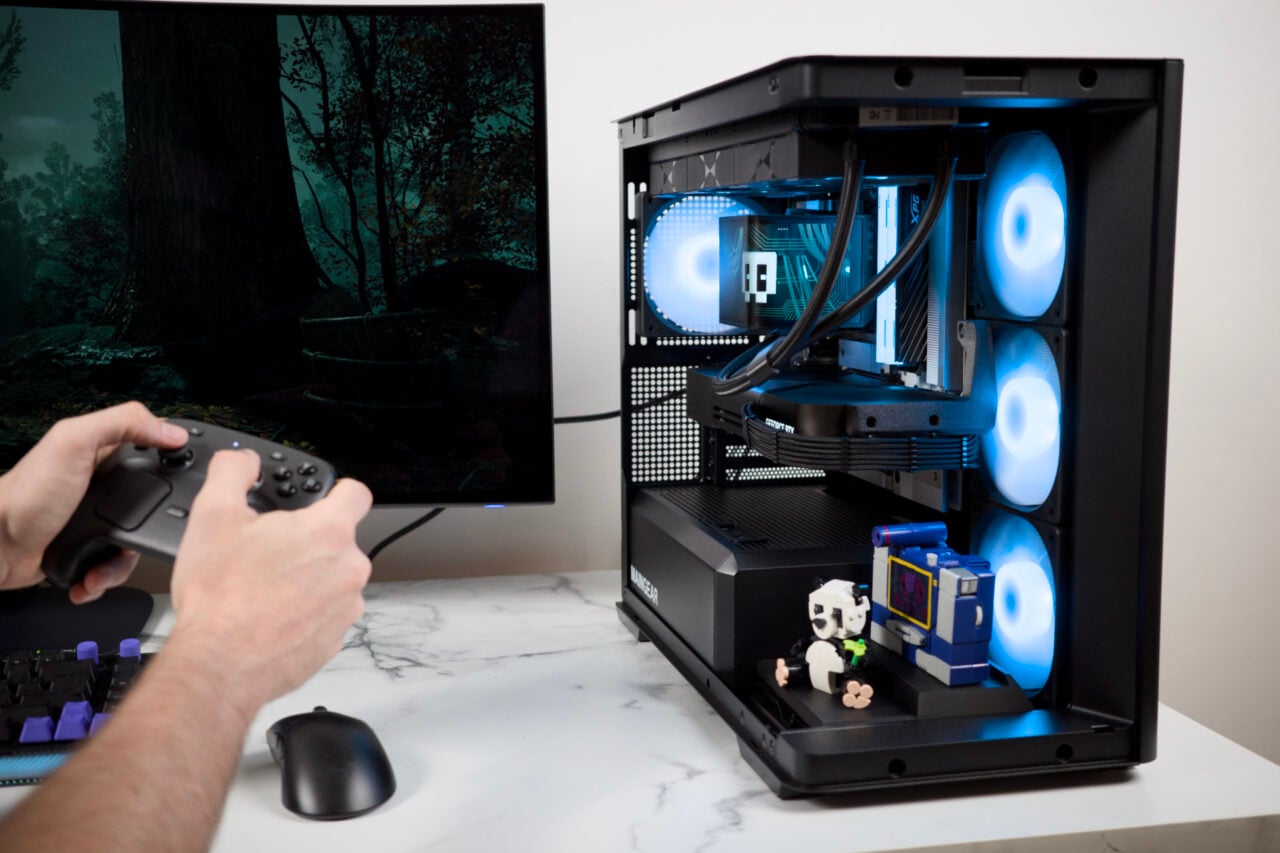
Lift the top panel with the two tabs Maingear put under it, get the glass off without smudging it, and the board underneath is micro-ATX [9][7]. The review's pros list the easy-open case, the cable routing, the quiet running [8]. The cons list "mATX motherboard has limited slots" and limited top I/O [7].
On price, the same review argues both sides. It calls the $6,500 Champion configuration "still an insane asking price" and says "Zero costs a premium that rises above other pre-built PCs" [13][12]. It also says that sourcing the review unit's components separately, at the lowest prices the reviewer could find, would come to close to $7,700 [5]. Subtract: $7,700 minus $6,500 leaves $1,200 in the pre-built's favor [14].
Both lines can be true because they use different baselines. Gizmodo's reviewer found the RTX 5090 selling for more than $5,090 at some online retailers [6]. Against a $6,500 machine, $5,090 is at least 78% of the price [15]. The premium in that sentence is measured against other pre-builts; the $7,700 is measured against retail parts. Nvidia is the only GPU brand in the lineup, so a buyer who dislikes that number cannot route around it inside the configurator [4].
Lower down the range the mix changes. The Emerald starts at $2,800 with an RTX 5070 and Intel's Core Ultra 5 250K Plus, and a Ryzen 7 7800X3D version is $3,000, $200 above the entry price [2][3][17]. The spread from the entry configuration to the Champion is $3,700 [16].
This purchase turns on how often you open the machine, and on whether your next upgrade replaces a part or adds one. Replacing a GPU, a cooler or a drive is where captive screws and pressure-fit panels save time; the review's account of the revised MG-1, whose side panel "wouldn't seat correctly no matter how many times you'd try it," shows the alternative [9][10]. Adding a card or a drive beyond what the board carries runs into the mATX layout and the thin top I/O [7].
I would pay for this case at the $2,800 end, where access is a larger share of what the money buys and slot count matters less next to a mid-range card. At $6,500 the buyer is mostly paying a market price for an RTX 5090 and taking a board that caps what comes next. Gizmodo's reviewer called the Zero his favorite pre-config Maingear has put out in two years, and put the slot count in the cons list of the same review [18][7].
What to watch
- Whether Maingear offers an ATX board option in the Zero line, which would remove the slot-count objection without changing the case.