Product1 distinct publisher3 min readPublished
Apple held the Mac Studio's Max tier at $2,499 while pushing the Ultra to $5,499, where the entry machine carries just 96GB of unified memory, so the premium only starts earning its keep at the 256GB rung and above.
The Product Desk · Product desk

product
Apple takes the CPU upgrade option off the Mac Studio order page1 distinct publisher
product
Apple's M5 Ultra stops being two Maxes glued together, and that changes how you size a Mac Studio1 distinct publisher
product
Apple's M6 is a 2nm inference upgrade with a CPU refresh attached1 distinct publisher
product
The Mac mini is sold by the gigabyte, which makes its refresh a DRAM story4 distinct publishers
Compiled by The Product DeskSomething wrong?How this is made
The decision actually gets made in the configurator, with a list of model weights open in another tab. You click up the memory on an M5 Max, watch the total climb faster than it used to because memory and storage upgrades cost more than usual this cycle [5], and start wondering whether the Ultra is the cleaner answer. Apple's memory ladder makes that comparison worse than it looks. The Ultra opens at 96GB [6], which is 32GB less than the most you can order in a Max [21], so the entry premium hands you cores and bandwidth while taking memory away.
Work backwards through the pricing history and the widening is easy to size. MacRumors puts the $5,499 start at $1,500 above the M3 Ultra's launch price and $200 above what the M3 Ultra cost after June's increase [3], which sets the launch price at $3,999 [16] and the post-June price at $5,299 [17]. June added $1,300 to the Ultra tier [18] while the Max tier sat still at $2,499 [2]. The spread between the cheapest and dearest Mac Studio has gone from $2,800 to $3,000 [19], and the Ultra now opens at roughly 2.2 times the price of the Max [20].
Teams tell themselves they are buying headroom for whatever the models look like in eighteen months, but what they actually run is a quantised checkpoint with a resident footprint someone can measure this afternoon. That measurement is the decision. MacRumors' read is that the Ultra only separates itself at 256GB and above, and that Apple restricts the 512GB option to the 80-core GPU model, so the configurations that vindicate the machine sit far above its starting price [9]. Its own guidance sends the overwhelming majority of buyers, most professionals included, to the Max [10], and reserves the Ultra for people who expect to hit a ceiling the Max cannot clear, with whole-model local inference as the obvious case [11].
The Ultra's case weakens further, too. Memory is fixed at purchase, which is why the guide argues for spending on unified memory rather than the higher chip tier [12], the opposite of the usual upgrade instinct. And Apple says four Mac Studio systems clustered over Thunderbolt 5 and RDMA deliver up to 3x faster AI inference than one machine [13], which separates throughput from capacity.
So the forcing question has two axes rather than one. First, does the working set have to be resident all at once, or can it be split across machines? Second, is it bigger than 128GB, the Max ceiling [7]? Resident and under 128GB is a Max with memory maxed, and the money left over goes to storage and displays [23]. Resident and over 128GB is an Ultra at 256GB, priced in the knowledge that the 512GB rung requires the 80-core GPU [9]. Splittable and over 128GB is a cluster [13]. Splittable and under 128GB was never an Ultra question at all.
None of that requires a view on where local models are heading; it comes down to one number, peak resident bytes under a real job, measured before anyone opens the configurator.
Ranked by verification strength, evidence, and original report placement.
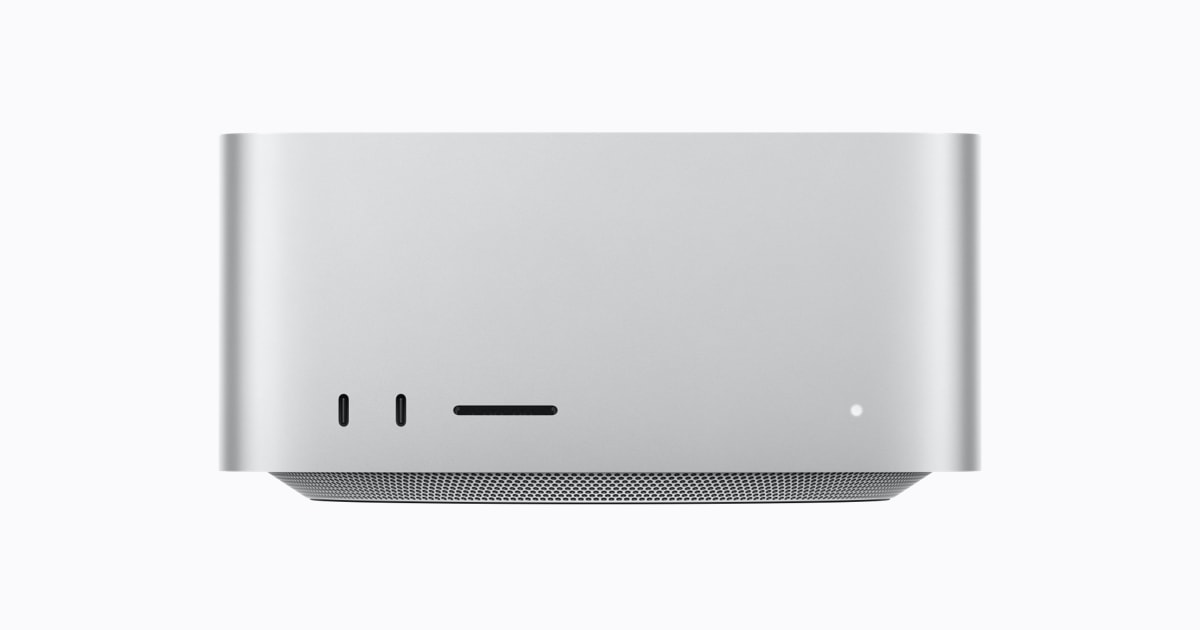
Apple last week announced two new Mac Studio models, one built around the M5 Max chip and one around the all-new M5 Ultra chip, replacing the M4 Max and M3 Ultra models that had been on sale since March 2025.
Mac Studio with M5 Max starts at $2,499, holding the price Apple set when it raised Mac prices in June.
Mac Studio with M5 Ultra starts at $5,499, a $200 increase on the post-June M3 Ultra price and $1,500 above what the M3 Ultra cost at launch.
The premium between the M5 Max and M5 Ultra Mac Studio is $3,000 before any configure-to-order options.
The M5 Ultra begins at 96GB of unified memory, which is less than the 128GB you can configure on the M5 Max.
The M5 Max offers an 18-core CPU, up to 40 GPU cores with Neural Accelerators, up to 128GB of unified memory and up to 614GB/s of bandwidth.
Distinct publishers with included, body-backed reporting in this cluster.
1 article · September 2, 2026
Follow any of these and your For You feed starts watching them — no settings page required.
Evidence-backed comparisons of source perspectives and observed adoption signals. Read the methodology
Which Builder, Operator, and Investor concerns the observed source mix emphasized—not a truth score.
Evidence, demonstrated adoption, hype gap, incentives, and confidence are assessed independently, each on its own current evidence. How these are measured.
Checkable prices, vendor-only speed
Split the story in two and it grades differently on each half. The prices and capacities — $2,499, $5,499, 96GB, 128GB, 614GB/s, 1.2TB/s — are the sort of thing anyone can verify at Apple's store today, and MacRumors' arithmetic on top of them holds. The performance half does not survive the same scrutiny: 3x Magic Mask, 1.4x Redshift, 50% graphics and 3x from four clustered machines are all Apple's published 'up to' numbers, relayed and labelled as such, with no hands-on test anywhere in this coverage.
Pre-orders, nothing shipped
Nothing has reached a desk yet. Pre-orders are open, hardware starts arriving September 22, and the 512GB Ultra that carries the entire local-inference argument does not exist for buyers until late October at a price MacRumors can only say will begin well above $10,000. The only real-world signals available are the price points themselves and the Mac mini positioned beneath the line.
Marketing multipliers, sober guide
Unusually, the writing pulls in the opposite direction to the product. MacRumors tells most readers to buy the cheaper machine, notes that the Ultra's entry configuration holds less memory than a maxed Max, and says the money is better spent on storage and displays if a workload fits in 128GB. What overstatement there is comes from the figures the guide passes through rather than from its framing: 'up to 3x', 'up to 50%' and a 3x clustering claim are doing persuasive work for a machine no independent party has run.
Seller's numbers, buyer's-guide beat
The company selling the hardware supplied every performance figure that makes the expensive model attractive, and the only outlet in this story is one whose beat is Apple purchase decisions — a format that exists because people are about to spend money. That is not a reason to discount the prices, which are trivially checkable, and the guide does recommend against the pricier machine. It is a reason to treat the Ultra's inference pitch as vendor positioning that has not yet been challenged by anyone with an opposing interest.
Firm on money, thin on performance
We would stand behind the pricing and configuration reporting with little hesitation — it is precise, internally consistent, and checkable within minutes. Confidence drops on two points: the memory-shortage explanation for upgrade pricing, which arrives as a bare assertion, and everything about how fast these machines actually are, which is one vendor's word relayed by one publisher.