Science1 publisher2 min readPublished
A year-long panel of 1,966 adults finds shifts in social tech use do not forecast life satisfaction
Georgetown, USC and Berkeley researchers surveyed the same Americans every three months, asked about ten platforms one at a time, and found no credible within-person link between use and satisfaction a quarter later.
The Scientist · Science desk
What happened
- Researchers at Georgetown, USC and UC Berkeley report in Nature Human Behaviour that changes in social technology use gave little evidence of predicting later life satisfaction among US adults.
- The panel followed 1,966 American adults across five survey rounds three months apart, drawn from USC's Understanding America Study, a probability-based nationally representative online sample.
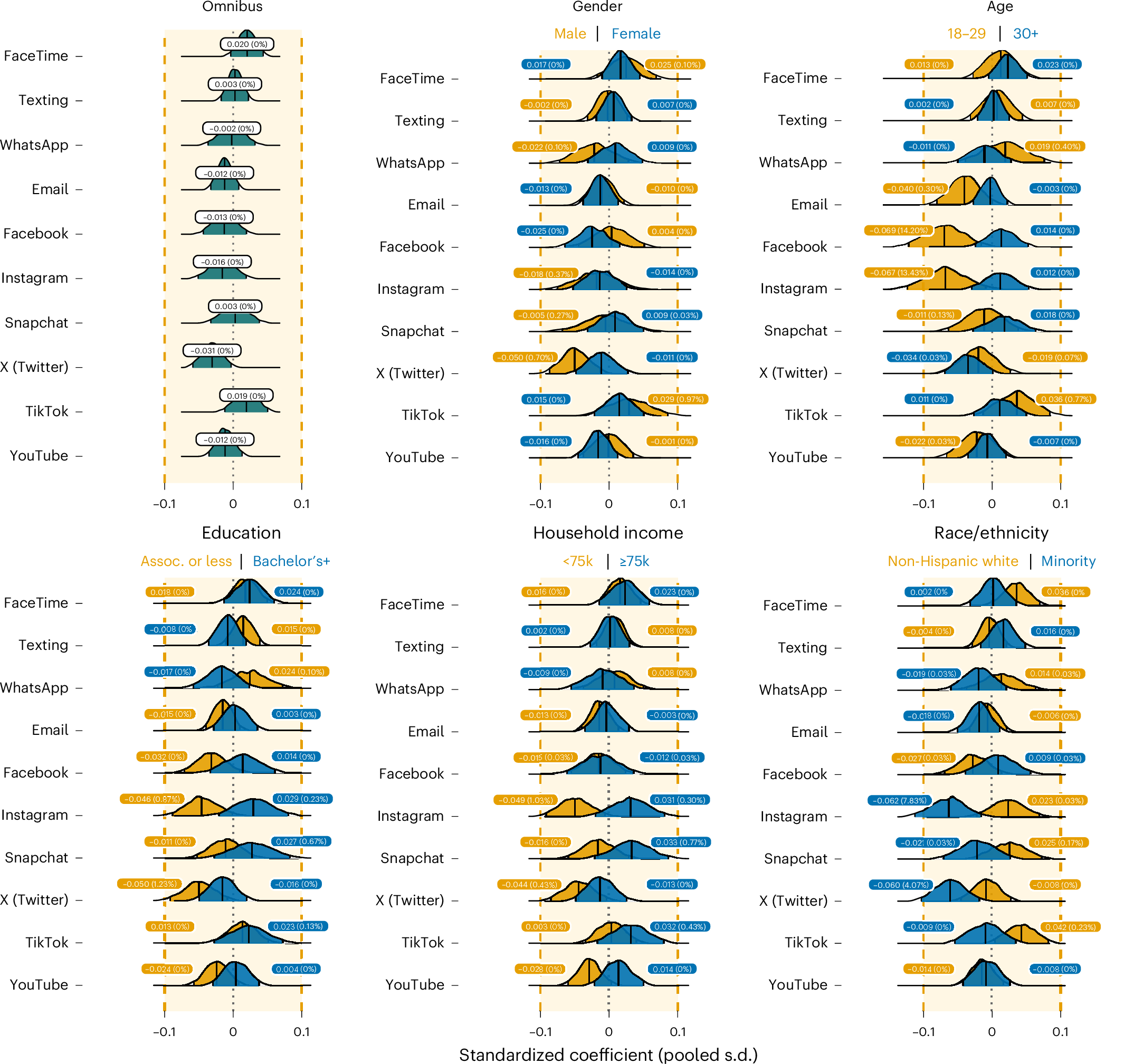
- Each round asked how often respondents used ten named technologies, among them email, Facebook, Instagram, TikTok and YouTube, and measured satisfaction with an established three-item scale.
- The null held when each platform was analysed on its own, Instagram and TikTok included, and within every demographic subgroup the team checked by gender, income and age.
Compiled by The ScientistSomething wrong?How this is made
Why it matters
- contradiction The study yields two estimates that point in opposite directions, so citing it is only meaningful if the citation says whether the number compares different people or the same person over time.
- constraint The input tested is how often adults say they use an app. A well-being argument about specific content, design patterns or session length is not the argument this panel weighed.
- precedent A Bayesian estimate that can report credible absence, rather than a failed significance test, raises what the next well-being paper built on a single survey wave has to answer for.
The design turns on two questions that survey work usually collapses into one. Whether people who use a platform more than others are less satisfied with their lives is a comparison between people [10]. Whether one person grows less satisfied after stepping up their use is a comparison within that person [10]. "The second question is the one that gets us closer to cause and effect," said Kostadin Kushlev, co-first author of the paper [11][16].
Five rounds three months apart put twelve months between a respondent's first survey and their last [1]. That leaves four consecutive three-month transitions per person [3], and up to 9,830 person-wave observations across the 1,966 respondents [2].
The statistics are Bayesian. A conventional null reports only that the data missed a threshold; Kushlev said their approach can go further. It lets them say whether the effect credibly exists, he said [12]. The phys.org write-up does not report effect sizes or the widths of those credible intervals [22]. Those bounds are what would tell you how small an effect this panel can exclude.
The between-person associations did not vanish. Kushlev said they did find that people who use TikTok or YouTube more report lower life satisfaction, but that associations of that kind could be due to third factors like age [13]. Those are the correlations most cross-sectional studies report, by his account [23].
What the panel measured is how often adults said they used each of ten technologies, and their life satisfaction on an established three-item scale [5][6]. Frequency is a coarse input, and a global satisfaction judgement three months later is a coarse output [7]. An adolescent sample, a daily diary, or a clinical symptom measure would be different studies, and this one does not stand in for them.
The team also checked whether answers differed by age, gender, race, education and income, and said it chose a method that separates a real effect from the trivial noise that reaches significance in any large sample [17][18]. The subgroup breakdowns came back the same as the whole [9].
Kushlev put the state of the literature this way: "Different researchers have looked at the same data and come to opposite conclusions" [14]. On the framing of the question itself, he said: "Asking whether social media is good for well-being is a bit like asking whether eating is good for your heart. Different foods do very different things, and the effects also depend on the person and other factors" [15].
What to watch
- Effect sizes and credible-interval bounds in the published paper: they set the smallest effect this panel could have excluded.
- A replication using logged device data in place of self-reported frequency of use.
- An equivalent five-wave panel in adolescents, a group this sample of adults does not cover.