Science1 publisher3 min readPublished
Four times as many Vypin islanders as Kozhikode residents say they can act on climate change
Researchers interviewed people in two coastal Kerala settings and found the island reporting sea-level rise and subsidence while the mainland reported shrinking sardines, with 65% against 16.25% saying they could act.
The Scientist · Science desk
What happened
- Researchers interviewed residents of two Kerala coastal settings, the low-lying island of Vypin and the mainland coast of Kozhikode, about their perceptions, beliefs and knowledge of climate change, publishing in Ocean & Coastal Management.
- On the Kozhikode mainland coast, participants more often described declining fish abundance and changes in the size of sardines.
- Sixty-five percent of Vypin participants said they could do something to address climate change, against 16.25% in Kozhikode.
Compiled by The ScientistSomething wrong?How this is made
Why it matters
- constraint One script cannot work at both sites: a sea-level-rise message misses what a Kozhikode fisher sees, and a mangrove-planting program has no analogue for a shrinking sardine catch.
- exposure If mistaken attribution inflates household responsibility, the households closest to the coast are the ones least likely to press governments and high-emitting sectors for adaptation support and climate finance.
- decision Anyone tracking self-reported willingness to act as an outreach metric has to decide what the number means, given that the higher figure sits in the community where a cheap local intervention was available.
- capability Adaptation planners can take site-specific monitoring signals from these accounts, sardine size on the mainland and flood recurrence on the island, reported by people who never used scientific vocabulary.
A percentage given to two decimal places says something about its denominator. 16.25% is 13/80 exactly, and 80 is the smallest whole-number sample that produces it [1]. Sixty-five percent of 80 is 52 people, also whole [4]. So the comparison plausibly rests on something like 80 interviews per site, though the phys.org account of the study does not state the sample sizes [15]. The two figures stand in a ratio of exactly 4.0 [2].
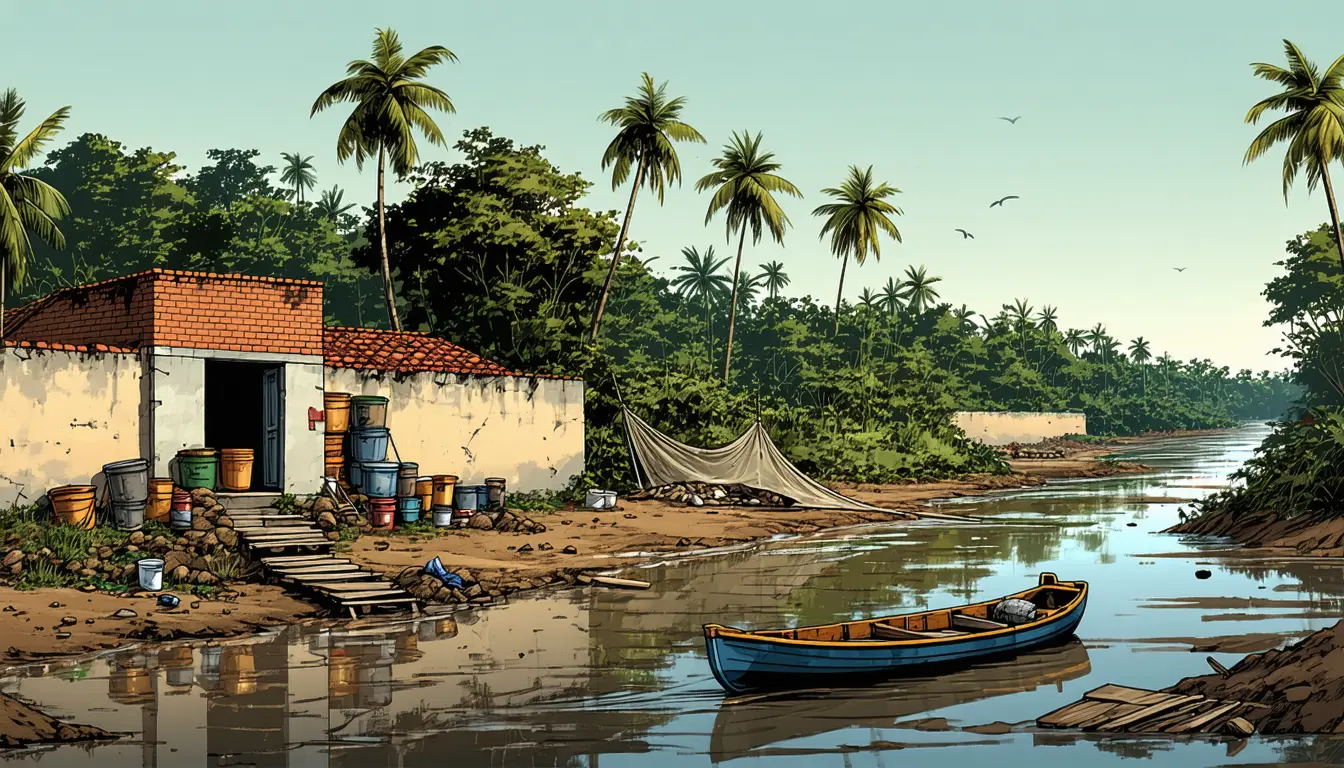
On Vypin, a low-lying island, participants raised sea-level rise, recurrent flooding and land subsidence [2]. On the Kozhikode mainland coast, they talked about fish: less of it, and sardines arriving smaller [3]. Both are climate observations, and the study found that lived experience can give a detailed understanding of the changes even where people do not use scientific terms [14].
They also attributed the changes to deforestation, pollution, plastic waste disposal and urbanization, and some explained them through religious and cultural worldviews, including divine control, punishment or an approaching end of the world [5]. "These perspectives should not simply be dismissed as ignorance; rather, they reveal how communities make sense of a complex and uncertain phenomenon through culturally embedded ways of understanding the world," said P. Afna, a doctoral researcher at the Indian Institute of Forest Management, Bhopal [7].
The fourfold gap in perceived agency is the figure a program designer will reach for. It is also the figure this design supports least. Vypin participants identified mangroves as a way to reduce erosion and protect settlements, and some had planted mangroves around their homes [9]. That is a household-scale action matched to the threat they named. Declining fish abundance and shrinking sardines sit outside what a household can do [3]. Do islanders feel more able to act because they understand the problem better, or because a cheap and visible intervention happens to exist where they live? Two sets of interviews at one point in time cannot separate the two.
Afna also points out that mistaken attribution can inflate personal responsibility, with people believing their own behavior alone can address a problem driven by much larger structural processes. Attention can then move away from the responsibilities of governments, high-emitting sectors and other powerful actors to provide adaptation support and climate finance [8]. That makes a high agency score ambiguous evidence of good communication.
The researchers set their results against current climate policy in Kerala and India. They argue that communication cannot rely only on broad top-down messages or scientific terminology, and should instead connect scientific knowledge with what people see, experience and value in their own environments [11]. The support for that is the divergence between two coastal settings the authors call broadly similar [13]. No campaign was tested against a control, and the two populations differ in elevation, livelihood and exposure as well as in whatever messaging reached them. Within one Indian state, two coastal populations reported different observed changes and a 48.75-point difference in whether they believed they could do anything [3].
What to watch
- The published paper's sample sizes and sampling method per site, which would show whether the 65/16.25 split rests on 80 interviews or several hundred.
- Whether Kerala's state climate plans adopt site-specific material: fisheries indicators on the mainland coast, subsidence and mangrove planting on the island.
- A before-and-after test of the same message at both sites, which is the design that would test the segmentation argument directly.