Science1 publisher3 min readPublished
Malawi's buried copper ingots came from Congo's Kipushi mine, lead isotopes show
Lead-isotope analysis ties a copper ingot hoard found in Malawi in 1967 to Congo's Kipushi mine, nearly 800 km away. The river route the researchers propose, by canoe down the Kafue and Zambezi, is their reading of the terrain, built on top of that match.
The Scientist · Science desk
What happened
- A farmer found eight copper ingots buried beneath a tree at Chombe, Malawi, in 1967, and five of them survive today.
- Lead-isotope measurements, published in the Journal of Archaeological Science: Reports, match the copper to Congo's Kipushi mine, nearly 800 km from Chombe.
- The researchers propose that the copper travelled a river route of more than 1,000 km, although a direct overland route was possible.
Compiled by The ScientistSomething wrong?How this is made
Why it matters
- capability Malawi has no copper ore of its own, so every copper object found there was imported, and matching each find's lead isotopes to a mine can build up the country's copper sources one object at a time.
- constraint The isotopes identify only the mine and the find spot. The case for canoes over the overland trek rests on the researchers' reading of the terrain and needs provenanced finds along the Kafue and Zambezi to test it.
- constraint The trade corridor, and Chombe's place as its midpoint, both hang on a single hoard of five crude recasts, so the network is one proposed link until more sites are sampled.
- precedent The study uses the metal to support Chewa oral traditions of a Maravi migration from the Copperbelt, a model for checking oral history against the chemistry of traded goods.
The study started with a short list of candidate sources. Malawi has no copper ore deposits, so the metal at Chombe had to come from somewhere else [6]. The study set aside small deposits in neighbouring Mozambique because their use was limited [7]. That left two candidates: the Copperbelt on the Zambia-DRC border, which holds the world's largest copper ore deposits, and Kipushi, an old mine near Lubumbashi [8].
Lead isotopes decided between them. A mass spectrometer separates the heavier and lighter isotopes of lead, and the proportions measured in a sample are matched to the ore deposit with the same mix [9]. "The lighter and more nimble sports car will move along the inside wall of the curve, while the heavier school bus will naturally move toward the outside wall," Jay Stephens of New York University said of the instrument [10]. The match pointed to Kipushi [11].
The thing this doesn't tell you is the route. Isotopes fix the two ends of the journey, a mine near Lubumbashi and a tree at Chombe. I'd treat the Kipushi match as the finding and the canoe route as a reasoned hypothesis. The researchers accept that a direct overland route was possible, and they propose a river route of more than 1,000 km [13]. That is more than 200 km farther than the distance between mine and hoard, and at least a quarter longer [1]. Smeda Matundu, chief curator of the Chichiri Museum, traced it "from the copper mines of what is now the DRC, down the Kafue River by canoe, east along the Zambezi, then overland through Mozambique into central Malawi" [14]. He put the whole journey at nearly 1,200 km [15]. The phys.org account calls the river path safer [20]. The study, as reported, calls it easier [13].
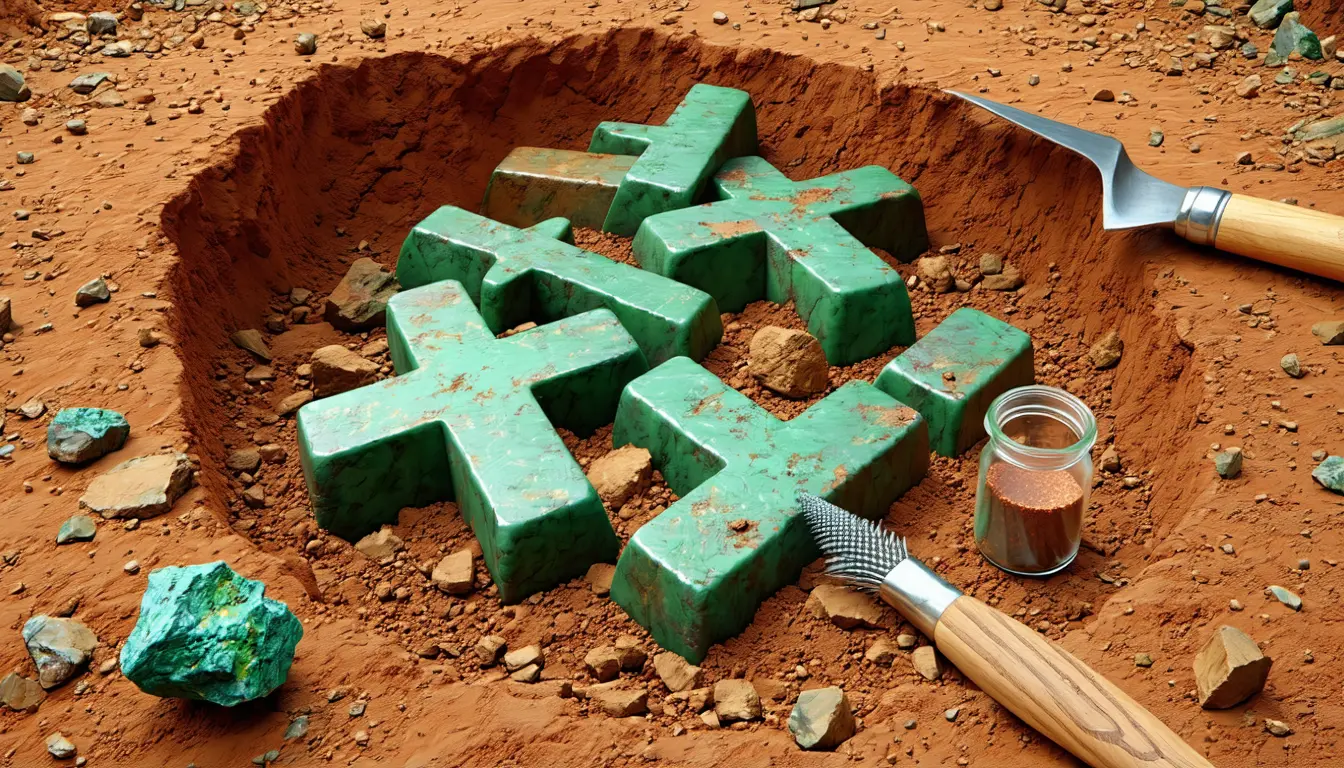
The ingots are odd objects in their own right. They copy the X-shaped ingots found across Zambia and Zimbabwe and dated to between the 14th and 18th centuries, but they are far lighter and rougher than any others [5]. The team concluded that trained metalworkers did not make them. Someone pressed ordinary ingots into moist sand and recast them as thinner copies in the rough mould [4]. Only five of the original eight survive [2]. The article does not say how many of those five were sampled, or how the Chombe hoard itself was dated. Nobody knows why they were buried. "It's a complete mystery," Stephens said [16].
The larger claims rest on this one hoard. The study suggests Chombe may be a stop on a trade corridor, a midpoint between the Copperbelt and the capital of the Maravi state in Malawi [17]. It also says the finds lend weight to Chewa oral traditions that the Maravi founders migrated from the Copperbelt [18]. The article lists Kipushi and the Copperbelt as separate candidate sources [8], so that fit depends on counting Kipushi as part of the wider copper region.
What to watch
- Whether copper finds along the proposed Kafue-Zambezi corridor are also provenanced to Kipushi, which would test the river route directly.
- A direct date for the Chombe hoard, which would anchor the route in time instead of relying on its resemblance to X-shaped ingots dated to the 14th to 18th centuries.
- Whether the three ingots missing since the 1967 find surface for analysis.