Science1 publisher2 min readPublished
Laser shocks on a plastic film produced three-nanometer diamonds that survived collection
A team at HZDR and Rostock fired a high-power laser three times a minute into 100-micrometer PET film, caught the ejected particles in a soft gel, and recovered a few hundred micrograms of near-uniform diamond after about 100 shots.
The Scientist · Science desk
What happened
- Researchers at HZDR and the University of Rostock began by firing high-power lasers into plastic to reproduce the pressures and temperatures found inside planets such as Neptune and Uranus.
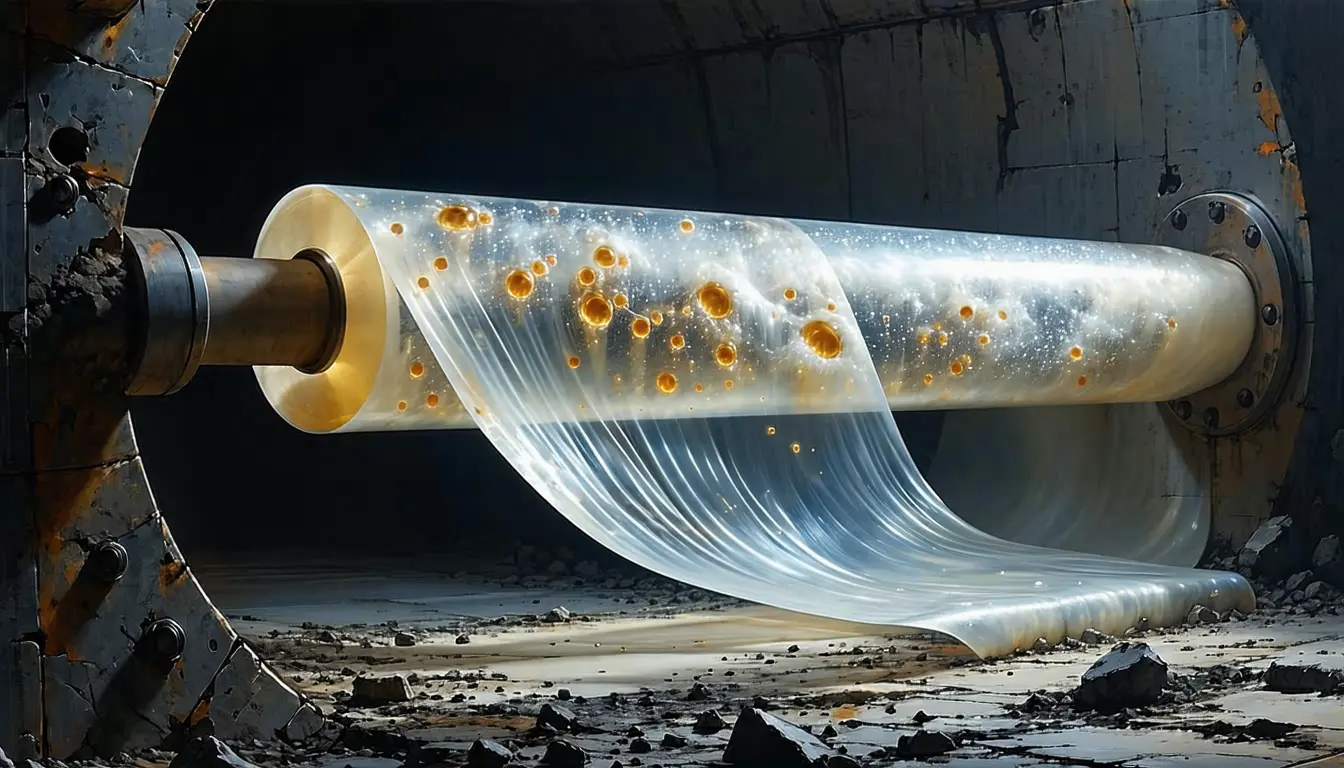
- The L4n-P3 high-power laser fires three times a minute into a PET film 100 micrometers thick, raster-scanned by the beam so fresh material meets each pulse.
- The diamonds form inside the shock wave and are ejected from the film into a cylinder of vacuum-compatible, water-soluble ionic gel chosen to stop them without destroying them.
- Each shot delivers about 10 trillion particles of nearly the same size, averaging three billionths of a meter across and containing roughly 3,000 carbon atoms each.
- About 100 shots produced a few hundred micrograms, enough to image and characterize the material on the ELMI-MV electron microscope at Rostock.
Compiled by The ScientistSomething wrong?How this is made
Why it matters
- capability A narrow size band at high purity is now something a group can hold in a vial, and HZDR and Rostock say explosive synthesis cannot produce it, so work that depends on uniform particle size no longer starts with sorting.
- constraint The demonstrated route needs a laser of ELI's class, so it stays inside large research infrastructure until high-repetition-rate, high-energy lasers exist elsewhere.
- decision A group weighing whether to test these particles in catalysis or a biomedical assay has to wait for larger batches; a few hundred micrograms supports characterization, not an application experiment.
Formation of diamond inside these shocks had been shown before, briefly, during the compression itself; what the new work settles is that the particles survive the return to ordinary pressure and temperature [6]. Getting them out of the target is violent. Dominik Kraus, founding director of HZDR's HEDI institute and a professor at the University of Rostock [21], said the compression wave "abruptly enters a vacuum, accelerating the nanodiamonds to speeds of more than 10 kilometers per second" [10]. "To prevent the diamonds from immediate destruction upon impact with the collection cylinder, we need to use a very soft collection medium," he said [11].
The technical idea came out of the planetary work. Kraus said: "We did expect nanodiamonds to form under these conditions. What surprised us, however, was how quickly it happened, which immediately sparked the idea of a potential technical application" [5].
The yield is where the manufacturing question sits. At the stated firing rate, the run of about 100 shots is roughly 33 minutes of laser time [1]. Read "a few hundred" as 300 micrograms and each shot contributes about three micrograms, so one milligram needs on the order of 330 shots, close to two hours [2].
The team's target is the milligram range. HZDR describes that as a quantity similar to conventional production processes [19]. The case for getting there is that yield tracks pulse count, and fusion research is driving high-energy lasers toward higher repetition rates [18]. That part is a projection about laser engineering. The experiments ran at the Extreme Light Infrastructure south of Prague, described as a unique facility combining a high repetition rate with very high energies [7], and the announcement does not include a cost or an energy figure per gram of diamond [22].
The particles remain untested in an application. The uses usually cited for nanodiamonds, in medicine, new materials, catalysis and energy technology, follow from hardness, stability and heat resistance [20], and none of those properties were put to work in this study. What the researchers did do was look at the product. Ben Heuser of HZDR, the study's primary author, who ran the experiments for his doctoral thesis at Rostock [17], said: "After extracting the nanodiamonds from the catcher material and purifying them, we were able to see them for the first time directly using the ELMI-MV. That was a special moment we had been working toward for years. With this instrument, we can even resolve individual atoms" [16].
What to watch
- Whether the Rostock lab runs reach the milligram range, and at what shot count and beam time per milligram.
- Size histograms and purity data in the Diamond and Related Materials paper, set against explosive synthesis products.
- Whether any laser outside a facility of ELI's class can run the raster-scanned film process at a useful repetition rate.