Science1 distinct publisher2 min readPublished
Yannis Laplace's group used accelerator-generated terahertz light to swing a gold-and-semiconductor metamaterial's optical properties, halving photon loss, though the result is a spectroscopic signature rather than a working amplifier.
The Scientist · Science desk

Compiled by The ScientistSomething wrong?How this is made
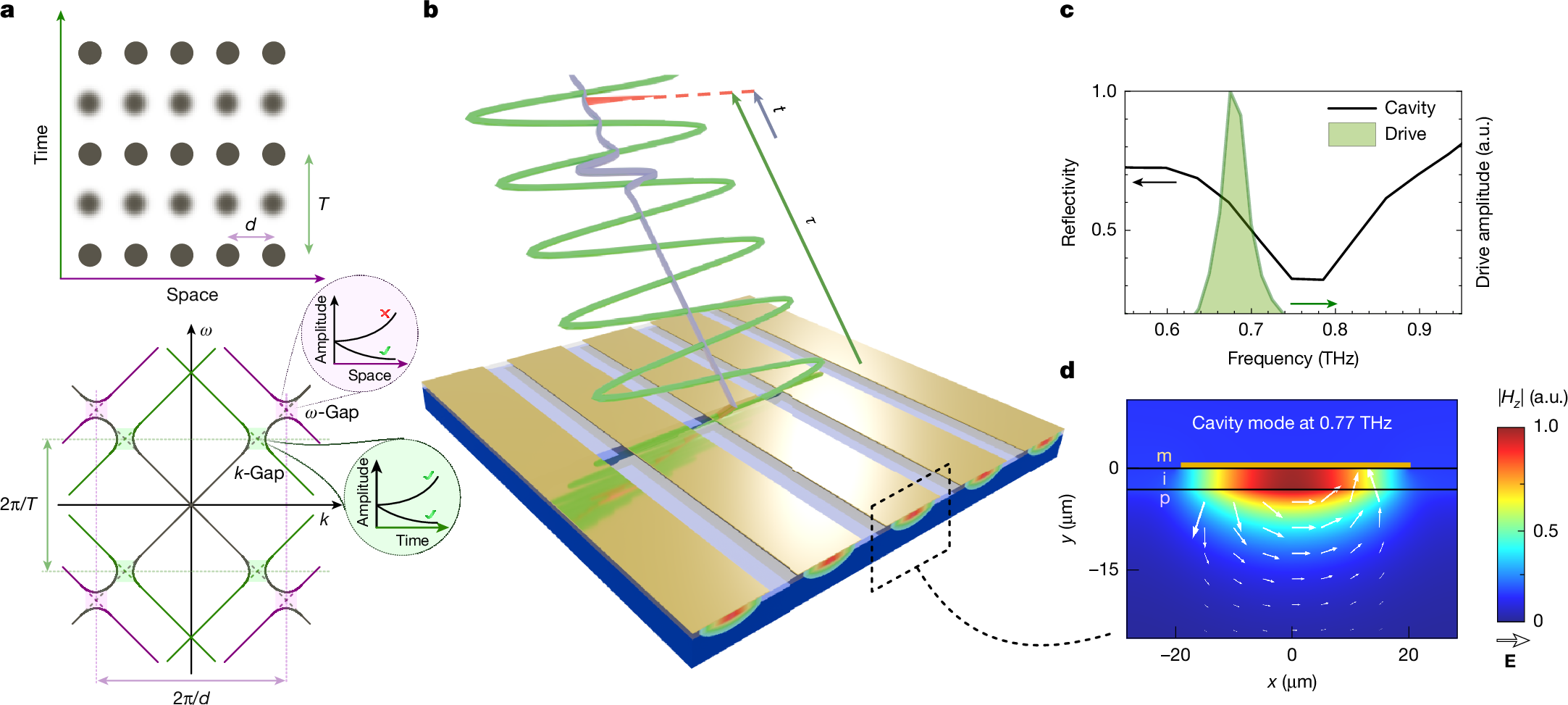
The design problem was a timing problem. A photonic time crystal only works if its properties are swung hard and on a timescale close to the temporal period of the light it acts on [9]. Terahertz means 10^12 cycles per second [11], so a 1 THz wave has a period of about one picosecond [1], and picoseconds is the window over which the drive field reshaped this metamaterial's optical properties [7]. That coincidence of timescales is the reason terahertz was the band where an all-optical version was likely to arrive first, and why earlier momentum-gap work stayed at microwave frequencies inside structures built around electrical circuits [10].
The confinement does the rest. Photons are trapped between the gold and the semiconductor, and surface plasmons, the collective oscillations of conduction electrons that couple very strongly to light, hold them at the semiconductor surface [5]. That coupling is what allows a terahertz field to move the optical properties by a useful amount rather than a marginal one.
What the group can demonstrate is narrower than the phrase time crystal suggests to a non-specialist. Laplace says the central question was whether the temporal modulation of the metamaterial would be strong and fast enough [12], and the answer arrived as a theoretical model built with Marco Schiro's group at the College de France that reproduced the experimental observations closely, alongside the spectroscopic signatures a photonic time crystal is expected to show [13]. The thing this does not tell you is how much gain a device would produce. A momentum bandgap grows waves exponentially in time [8]; dissipation is the same kind of exponential with the opposite sign, and this work pins down the first better than the second.
So the dissipation figure is the one I would follow. Read as a loss rate, the reduction the team measured roughly doubles how long a photon survives inside the structure [2], and they say they are looking to push optical losses lower still [15]. Laplace's stated targets, terahertz amplifiers, frequency converters and possibly new kinds of lasers aimed at closing what he calls the THz gap [16], depend on that ratio far more than on the lithography.
Ranked by verification strength, evidence, and original report placement.
Researchers in France and Germany have created the first all-optical photonic time crystal.
The team was led by Yannis Laplace of the Ecole Polytechnique in France, working with scientists from the College de France and the Helmholtz-Zentrum Dresden-Rossendorf (HZDR) in Germany.
The new photonic time crystal is made from a plasmonic metamaterial: an engineered nanostructure of micron-sized gold cavities atop an insulating layer and a semiconductor material based on indium and antimony.
The cavities trap photons between the gold and semiconductor layers, and surface plasmons, collective coherent oscillations of conduction electrons that interact very strongly with light, keep them on the surface of the semiconductor.
The researchers applied pulses of terahertz light from the TELBE light source at HZDR's ELBE accelerator to their structure.
Distinct publishers with included, body-backed reporting in this cluster.
1 article · September 3, 2026
Follow any of these and your For You feed starts watching them — no settings page required.
science
A pole-on magnetar hands vacuum birefringence its first astrophysical candidate1 distinct publisher
science
A phage kinase with no target list: EMBL finds one enzyme that breaks several bacterial defences1 distinct publisher
science
HIPAA Covers Less Than You Think, And "Anonymized" Is Not A Legal Shield1 distinct publisher
science
Malva indexes public single-cell archives by nucleotide sequence instead of by gene1 distinct publisher
Evidence-backed comparisons of source perspectives and observed adoption signals. Read the methodology
Which Builder, Operator, and Investor concerns the observed source mix emphasized—not a truth score.
Evidence, demonstrated adoption, hype gap, incentives, and confidence are assessed independently, each on its own current evidence. How these are measured.
Peer-reviewed, single-voiced
For a first-of-kind claim the measurement chain is refreshingly concrete: a named material stack, a named beamline, picosecond modulation, a halved dissipation figure, and a theory fit. Two things hold it back. The interpretation comes from the same collaboration that took the data — Schiró's model, Laplace's reading of it — and the primacy claim is a category judgement no one outside the group is quoted assessing. Peer review at Nature is doing most of the load here, and one relayed account is doing the rest.
Nothing yet to count
There is no deployment surface to assess. The structure sits in a German accelerator facility; no second laboratory, no prototype, no user appears anywhere in this reporting. Amplifiers, converters and lasers are named as hopes, and hopes do not register as uptake.
Computers promised, signature delivered
The distance between the first sentence and the data is the story. Physics World opens with ultrafast optical computers and new lasers; the experiment produced spectroscopic fingerprints consistent with a photonic time crystal and cut photon losses in half. The exponential growth inside a momentum bandgap — the whole reason anyone wants these structures — is explained as theory and never claimed as observed. The overshoot is in the timing and the applications, not in the physics, which is why this reads as moderately overstated rather than inflated.
The lead author frames his own result
Every interpretive sentence belongs to Laplace, who situates the work as continuing his group's own programme and whose stated next moves — THz amplifiers, converters, lasers — are the sort of thing proposals are written about. HZDR gains from a Nature result on its beamline. None of that touches the validity of the measurement; it does mean the 'first' and the roadmap are self-assessed, and a physics outlet built around relaying journal papers has little structural reason to push back on either.
Solid physics, one account
The mechanism is specified precisely enough that any group with a terahertz beamline could attack it, which is the strongest thing going for this assessment. Against that: one publisher, one paper, one collaboration's interpretation, and a claim to being first that only replication or a competing group's reply will actually settle. Moderate confidence in what was measured, lower confidence in what it means.