Science1 publisher2 min readPublished
Laser light drives antibody beads to flag a colorectal cancer marker in plasma within minutes
Osaka Metropolitan researchers used laser light to detect colorectal cancer marker CEACAM-5 at 1 to 10 picograms per mL of diluted plasma in minutes. The fast lab assay now needs clinical validation, the team's stated next step, before anyone can judge it as a blood test.
The Scientist · Science desk
What happened
- Osaka Metropolitan University researchers reported in Nanoscale Horizons that laser light sped up antibody binding to CEACAM-5, a colorectal cancer biomarker, in blood plasma.
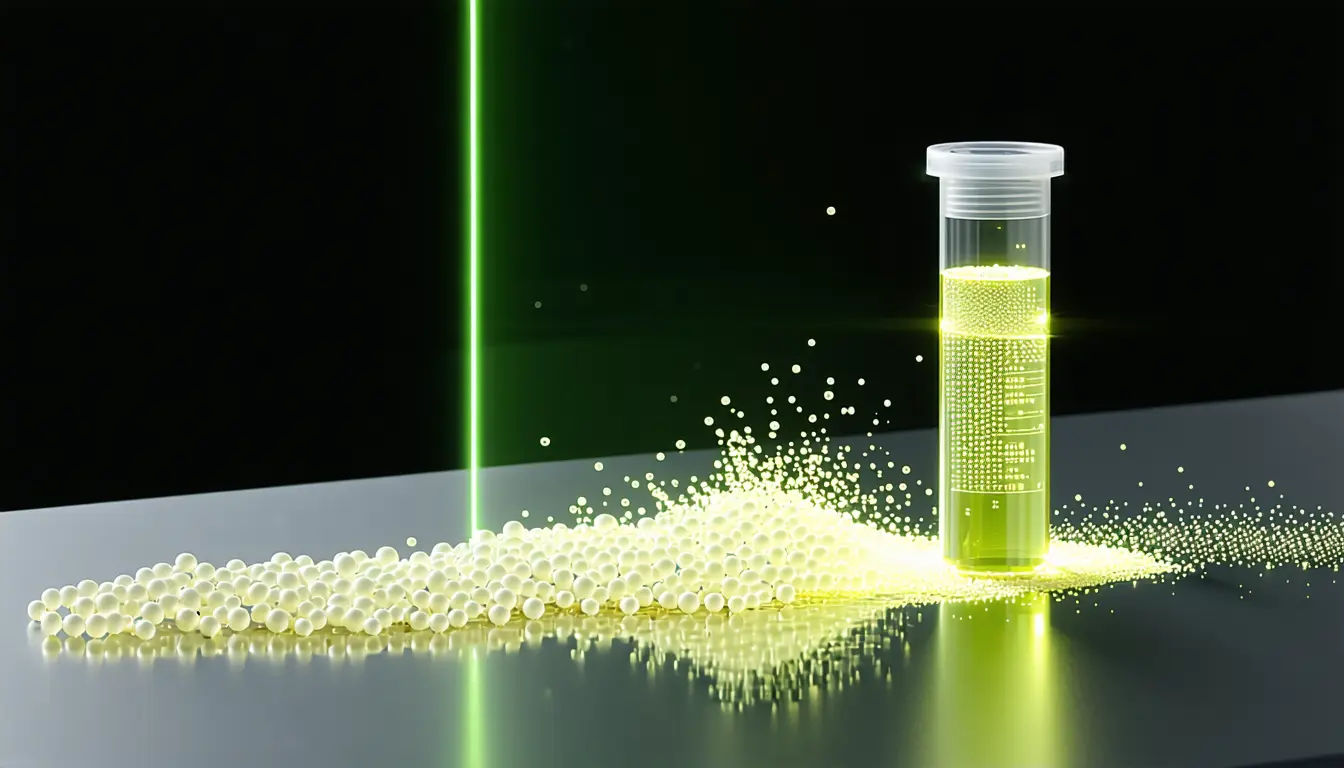
- Beads coated with multiple antibodies flowed through a tiny channel of plasma, assembled under the laser when they engaged CEACAM-5, and the assemblies were measured as the signal.
- The method detected CEACAM-5 at concentrations of 1 to 10 picograms per milliliter in diluted plasma.
- The university's account calls that a potential improvement of one to two orders of magnitude over the detection range of ELISA and immunoprecipitation.
Compiled by The ScientistSomething wrong?How this is made
Why it matters
- constraint Until clinical data show how often the assay flags people without cancer and misses people with it, its low detection floor cannot be used to judge its worth for screening.
- capability A readout in a few minutes from 5 microliters of plasma is the format a portable test would need, and the team says it plans to build such systems with industry partners.
- decision Developers eyeing dementia or infectious-disease markers would first need to know whether those molecules also clump in blood, since the sensitivity may partly depend on CEACAM-5's aggregates.
That 1 to 10 picogram figure comes from plasma that was diluted before it reached the channel. Each experiment started from 5 microliters, about the size of a sesame seed, serially diluted, and the team mainly used samples from colorectal cancer patients diluted 1,000-fold [7]. If the reported range was measured at that dilution, the undiluted plasma in those samples held roughly 1 to 10 nanograms per milliliter [14]. On that reading, the picogram number measures how far a sample can be thinned before the assay loses the marker, and the patients' own blood carried about a thousand times as much [14].
Speed is the other half of the claim. Standard immunoassays can need hours of incubation and washing, and the target protein sits among thousands of other proteins in blood [11]. "Our light-induced detection technology can detect extremely small amounts of CEACAM-5 in blood within just a few minutes compared to several hours for conventional techniques," said Takuya Iida, the Osaka Metropolitan University professor who is the study's lead author [3][5].
I think the more interesting result concerns the marker itself. "We found that CEACAM-5 exists in blood as nanoscale aggregates," Iida said [9]. According to the university's account, those clusters may bind the antibody-coated beads efficiently and produce a stronger signal, and that might explain the low detection limit [10]. If so, part of the sensitivity comes from how CEACAM-5 is packaged in blood, alongside whatever the laser contributes [9][10].
The comparison with enzyme-linked immunosorbent assays (ELISA) and immunoprecipitation is a comparison of detection ranges [8], a factor of 10 to 100 [15]. The thing this doesn't tell you is how the test performs on people: the account does not say how many patients were sampled or whether plasma from people without cancer was run as a control. A detection floor is a bench measure. A blood test for cancer is judged on how often it flags healthy people and how often it misses sick ones.
The team names that as its next step: validating the technology in clinical settings and determining how reliably it can distinguish disease-related signals [12].
What to watch
- Clinical validation data reporting how often the laser assay flags plasma from people without colorectal cancer, and how many patients were tested.
- A same-sample comparison of the laser assay against ELISA on patient plasma, testing the claimed one-to-two orders of magnitude advantage directly.
- Whether a dementia or infectious-disease biomarker gives the same gain, and whether that marker also circulates as nanoscale aggregates.