Science1 publisher2 min readPublished
POSTECH's metasurface encodes molecular binding as a moving dark line in a camera image
The chip spreads its optical resonances across 300 micrometres, so a fixed-wavelength laser and an ordinary image sensor can track a shift that normally needs a high-resolution spectrometer. Proteins and DNA were read at hundreds of picomolar.
The Scientist · Science desk
What happened
- A POSTECH team led by Junsuk Rho built a metasurface biosensor that reads molecular binding from an image, with no spectrometer in the measurement chain.
- Within about 300 micrometres of chip, the device combined a broad sensing range with a spectral readout resolution of roughly 0.1 nanometres.
- Protein and DNA experiments detected targets at concentrations in the hundreds of picomolar, and the sensor discriminated specific DNA sequences.
Compiled by The ScientistSomething wrong?How this is made
Why it matters
- capability Label-free optical biosensing can now be attempted with a compact single-wavelength laser and an image sensor, hardware that does not need a bench to sit on.
- cost The saving claimed is the broadband source and the high-resolution spectrometer. The paper does not disclose either price, so anyone costing a device from this design has to price the laser and the metasurface fabrication themselves.
- constraint A floor in the hundreds of picomolar, measured on proteins and DNA, bounds which clinical targets this readout could serve without an amplification step in front of it.
- decision Engineers building an instrument on this principle inherit a calibration problem in nanofabrication and laser stability, in place of the one a spectrometer vendor used to solve for them.
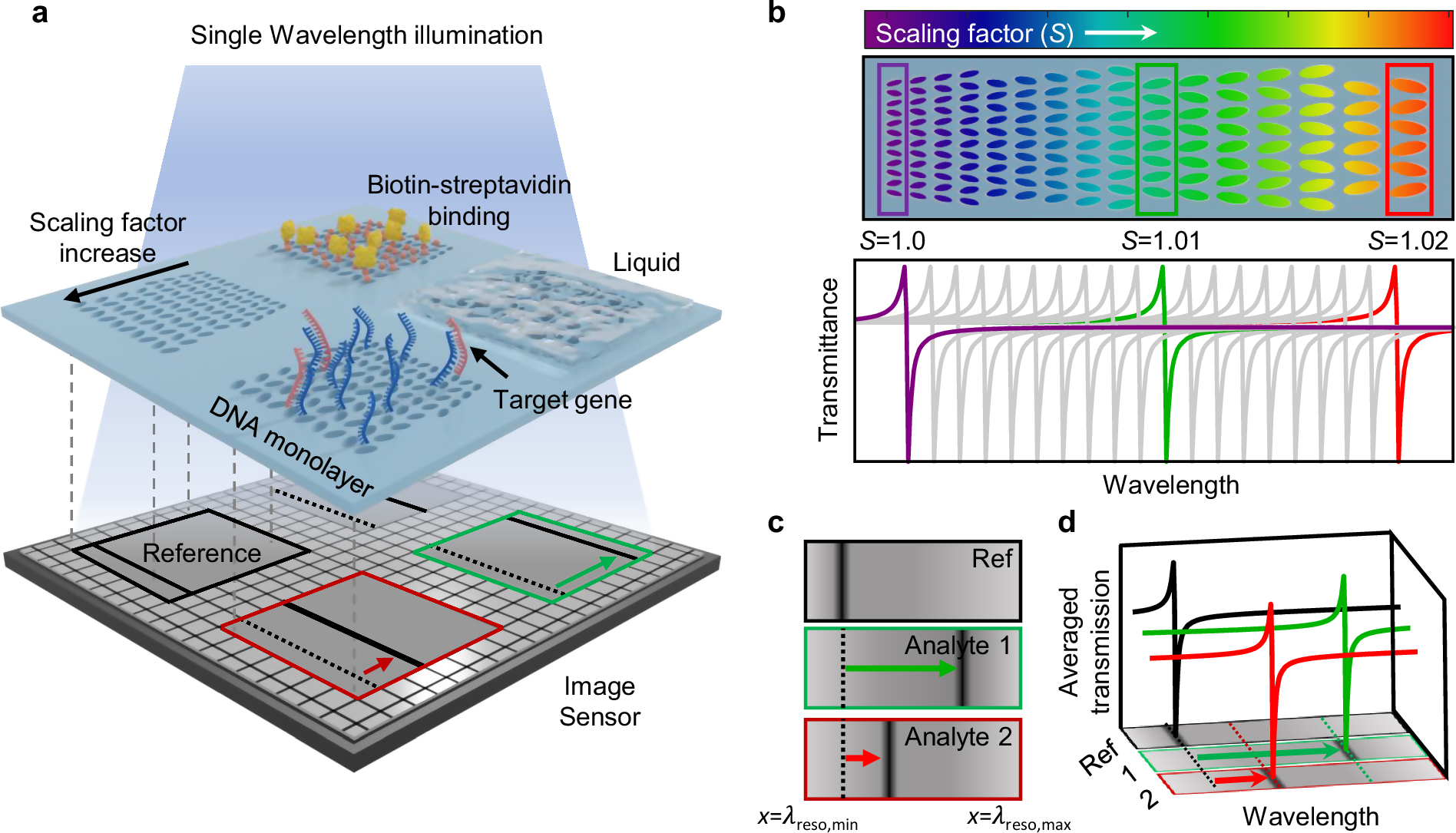
A uniform metasurface resonates at one wavelength, so finding that resonance means sweeping the light across it. The standard way to do that is a broadband source plus a high-resolution spectrometer, and phys.org reports that both are bulky and expensive enough to have kept label-free optical biosensing inside labs and hospitals [4].
The POSTECH chip spreads its resonances out in space. Its nanostructures change geometry continuously along one direction, so each position along that axis resonates at a different wavelength [3]. Illuminate it with a single-wavelength laser and one position matches: transmission there is strongly suppressed, and a dark line appears in the captured image [5]. Target molecules binding to the surface change the local refractive index. The resonance shifts, the dark line moves, and tracking that displacement gives the binding signal [6].
The active area is about 300 micrometres across, which is 0.3 mm [7][11], described in the report as roughly the width of several human hairs [15]. Across that span the device held a broad sensing range and a spectral readout resolution of about 0.1 nm at the same time [7]. In experiments with proteins and DNA it detected targets at concentrations in the hundreds of picomolar [8], on the order of 1x10^-10 moles per litre [12], and it discriminated specific DNA sequences [9].
The substitution is concrete. Out go the broadband source and the high-resolution spectrometer; in come a compact single-wavelength laser and an imaging sensor [10]. That is a real change to the parts list of a label-free optical assay, which is the class of test that works without fluorescent tags [14]. Cost is a separate question, and the report does not price either configuration. Whether a handheld device built this way undercuts existing point-of-care testing depends on the cost of patterning gradient metasurfaces at volume, and on the laser.
Encoding wavelength as position also moves the precision requirement. In a spectrometer-based system, the instrument is calibrated; here the mapping from position to wavelength is fixed when the nanostructures are patterned, and the reading is a displacement in an image interpreted against that mapping [13]. The laser matters for the same reason. Which position goes dark is set by the laser's wavelength [5], so an instrument's accuracy rests on holding that wavelength steady and on the fabricated gradient being what the calibration says it is [13].
The work was published in Nature Communications, with collaborators from Hyomin Lee's group at POSTECH and Yong-Sang Ryu's group at Korea University [2].
What to watch
- Whether the 0.1 nm readout resolution survives in clinical samples rather than the protein and DNA tests reported.
- Whether laser wavelength drift and chip-to-camera alignment hold the dark line's position steady in a handheld build.
- The cost of patterning continuous geometric-gradient metasurfaces at volume, which the report does not quantify.