Product1 publisher3 min readPublished Updated
Vigor unveils USAV Craney Island, and the Army's landing craft plan finally has a hull
The MSV(L) program now has a named builder, an aluminum line in Vancouver at full-rate production, and a stated payload of 82 tons. Contract quantities and trial dates are still missing.
The Product Desk · Product desk
Drafted by a language model from the sources cited here and checked against its claim ledger before publication. How we use AISend a correction
What happened
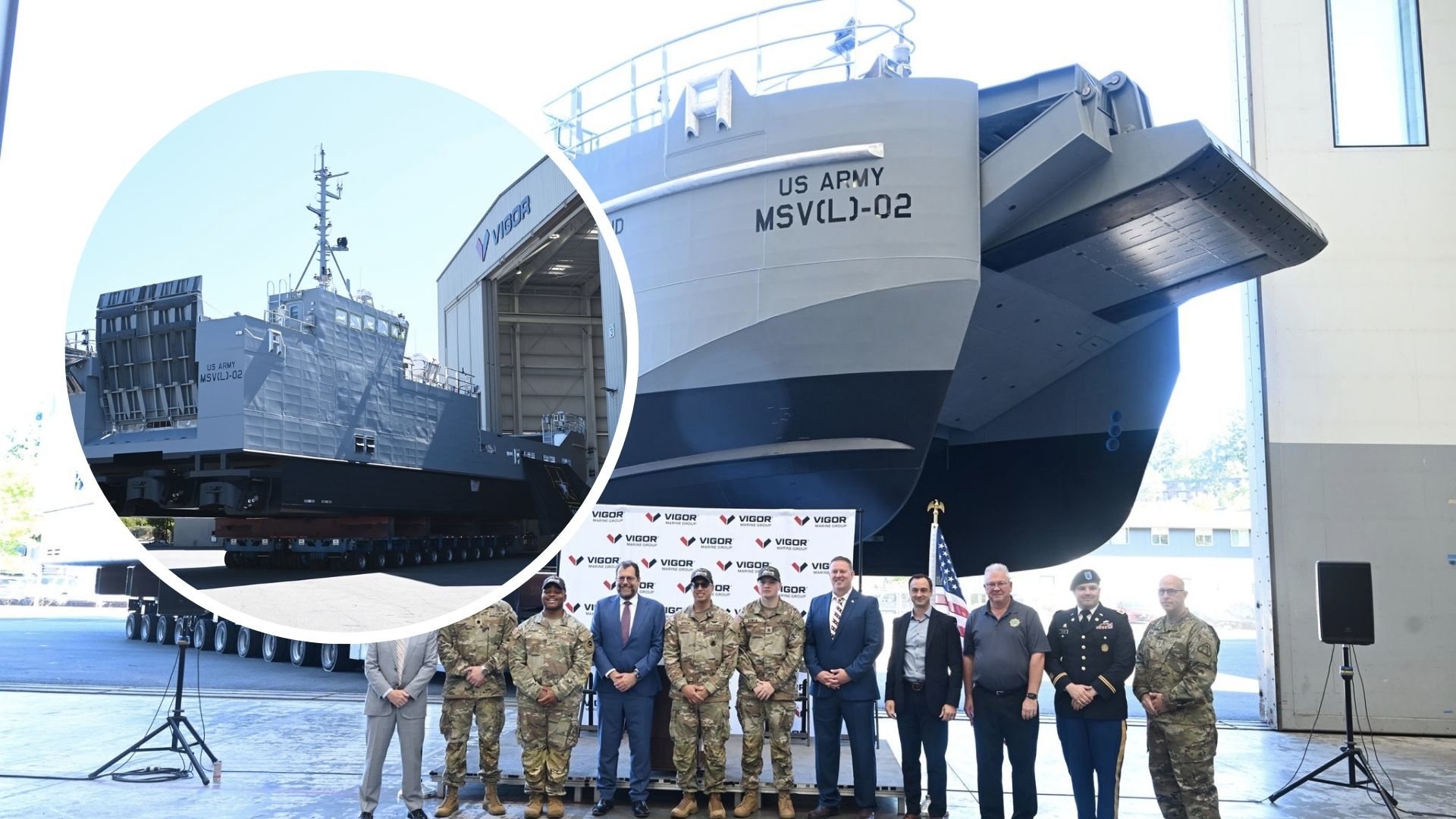
- An Oregon-based company, Vigor Marine Group, unveiled a support vessel called USAV Craney Island, developed to help modernize the U.S. Army's watercraft fleet.
- USAV Craney Island is designed to improve payload capacity, maneuverability, speed and operational flexibility, and is described as offering vastly superior technology to the current class.
- Reports have revealed that the MSV(L) can carry 82 tons at 21 knots, and the vessel is designed to carry main battle tanks and armored vehicles.
- According to Vigor Marine Group, the vessel's tribow monohull form maximizes seakeeping and provides speeds in excess of 20 knots fully laden.
- The vessel is stated to carry modern equipment into diverse littoral settings up to and including a main battle tank, to offer greater maneuver options in anti-access, area-denial environments, and to provide superior seakeeping and survivability with no height constraints on payload.
Compiled by The Product DeskSomething wrong?How this is made
Why it matters
Vigor Marine Group, an Oregon-based company, has unveiled USAV Craney Island, a support vessel built to modernize the US Army's watercraft fleet [1]. The significance is not the ceremony but the industrial fact underneath it: the Army's landing craft recapitalization now has a named builder, an aluminum production line running at rate, and a finished hull to point at [1][7].
The vessel is described as designed to improve payload capacity, maneuverability, speed and operational flexibility over the current class [2]. Reports cited by Interesting Engineering put the MSV(L) at 82 tons of payload at 21 knots, with the craft designed to carry main battle tanks and armored vehicles [3]. Vigor's own claim is narrower in wording and similar in substance: its tribow monohull provides speeds in excess of 20 knots fully laden [4]. The two figures do not contradict each other [11]. The company also states there are no height constraints on payload and that the design offers greater maneuver options in anti-access, area-denial environments, along with superior seakeeping and survivability [5]. Those are design assertions in a press release, not results from a test program, and the material does not report sea trials [10].
The more checkable part is the factory. Vigor says its Vancouver facility is in full-rate production of MSV(L) hulls while continuing fabrication of the Combatant Craft Medium, of which it has produced more than 30 [7]. That is two military aluminum programs running concurrently at one site [12], which is the kind of load that tends to expose supplier and welder constraints before it exposes design ones. According to the company's press release, more than 300 skilled workers at the Vancouver plant contributed to Craney Island, alongside more than 40 Washington state-based companies plus suppliers across the Pacific Northwest and the United States [8]. Francesco Valente, CEO of Vigor Marine Group, called the unveiling "a critical milestone for both the U.S. Army and for our skilled Vigor Marine Fabrication workforce in Vancouver, where this journey began years ago" [6].
The design lineage is stated plainly: Vigor has previously said the MSV(L) was developed in partnership with BMT after a study of the Army's needs and available options, and that it improves on the current LCM-8 while offering what the company calls the optimal combination of performance, operational flexibility and life-cycle cost [9]. The LCM-8 comparison is the whole business case, and the source gives no numbers for the older craft to measure it against [10].
What is absent from the material is what an operator would actually use to judge the program: how many MSV(L) hulls the Army has on contract, at what unit price, on what delivery schedule, and when Craney Island moves from unveiling to acceptance [10]. Full-rate production is a manufacturing state, not a delivery record, and the two diverge often enough that the distinction is worth holding onto.
Watch for the Army's contract quantity and delivery milestones, and for whether the 82-ton-at-21-knots figure survives loaded trials rather than remaining a design number [3][10]. Watch, too, whether the Vancouver line sustains MSV(L) rate while CCM fabrication continues [7][12], because that is where a supplier base of 40-plus regional firms either holds or shows its seams [8].