Invest1 publisher3 min readPublished
Korea counts 62.4 trillion won of loan extensions inside its 102.6 trillion won Chuseok package
The Financial Services Commission's holiday tally for small firms comes to 102.6 trillion won, and 62.4 trillion of it extends maturities on loans already outstanding, leaving roughly 40.2 trillion won of new credit.
The Investor · Invest desk
What happened
- The Financial Services Commission said on the 13th that policy finance institutions and every financial sector will together supply 102.6 trillion won to small business owners and small and medium-sized enterprises for Chuseok.
- Inside the 23 trillion won policy tranche, Korea Credit Guarantee Fund's 10.1 trillion won is 2.1 trillion won of new guarantees plus 8 trillion won of extended ones, with simplified review procedures.
- For traditional market merchants, the Korea Inclusive Finance Agency will lend 5 billion won through merchant associations, capped at 10 million won each at up to 4.5 per cent a year, through the 23rd.
Compiled by The InvestorSomething wrong?How this is made
Why it matters
- constraint Only about 40.2 trillion won of the headline can fund anything a small firm has not already borrowed, so the package expands SME balance sheets by roughly two fifths of the number being quoted.
- exposure Korea Credit Guarantee Fund keeps 8 trillion won of guarantee exposure alive for another cycle. The fund's cash only leaves when a borrower defaults, and a default lands after the holiday.
- decision The decision on whether roughly 880 billion won a day of small-business maturities gets rolled between Aug. 24 and Oct. 16 sits with bank credit officers, not the FSC.
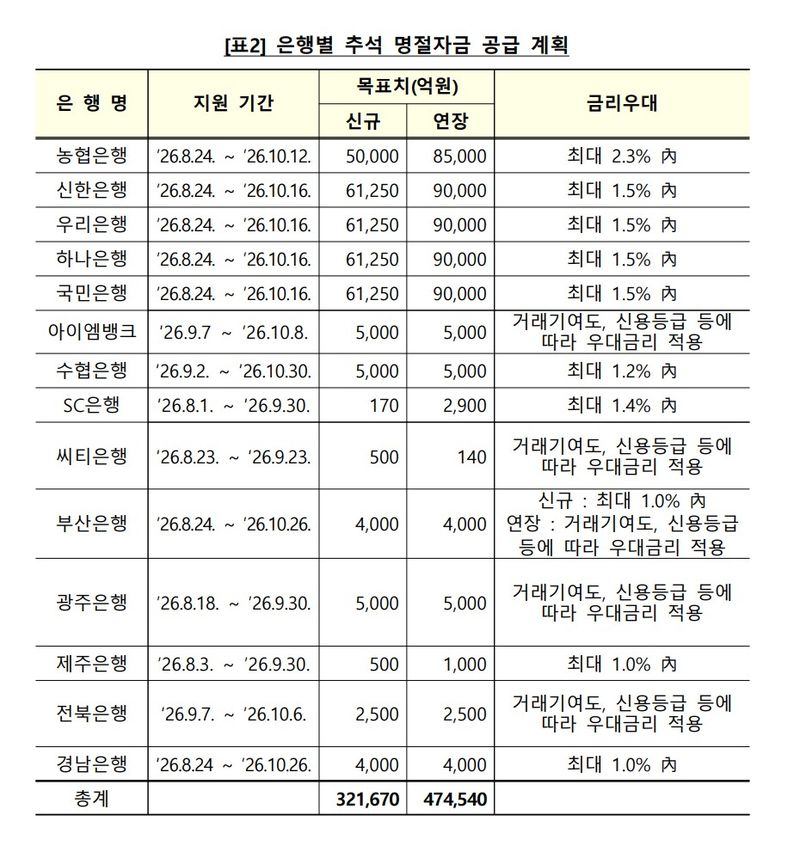
Banks are putting up 47.4 trillion won of maturity extensions against 32.2 trillion won of new loans [3]. The three policy institutions named in the Financial Services Commission's tally account for the entire 23 trillion won policy tranche [16]. They add 15 trillion won more of extensions against 8 trillion won of new money [14]. Of the 102.6 trillion won headline, 62.4 trillion is credit already on the books, about 61 per cent [15]. New lending is roughly 40.2 trillion won [17].
Two different things are being called an extension. Loans maturing at banks, insurers, savings banks and credit card companies between the 24th and the 27th roll automatically to the 28th without late interest, because the holiday shuts the payment system [8]. Those four days are a calendar adjustment. The 47.4 trillion won in the bank programs sits inside a window that opens on Aug. 24 and closes on Oct. 16 at the four major commercial banks [7], 54 days. Every maturity inside it is a decision a lender has to take: about 880 billion won a day of small-business paper to roll or refuse [18].
The FSC published the figure on the 13th [1]. The programs opened on Aug. 24, twenty days earlier, so about 37 per cent of the bank window had already run before the number was announced [2][19].
For the state the bill is small. Korea Development Bank is providing 3.7 trillion won with interest rate cuts of up to 0.4 percentage point [4]; apply the full cut to the full amount and the forgone interest is 14.8 billion won a year [20]. Korea Credit Guarantee Fund's 10.1 trillion won is the largest single line in the policy tranche, 44 per cent of it [22], and 8 trillion of that is extended guarantees [6]. A guarantee costs the fund nothing until the borrower fails.
The FSC did not publish comparable figures for previous Chuseok packages, and without them the 62.4 trillion won supports more than one reading. Seasonality is the obvious rival: a loan book with maturities every week will always have several weeks of them falling inside any 54-day window, and rolling those is ordinary business. Preferential rates are set on factors such as transaction history and credit rating [23], so a sound borrower has every reason to take the cheaper rate when it is offered. In my view, a package in which extensions outweigh new money by 62.4 trillion to 40.2 trillion is describing a rollover that does not clear unaided at market pricing. That view fails the moment the extension share turns out to be flat against last Chuseok.
The bottom end of the package is smaller than the headline suggests. The Korea Inclusive Finance Agency will supply 5 billion won through merchant associations. Traditional market merchants can borrow up to 10 million won each at up to 4.5 per cent annually through the 23rd [9]. At the cap, that reaches 500 merchants [21].
Much of the rest is dates moving around the holiday. Deposits maturing during the holiday will be paid on the 28th with the holiday's interest included, or on the 23rd if the customer asks [10]. A share sold on the 23rd settles on the 29th under the two-day cycle [11]. Twelve banks will run eleven mobile branches at places such as highway rest areas, where customers can deposit, withdraw and exchange bills for new notes [12]. An FSC official also urged caution. "Before and after the Chuseok holiday, people need to watch out for text message scams that impersonate holiday gift delivery services or public agencies, such as notices of fines for traffic violations." [13]
What to watch
- Whether the Oct. 12 policy deadline and the Oct. 16 bank deadline get pushed back once the holiday is over.
- How much of the 32.2 trillion won of new bank loans is actually drawn by the time the windows close.
- Whether the Korea Inclusive Finance Agency's 5 billion won for market merchants is fully lent by the 23rd.