Invest1 publisher3 min readPublished
Korean car output's 24.8% slump pulls August industrial production down 1.3%
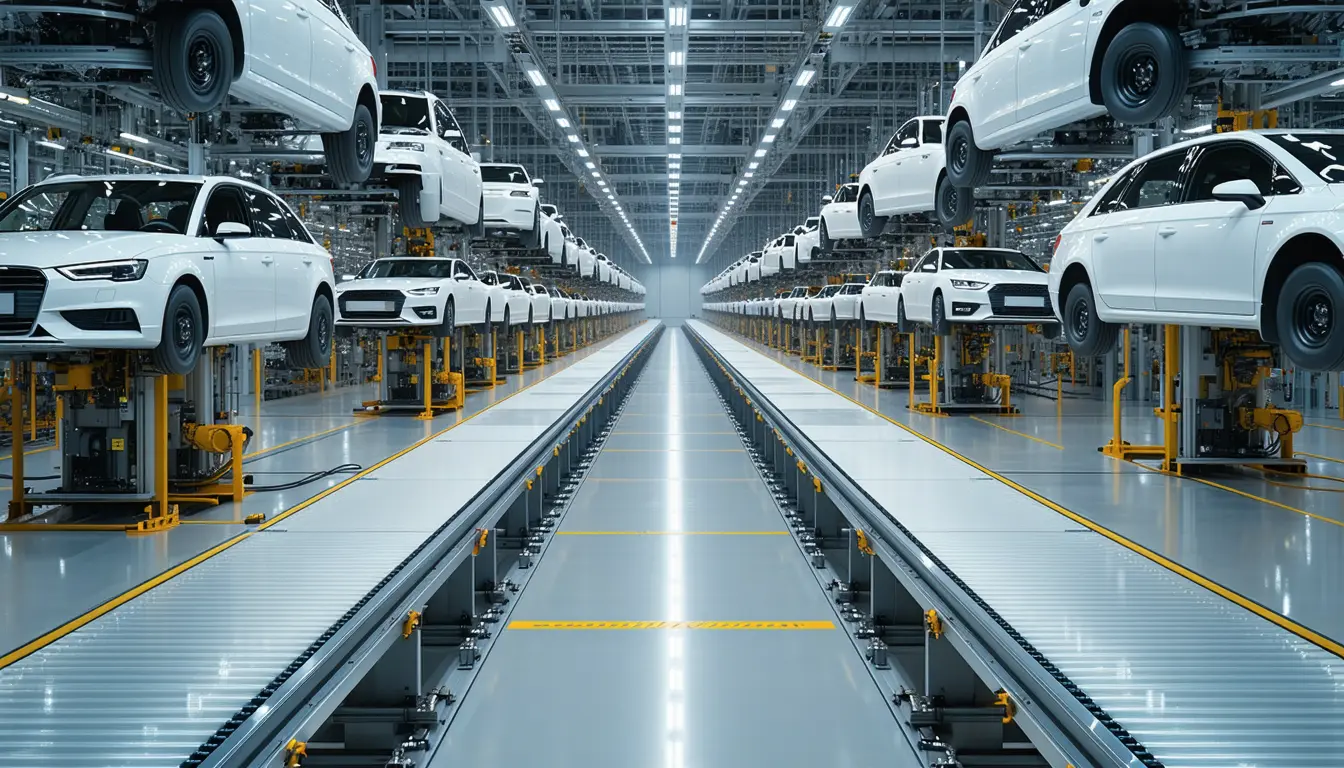
South Korea's industrial output fell 1.3% in August as car production dropped 24.8%, the steepest fall since February 2020. Officials call it temporary, but retail sales will take longer to recover from car buying rushed before a June tax cut expired.
The Investor · Invest desk
What happened
- Output, consumption and facility investment all fell in the same month for the first time since May.
- Mining and manufacturing output fell 4.8%, outweighing a 0.5% rise in services and a 1.9% gain in construction.
- Strikes began at some automakers in July, and the car industry had about five fewer working days in August than in July.
- Passenger car sales fell 13.6%, the largest drop in 31 months, and home appliance sales fell 6.2% for a second straight month.
- Facility investment fell 9.5% as transport equipment dropped 32.8% after a large July intake of ships and aircraft.
Compiled by The InvestorSomething wrong?How this is made
Why it matters
- decision The finance ministry forecasts that production, retail sales and facility investment all rebound in September, so its reading that growth is not slowing now depends on one month of data.
- exposure Car output carries the September risk. Holiday days return on their own, but production lost to strikes comes back only once the stoppages that began in July end.
- constraint Car purchases made before the June tax-cut expiry are purchases later months lose, so retail sales have a slower path back than factory output.
The National Data Office's report does not give the weight of cars in all-industry output, so it is not possible to work out how much of August's 1.3% fall came from the car plants [1]. The office said the manufacturing slump largely reflected cars [4]. Semiconductor production slipped 2.2% too [5].
The official account treats the strikes as only part of the cause. Lee Doo-won, director of economic trend statistics review at the office, said the strikes had a partial impact [7]. He spent more of his explanation on the calendar. "In the past, summer holidays in the auto industry tended to be spread across July and August, but this year they were concentrated in August," Lee said [8].
July's 0.1% dip and August's 1.3% fall compound to a two-month drop of about 1.4% [1]. The government answers that July and August together still ran 0.8% above the second quarter [18]. Both can be true only if June ended high. If the 0.8% compares monthly averages, June output would have been about 1.6% above the second-quarter average [3].
Retail is where the temporary label is weakest. A holiday bunched into one month moves production into the next, but a purchase pulled forward lowers sales until the buyers who moved early would have bought anyway. Two months of retail declines, 2.6% and then 1.8%, come to about 4.4% [10][2]. Lee put that down to timing as well. "For passenger cars, buying was concentrated ahead of the end of the individual consumption tax cut in June, and that base effect combined with fewer working days in August," he said [12]. "Home appliances were also affected by purchases being pulled forward through discount and rebate events in June and July," Lee said [13].
The investment fall came from transport equipment [14]. Machinery, including chip-making equipment, rose 1.6% [15], and construction work on both semiconductor plants and apartments increased [16].
The finance ministry expects production, retail sales and facility investment all to rebound in September [21]. Lim Hong-ki, director of the ministry's economic analysis division, expects car output to recover as the new Avante model takes hold [19]. "As the drag on consumer sentiment from the stock market correction in July and August eases, production, retail sales and facility investment should all rebound," Lim said [20]. A second outcome has production recovering as the lost working days come back while retail stays weak, because some of the demand was spent early. A third has the strikes that began in July continuing and car output staying low [7].
I'd expect the second. The best evidence against that view is the cycle gauge. The coincident index's cyclical component rose 0.5 point to 101.7, its highest since May 2008, though the leading index slipped 0.1 point to 104.2 [17]. A September report showing retail sales up and passenger car sales recovering would prove the view wrong.
What to watch
- The September industrial activity report, especially whether car production and passenger car sales recover from August's 24.8% and 13.6% falls.
- Whether the strikes that began at some automakers in July are settled before September production is counted.
- Early sales of the new Avante model, which the finance ministry expects to lift car output.