Science1 publisher2 min readPublished
Simulations on ATERUI III grow Little Red Dots from radiation-forged black hole seeds
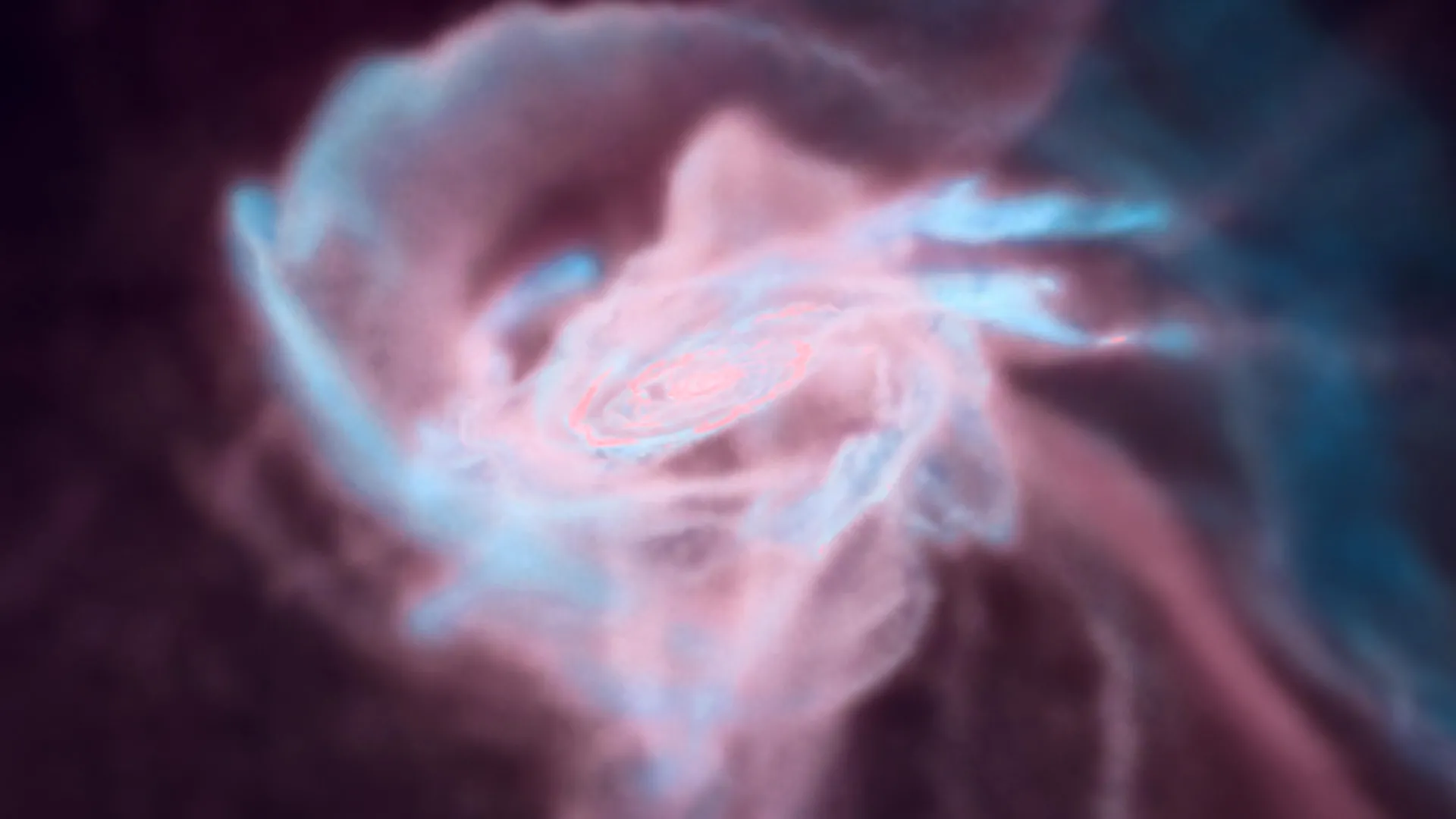
A team led by Sunmyon Chon ran nested cosmological simulations on Japan's ATERUI III and got black holes growing dozens of times faster than anything can today, with properties the release says resemble Webb's dots.
The Scientist · Science desk
What happened
- New simulations run on Japan's ATERUI III supercomputer suggest the Little Red Dots that JWST keeps finding are early-universe black holes caught in a phase of very fast growth.
- The team reports that the properties of the simulated black holes closely resemble the Little Red Dots seen by Webb, which would make the dots an early stage of that rapid growth.
- The puzzle behind the work is that black holes of millions to billions of solar masses already existed less than 600 million years after the Big Bang.
Compiled by The ScientistSomething wrong?How this is made
Why it matters
- constraint If ordinary radiation hydrodynamics and known accretion physics suffice, the early black hole problem stops being a search for exotic seed channels and becomes a question of whether the cloud-scale physics is modelled correctly.
- capability A single run that resolves both young-galaxy scale and individual gas clouds lets seed formation and the first accretion phase be computed together, so neither has to be inserted as an assumption about the other.
- decision The abundance claim is the one observers can attack first: how often young galaxies sat next to bright enough neighbours sets a predicted sky density that Webb's growing catalogue of dots can be counted against.
Far-ultraviolet radiation is the part of this picture that has to be common. In the simulations, FUV light from neighbouring galaxies keeps a gas cloud from cooling into many ordinary stars, so the cloud collapses into a single supermassive star [4], which then collapses into a black hole seed [5]. Seeds made that way start heavy, and a heavy seed needs fewer doublings to reach a billion solar masses [15].
Speed is the second ingredient. Dense disks around the seeds trap radiation and let them take up material more efficiently than black holes can in the present-day universe [6], by dozens of times [7]. "Dozens" is the release's word and not a measured multiplier. Take it as thirty: a doubling that would need 100 million years at modern rates takes a little over 3 million [16]. Compression of roughly that order is what the observations require, because black holes of millions to billions of solar masses already existed less than 600 million years after the Big Bang [10].
The design is a zoom-in. The run begins at the scale of a young galaxy, then refines into progressively smaller regions until individual clouds of gas are resolved, which is what the high-resolution capacity of ATERUI III was for [3]. Seed formation and the first phase of accretion happen at scales far apart, and one calculation covers both.
The dots themselves are still unidentified objects: tiny, extremely red, and present in numbers nobody expected before Webb [12]. The National Institutes of Natural Sciences release, dated September 17, says the simulated black holes closely resemble them [8][14], and that no unusual physics or highly unlikely event was needed to produce them [9]. It does not say which observed properties were compared, or name a journal for the work [17]. Matching properties in a simulation makes this growth channel viable; identifying the dots would take an observation that separates it from other ways of making the same appearance.
What to watch
- Whether independent groups reproduce collapse into a single supermassive star under the same far-ultraviolet conditions.
- Whether JWST spectra of Little Red Dots show the dense, radiation-trapping gas the model puts around these seeds.
- Whether the simulated growth phase ends at the millions-to-billions of solar masses already seen before 600 million years.