Product1 publisher3 min readPublished
Valve puts Steam Frame's color passthrough behind a $150 plug-in module
The headset ships with monochrome infrared cameras and a PCI-E slot on the front, and the Arcturus module that adds color costs $150 on top. Anyone building mixed reality has to guess how many owners bought it.
The Product Desk · Product desk
What happened
- The module attaches to the front of the headset through a PCI-E expansion slot. Other third-party hardware can use the same slot.
- Valve told PCGamer it is making a separate headstrap with a hot-swappable battery and higher-end speakers, along the lines of its 2019 Index.
- Polyarc, the studio behind Moss and Moss II, shut its doors in the week before the $1,060 Steam Frame's debut.
Compiled by The Product DeskSomething wrong?How this is made
Why it matters
- constraint A studio building color mixed reality for the Steam Frame is building for the subset of owners who paid $150 extra, and it has no published number for how large that subset is.
- cost The color-capable setup costs $1,210 before games, and the buyer pays that to get a camera the base unit does not carry.
- decision Anyone buying now has to decide whether to hold off for Valve's battery headstrap, and Gizmodo's account has no price for it.
- capability The expansion slot lets outside makers add sensors Valve chose not to ship. That is what makes optional full-body tracking hardware worth designing.
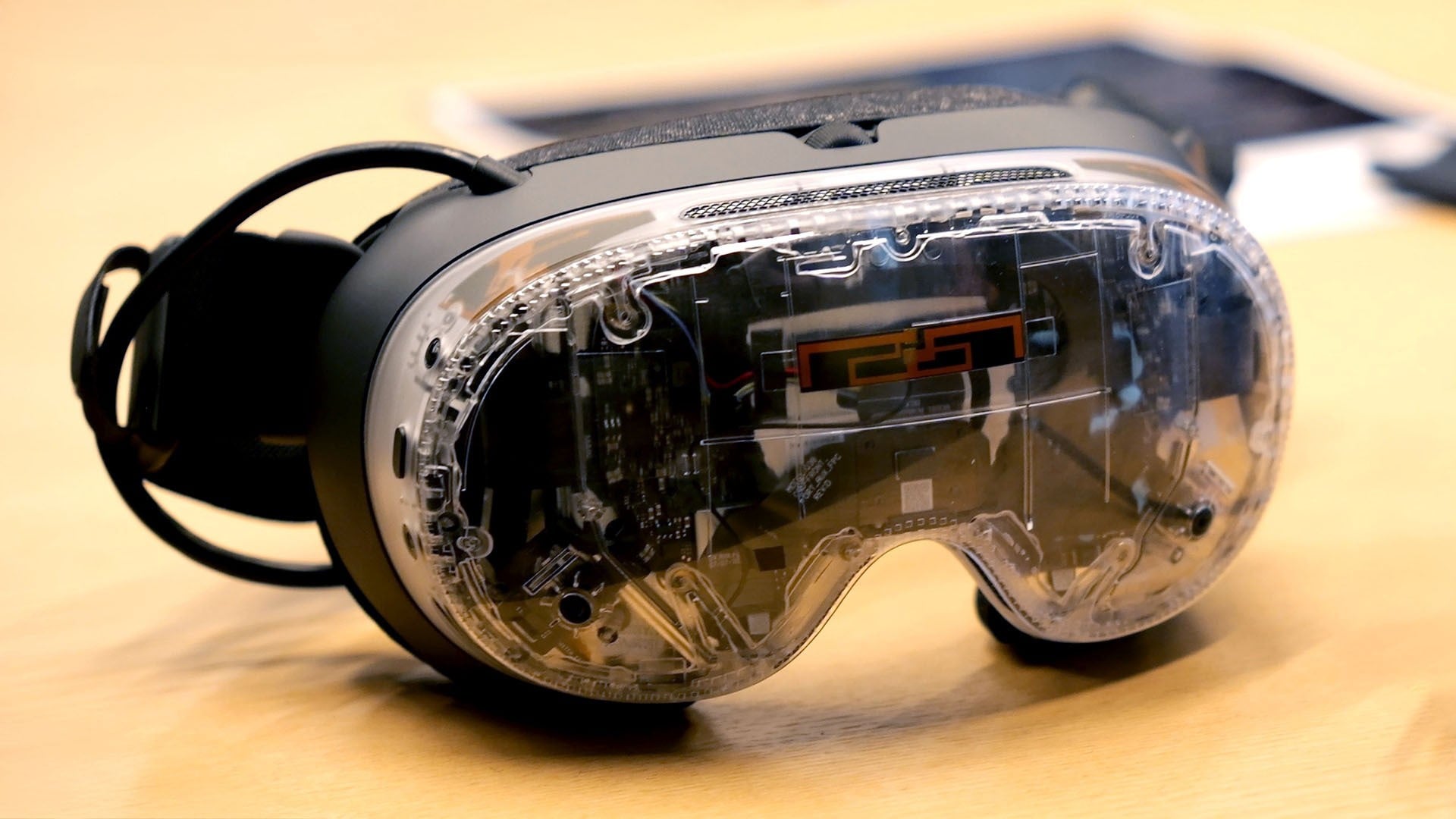
A Steam Frame owner who wants a game to see the living room in color has to buy two things. The headset ships with monochrome infrared passthrough cameras. Gizmodo calls it an awkward device for any augmented reality content [4]. Color passthrough and 3D video capture come from a $150 accessory made by Arcturus, promoted by Valve at launch, that plugs into the front of the headset through its PCI-E expansion slot [2][3].
At $1,060 for the headset [1], the color-capable configuration costs $1,210 [17], and the module alone is about 14 percent of the headset price [16]. For a buyer that is one line item. For a studio it splits the audience for every mixed reality feature it builds, into owners who bought the add-on and owners who did not, and nobody outside Valve can size those two groups yet.
The same pattern applies to the battery. Gizmodo names limited battery life as the weak point when the headset plays 2D and VR titles natively [5], and the fix Valve described to PCGamer is another accessory: a new headstrap with a hot-swappable battery and higher-end speakers, along the lines of what was in the 2019 Index [6]. Gizmodo does not report a price for that kit [18].
The slot is what makes third-party hardware plausible at all. Soulart, an indie company, is designing hardware-agnostic base stations it has promised will be compatible with Valve's headset [8], even though the Steam Frame tracks itself and its controllers without any infrared base stations [7].
Modular hardware still needs a market. Polyarc, the studio behind Moss and Moss II, shut its doors the week before the $1,060 headset's debut [9]. Gizmodo wrote that the Amsterdam team at Vertigo Games, which made Metro Awakening, met its end because the "VR market remains a challenging space" [10]. PCGuide was first to point out that practically all major online retailers, PlayStation Direct included, list the PSVR2 as out of stock or available only used or refurbished [11]. Gizmodo attributes rising VR hardware prices and thinner release schedules in large part to the ongoing RAMpocalypse [13].
A comparison with what Meta and Apple have chosen to build is not something this reporting can settle. The Meta item here is a "Project Pheonix" glasses and headset hybrid that Gizmodo says may be revealed at Meta Connect on Sept. 23, alongside Google and XReal's Project Aura glasses [14][15], and Gizmodo doubts either is built with play in mind.
For anyone shipping software on hardware with optional sensors, the decision turns on whether the feature needs a part that is absent from the base unit, and on whether you can put a number on the share of owners who will buy that part. Needing the part while having no such number means you design for the base unit and treat the module as a second path. The tradeoff is real: the showcase color demos will go to whoever bets on the $150 Arcturus module instead [2].
What to watch
- Whether Valve puts a price and a ship date on the hot-swappable battery headstrap it described to PCGamer.
- Whether Soulart's hardware-agnostic base stations ship with confirmed Steam Frame compatibility.
- Whether Meta's Project Pheonix turns up at Meta Connect on Sept. 23 with a gaming pitch attached.