Science1 publisher2 min readPublished
Michigan chemists reduce nitrate to ammonia by copying how plants grip it
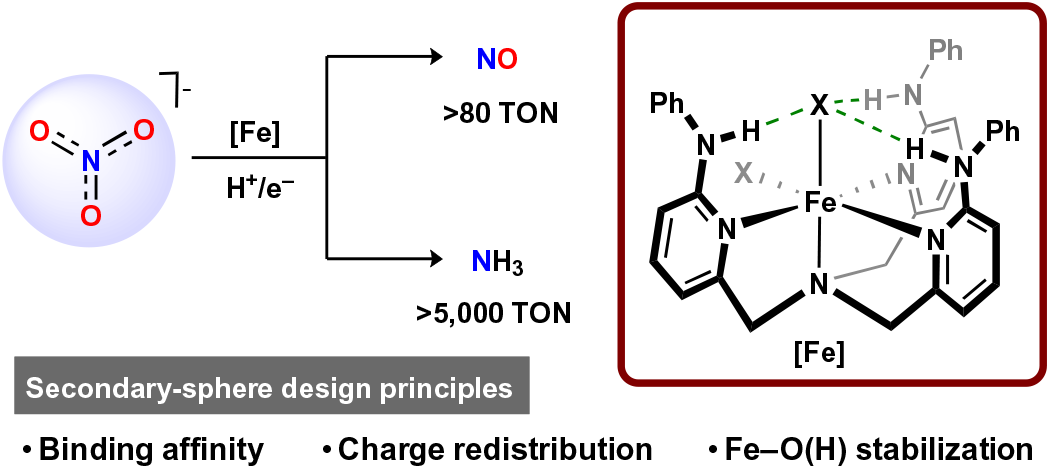
By engineering hydrogen-bond donors into the shell around an iron complex, a University of Michigan group forced the stable pollutant to react, using heat to make nitric oxide and light to make ammonia.
The Scientist · Science desk
What happened
- Chemists at the University of Michigan, led by Nathaniel Szymczak, reported a nitrate-reduction method in the journal Nature Chemistry.
- Driven by heat, the iron complex pulls oxygen atoms off nitrate and stops at nitric oxide.
- Under light, the same complex strips the oxygen away completely and yields ammonia.
Compiled by The ScientistSomething wrong?How this is made
Why it matters
- capability Because the product depends only on whether heat or light drives the reaction, one catalyst can be steered toward nitric oxide for medicine or ammonia for fertilizer.
- constraint The result is molecular chemistry at a single complex, and Szymczak says a device for a wastewater plant is still downstream work.
- precedent Showing that well-placed hydrogen bonds force the reduction gives other chemists a design rule to reuse on other hard-to-reduce molecules.
Nitrate resists cleanup for the same reason it works as fertilizer: it is a stable molecule, and stable molecules are hard to take apart [3]. It is the culprit behind harmful algal blooms and some groundwater contamination [2]. The Michigan group looked at how plants handle it. Nitrate transporter proteins grip the anion with hydrogen bonds from a surrounding shell of molecules that chemists call the secondary sphere [6].
Szymczak's team built that shell around an iron complex, positioning hydrogen-bond donors to latch onto nitrate and prime it for reaction [7]. "We found that just by having well-positioned hydrogen bonds, you can actually change the bonding structure in nitrate and force a subsequent reduction step," Szymczak said [8].
Heat drives the iron to pull oxygen atoms off nitrate and stop at nitric oxide, which is used in medical therapies to lower blood pressure [9][11]. Light drives the reaction further, stripping the oxygen away entirely to leave ammonia, which can be reused as fertilizer [10][11].
The paper's title calls the process catalytic, meaning the iron complex is not consumed as it works [15]. The summary did not report yields or rates, and it did not say how much the engineered hydrogen bonds strengthen nitrate binding. This is a molecular demonstration, and Szymczak is careful about its reach. He says scientists first have to understand how nitrate behaves and how it reduces before anyone builds a device for a site like a wastewater treatment plant [13].
"Now we tend to overfertilize crops, and a huge majority of the fertilizer we apply actually leaches away with runoff into streams, groundwater, lakes and oceans," Szymczak said. "Human impacts have basically caused an imbalance, and it's impossible for biological systems to compensate for as much nitrate as we're dumping into them" [12].
Reducing nitrate to ammonia turns a pollutant back into a fertilizer input [1][11]. "We are giving people a roadmap of how to achieve the difficult reduction step that we hope could be translated to engineered systems that might be used down the road," Szymczak said [14].
What to watch
- Whether the yields, selectivity, and turnover numbers in the full Nature Chemistry paper are strong enough to matter beyond a single molecule.
- How the catalyst behaves in real contaminated water, where other ions can compete for the binding site.
- Any step from the molecular complex toward the engineered remediation system Szymczak describes.