Build2 publishers3 min readPublished
Databricks raises Lakebase's 1 GB shared buffers cap to most of the machine's memory
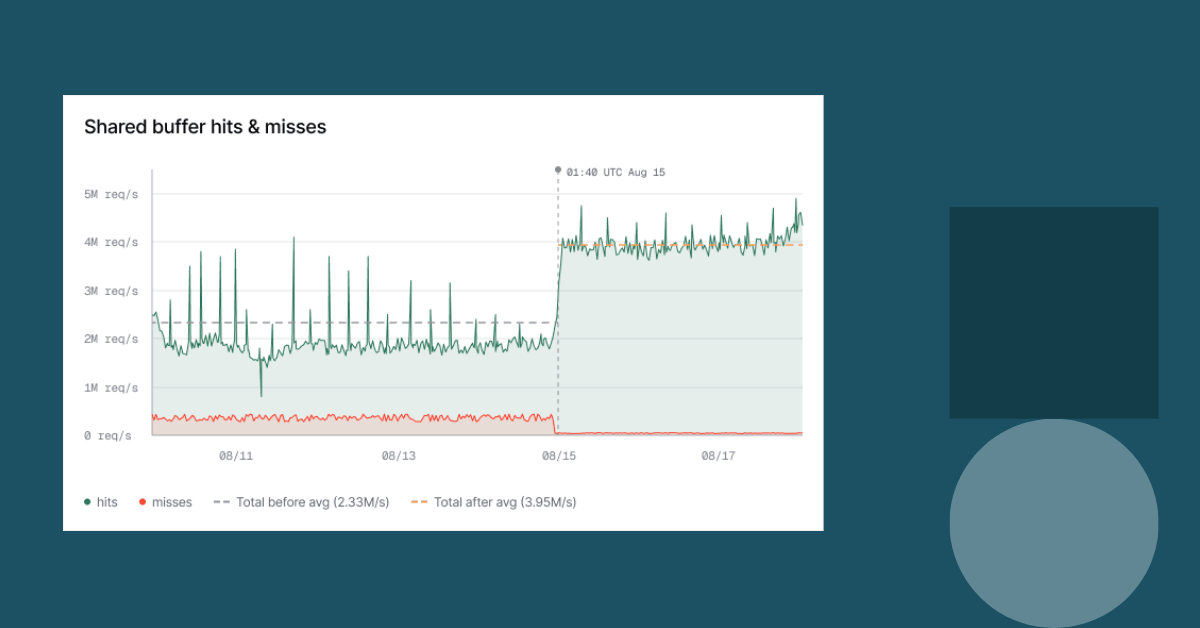
Hot pages on large fixed-size Lakebase computes now sit in Postgres shared buffers backed by huge pages instead of falling through to the local file cache, and Databricks measures up to about 2x throughput.
The Engineer · Build desk
What happened
- Lakebase Postgres keeps its data in an object store such as S3 and caches it at two layers, once in distributed storage and once on the compute, where frequently accessed pages are served from DRAM.
- Most of a large fixed-size compute's memory now goes into shared buffers backed by huge pages, live at CU 80 and above on Databricks and CU 18 and above on Neon.
- Databricks says it is measuring up to about 2x throughput on the new configuration, with fewer reads reaching the storage layer and lower latency.
- The stated end state is dynamic shared buffers that autoscale with the workload and use up to 75% of available memory, with autoscaling computes deferred to a promised part 2.
Compiled by The EngineerSomething wrong?How this is made
Why it matters
- decision Getting the DRAM tier today means choosing a fixed-size compute at CU 80 or above on Databricks, which trades away the autoscaling the local file cache was built to make possible.
- contradiction The post counts the LFC against a DRAM budget in one place and calls it a local disk cache in another, which changes how much of the throughput gain you should expect to reproduce.
- precedent If the autoscaling shared buffers work lands in community Postgres as Databricks says it will, LFC-style shims become a transitional artifact of serverless Postgres, a stage rather than a lasting tier.
Postgres runs a separate operating system process for each active connection [2], and every backend maps shared buffers into its own address space, which requires its own page table entries, the kernel-maintained structures the hardware walks to translate virtual addresses to physical memory [3]. Linux does that mapping across 4 KB pages by default [4]. One gigabyte of mapped shared buffers therefore costs 262,144 page table entries inside each backend [5], and the bill is charged again for every connection you open [2]. That is why the Databricks post says sizing shared buffers at 75% of DRAM on fixed-size computes was not as simple as a configuration change [17], and why the shipped configuration treats huge pages as load-bearing, not a tuning flourish [6].
Up to about 2x throughput is the figure in the summary, and it arrives there without a workload attached to it [11]. The conditions for it to transfer are legible from the mechanism. Your working set has to exceed 1 GB, because that was the largest shared buffers size ever configured, and everything above it was served by the slower local file cache tier [8][9]. It also has to fit inside the memory now handed to shared buffers, because a miss in both tiers still routes from the compute node to distributed storage [10]. A hot set that already fit in a gigabyte was already being served from shared buffers, and this change moves nothing for it.
Databricks turned the new configuration on at CU 80 and above; Neon at CU 18 and above [7], a gap of roughly 4.4x between the two floors [20]. Whether that reflects different memory per CU or different appetite for risk on each platform is not something the published thresholds settle.
The two descriptions of what the local file cache actually is do not line up. In the body of the post, the LFC takes whatever remains of a compute cache budget of up to 75% of DRAM once shared buffers have their gigabyte [8]. In the Neon summary, the same pages were falling through to a local disk cache [12]. Reads in a disaggregated system such as Lakebase do not travel through the OS filesystem or its page cache [22], which makes the memory accounting for a file-backed cache tier the interesting gap. How much of the 2x is DRAM against disk, and how much is one tier against another, depends on that answer.
Two of the wins follow from structure alone, with no benchmark behind them. Double buffering goes away, so a gigabyte of cached pages consumes a gigabyte of RAM instead of two [15][21]. And because the cache lives inside Postgres rather than the kernel, eviction can be decided with knowledge of database state, which the post frames as future positioning to pursue smarter replacement policies [16]. The authors call the LFC a clever and pragmatic solution and say they intend to retire its current form as they move to fully dynamic shared buffers [13][14]. It is still in use on all compute [13], so until part 2 the autoscaling path is the old path.
What to watch
- Part 2 on autoscaling computes, and whether the CU floors drop once shared buffers can resize without a restart.
- Whether the dynamic shared buffers work lands in community Postgres as patches or stays a Lakebase-side configuration.
- Whether Databricks publishes the workload, huge page size, and connection count behind the up-to-2x figure.