Product1 publisher3 min readPublished
ICE Buys A Camera For Every Officer, And A Release Rule That Defaults To No
Universal body cams by the end of August, under a February 2025 policy that releases death and serious-injury footage only when ICE decides it serves the agency. The spend grows storage, not disclosure.
The Product Desk · Product desk
Drafted by a language model from the sources cited here and checked against its claim ledger before publication. How we use AISend a correction
What happened
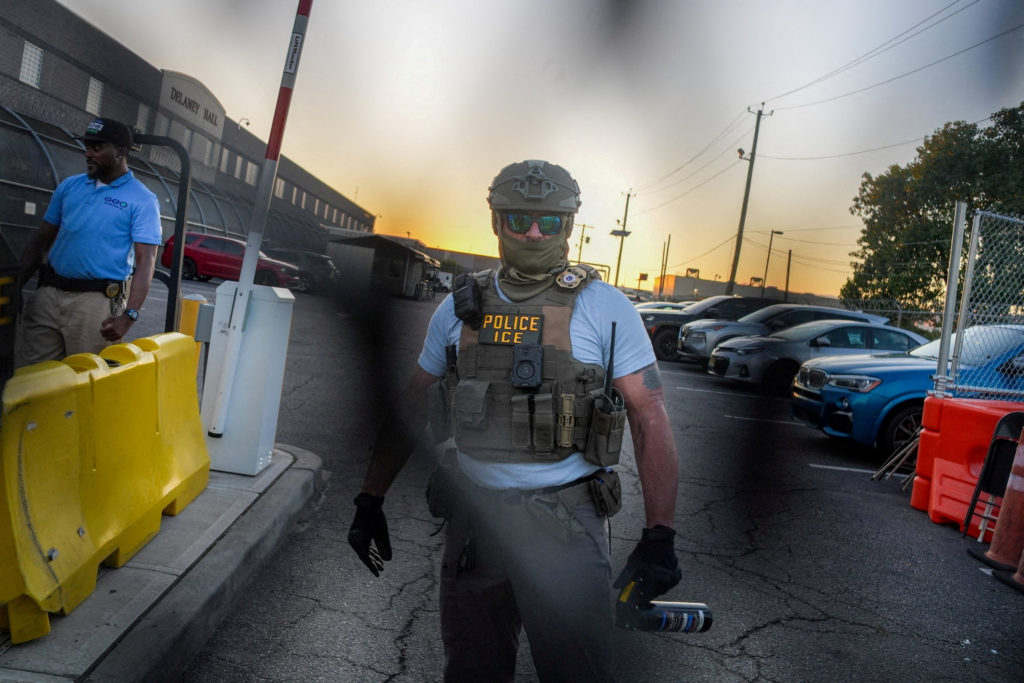
- ICE said Saturday it expects every officer and agent in the field to be equipped with a body camera by the end of August, a rapid expansion that could provide an unprecedented visual record of the federal government's immigration enforcement operations.
- ICE's policy says it will promptly release video of shootings and other encounters in which its agents cause death or serious injury only after determining "it is in the best interests of the agency" to do so; experts on body camera policies said that gives its director discretion to release recordings that reflect well on the agency's image while working to keep others secret.
- The body camera release policy was issued on February 18, 2025 and updated a day later; Techdirt writes that it gives ICE considerable discretionary control over releases and adds "a bunch of asterisks" to something meant to look like a release-by-default directive.
- The disclosure policy predates the camera fleet: it was issued in February 2025, while nearly every officer still lacked an agency-owned camera six months after the Minneapolis killings and full deployment is only promised by the end of August.
- Techdirt writes that after immigration officers murdered two people in Minneapolis, DHS made noises about outfitting officers with body cameras, and six months later nearly every officer was still without state-owned recording devices.
Compiled by The Product DeskSomething wrong?How this is made
Why it matters
ICE said on Saturday that it expects every officer and agent in the field to be equipped with a body camera by the end of August, a rollout the reporting describes as potentially an unprecedented visual record of federal immigration enforcement [1]. The same agency's written policy releases footage of encounters in which its agents cause death or serious injury only after it determines that release "is in the best interests of the agency," which experts on body camera policy say hands the director discretion to publish flattering recordings and bury the rest [2].
Note the order of operations. The disclosure policy was issued on February 18, 2025 and updated a day later [3]. The fleet is arriving now [1]. The rules were finished long before the hardware existed [4]. Anyone who has shipped an evidence system knows which of those two artifacts is the actual product spec: retention, access control, and release conditions determine what the system does, and the camera is just an input device.
The budget story is worth reading as a diagnostic. According to Techdirt, immigration officers killed two people in Minneapolis, and six months later nearly every officer was still without an agency-owned recording device [5]. Border czar Tom Homan told reporters on a Tuesday that "hundreds" of cameras were bought and sent to Minnesota after the shootings of Renee Good and Alex Pretti, but "there wasn't enough cameras to outfit every ICE agent, I was waiting up for more money" [6]. The legislation that made ICE the largest federal law enforcement agency carried $45 billion for new detention centers, $14 billion for deportation operations, and $3.5 billion in reimbursements to state and local governments [7], or $62.5 billion in total [8]. Techdirt notes it passed months before the killings and nearly a year before Homan's remarks [9]. The cameras themselves cost taxpayers tens of millions [10], under 0.2 percent of that package [11]. Money was not the binding constraint. Sequencing was.
What universal deployment reliably expands is ingest, storage, retention, search, and internal review. What it does not expand is a publication pipeline, because there is nothing in the policy that behaves like one. The single dated commitment is a possible 72-hour release window for injuries or deaths in custody [12], which Techdirt characterizes as a release-by-default gesture surrounded by asterisks [3]. Everything else routes through a case-by-case determination [2]: no queue, no service level, no default state.
Acting ICE director David Venturella says the policy "permits expedited release when appropriate" and clarifies that release is not appropriate where it could compromise investigations or privacy, that this mirrors other federal agencies, and that it is consistent with FOIA and the Privacy Act [13]. He also says ICE is committed to transparency and is ahead of its original timeline [14]. Techdirt's objection is structural rather than rhetorical: every shooting or serious-injury confrontation will be investigated, so the investigation carve-out can cover any of them [15].
Three things to watch. Whether the end-of-August date holds and how narrowly "in the field" is scoped [1]. Whether any death or serious-injury video actually surfaces inside 72 hours [12]. And whether the "best interests of the agency" determinations are written, dated, and logged, or exist only as an outcome [2].