Product1 publisher2 min readPublished
At 100 grams, Meta's VR glasses feel lighter and less fatiguing, with a 70-degree field of view
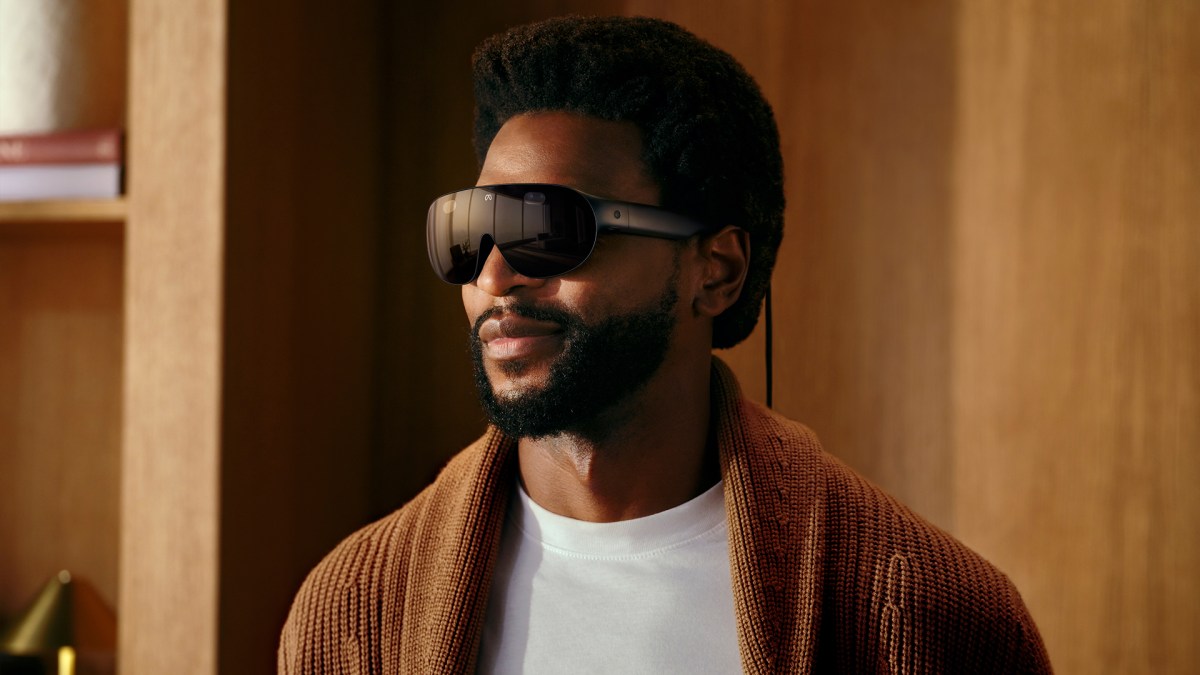
Meta's two-piece VR Glasses go on like eyewear and take the comfort objection away from anyone deciding about headsets at work. ZDNET's demo found the displays and the surface typing to be the weaker parts.
The Product Desk · Product desk
What happened
- Meta gave ZDNET a private demo of its VR Glasses, worn like eyewear at about 100 grams of magnesium alloy, with no light blocker and detachable nose pads.
- The battery and processing unit sit in a separate computing puck, the same two-part split Apple uses on the Vision Pro, which keeps components and weight out of the frame.
- Meta plans a spring 2027 launch in regular and large frame sizes, both priced at $1,299.
- The glasses run Horizon OS on the same tap-and-pinch gesture controls as the Quest 3 and Vision Pro, and any flat surface can be turned into a virtual keyboard and trackpad.
Compiled by The Product DeskSomething wrong?How this is made
Why it matters
- decision Teams that passed on headsets because nobody would wear 515 grams now have to argue about something else: whether a two-piece device with a puck to charge, pair and track fits how their people work.
- constraint Lens spacing is set by hand, so a shared pair needs a fitting at every handoff. Training rooms and hot-desk deployments pay that in helpdesk minutes per wearer rather than once per device.
- cost Surface typing is conditional, so text-heavy roles keep the physical keyboard and the glasses land as an addition to the desk budget instead of removing a monitor from it.
- capability Someone doing two-window work at a laptop can get extra displays without buying monitors, provided the picture quality holds up over hours. A demo covers half an hour.
ZDNET's reviewer sat with a code window floating in the air and a live web page beside it, editing in one and watching the other change [16]. The demo ran roughly 30 minutes and covered browsing, coding and movies [6]. On the wearing part, the reviewer wrote that "they weren't as much of a burden as I remembered similarly capable headsets feeling" [7].
Quest 3 weighs 515 grams and Apple's Vision Pro 600 [3]. At about 100 grams of magnesium alloy, with no light blocker and detachable nose pads [2], the glasses come in 415 grams under a Quest 3, a bit under a fifth of its weight [1][2].
The compute is off the face. The puck holds the battery and the processing unit, the same two-part split Apple ships on the Vision Pro [4]. ZDNET's review does not give a battery life figure, and it does not say how the puck connects. Whoever buys a fleet of these is buying a second asset per user to charge, pair and replace when someone leaves it in a hotel room.
ZDNET called the 5K displays, with their 70-degree field of view, "just all right" [10], saw blurriness and static around the players and crowd in an immersive NBA Finals replay [11], and wrote that the passthrough resolution is far from realistic [12]. Passthrough quality decides whether a wearer can read a paper form or a phone screen without taking the glasses off.
At $1,299 a head [5], a 20-person pilot is $25,980 of hardware [3]. ZDNET judged the capability closer to VR headsets that have sold for $2,000 or more [15], a gap of at least $701 per unit [4].
The use cases sort on whether the task needs sustained text entry and whether the wearer is parked at a laptop. Where typing matters, the physical keyboard stays and the glasses are extra screens for reading and watching; the multipoint trackpad gestures worked well in the demo, while surface typing needed the reviewer to lean forward at the right angle [13]. Where the wearer moves around, the puck joins the list of things that go missing. The clean quadrant is a stationary knowledge worker with a Windows or Mac laptop and no monitor budget. Extending that laptop into floating windows was the third item on Meta's own pitch list, behind 3D movies made with animation companies and casting Xbox games [14].
What to watch
- Whether Meta publishes a puck battery life figure and says how the puck connects to the glasses before spring 2027.
- Whether shipping units add automatic lens spacing adjustment.
- Whether any enterprise SKU, bulk price or device management appears; Meta's pitch to ZDNET was gaming, work and multimedia.