Product1 distinct publisher3 min readPublished
The Ace Ultra's obvious upgrades sit in the microphone array and the 44mm driver, but the feature that needed a new chip is Headphone Linking, and it only earns its keep in a house that already runs several Sonos speakers.
The Product Desk · Product desk

Compiled by The Product DeskSomething wrong?How this is made
Sonos built dedicated silicon for a specific, small moment: when you stand up mid-episode and walk to the kitchen, the sound either follows you or you go find a phone to make it follow you. Sonos decided that moment was worth a chip [2].
That is an odd place to spend silicon if you believe the last decade of headphone marketing, which argued about drivers and cancellation depth. The Ace Ultra still makes those arguments, with a 10-microphone array, a re-engineered 44mm driver and a quoted 35 hours with ANC on [9][10][11], and the Tom's Guide reviewer thinks they hold up against Sony and Bose at the price [15]. The specs that required new hardware are the network ones.
In practice, wireless headphone use is less about pairing once and settling in than about moving audio between destinations several times a day, with each move a negotiation with a settings screen. The failure list in the Tom's Guide hands-on is entirely about that negotiation, naming lip-sync drift, compressed audio, range limits and a trip back into menus to get the TV speakers working again [13]. Those are network and software failures, not transducer problems.
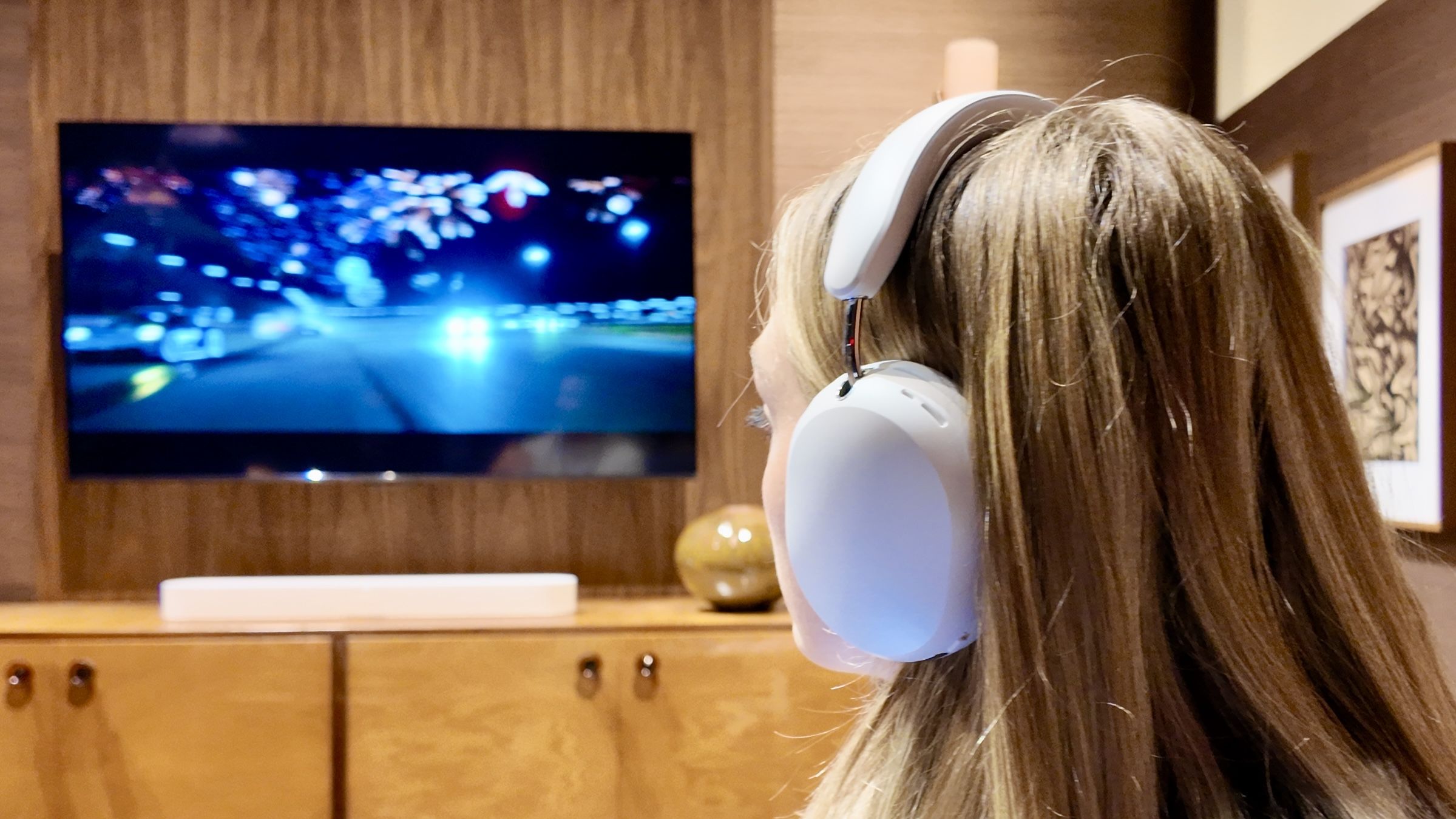
The mechanism is worth separating from the pitch. Headphone Linking, which arrives with the Sonos 27 software, means pressing the action button on the earcup next to a Sonos speaker to pull or push whatever is playing in that room, with no app open and the phone switched off elsewhere [5][6]. The reviewer's comparison is to Apple, where an AirPlay handoff still starts with physically tapping the iPhone to the speaker, and where HomePod audio cannot be grabbed by AirPods from a button on the headphones [8]. The difference is which device initiates, and Sonos moved that job off the phone.
It also moved the gate. Every part of this that needs the chip needs a Sonos speaker in the room you walk into [5]. Count the routes into these headphones and you get four: Wi-Fi, Bluetooth, USB-C and 3.5mm [17]. Three of the four work with anyone's source. The one that justifies Headphone Engine 2 works only inside your own install base.
So the forcing function is two counts you can do from the couch. How many Sonos speakers sit in rooms you actually walk into, and how many times a week you move audio from one place to another. Several speakers plus several moves a day is the only quadrant where the new silicon does work you would miss. One soundbar plus frequent switching was already served by TV Audio Swap on the 2024 Ace [7]. Several speakers plus occasional switching means $449 spent on isolation and battery, which is a defensible purchase on the reviewer's own comparison [15]. One soundbar plus rare switching is a Bluetooth headphone with extra steps.
The evidence that would settle this is the share of a household's listening minutes arriving over Wi-Fi rather than Bluetooth after a month, and the count of action-button handoffs per week, not a review score [5][12]. Judged that way, the Ace Ultra is a networking product with good headphones attached, and it fits the buyers whose houses already answer to Sonos.
Ranked by verification strength, evidence, and original report placement.
The Ace Ultra uses dedicated Headphone Engine 2 silicon that lets it connect to a local Wi-Fi network rather than relying solely on a Bluetooth connection to a phone or TV.
New Headphone Linking capabilities, part of the Sonos 27 software version, let the wearer tap the physical action button on the earcup beside virtually any Sonos speaker to instantly push or pull whatever audio is playing in that room.
For a Headphone Linking handoff the TV does not need to be on, an app does not need to be opened, and the phone can be completely turned off in another room.
The original Sonos Ace, released in 2024, introduced TV Audio Swap, which Tom's Guide describes as strictly a point-to-point link locked to a single soundbar.
Tom's Guide says Apple's closest equivalent still requires physically tapping an iPhone to a HomePod to initiate an AirPlay switch, and that audio cannot be handed from a HomePod to AirPods by pressing a button on the headphones.
Distinct publishers with included, body-backed reporting in this cluster.
1 article · September 1, 2026
Follow any of these and your For You feed starts watching them — no settings page required.
product
Sonos rebrands its audio software as an annual operating system release2 distinct publishers
product
Sonos turns lifting a speaker into the setup step for surround sound1 distinct publisher
product
Sonos opens every app-compatible speaker to ChatGPT and Gemini on September 81 distinct publisher
product
Sonos ships an operating system before it will say which speakers run it1 distinct publisher
Evidence-backed comparisons of source perspectives and observed adoption signals. Read the methodology
Which Builder, Operator, and Investor concerns the observed source mix emphasized—not a truth score.
Evidence, demonstrated adoption, hype gap, incentives, and confidence are assessed independently, each on its own current evidence. How these are measured.
One reviewer, one demo, Sonos's numbers
Every load carried in this story rests on a single Tom's Guide hands-on: the $449 price, the microphone count, the driver rework, the 35-hour rating and the phrase "zero-latency" are all as-reported, none independently measured. The reviewer usefully discloses where she listened — a living room setup with the Beam Ultra and a noisy event floor — which is exactly why the whole-house roaming claim is the weakest link: it is the one assertion the described setting could not have tested.
Announced, not yet adopted
There is nothing to count. Tom's Guide describes hardware and a software version, not people using them: no shipping date, no sales, no installed-base figure, and no sense of how many households own the several Sonos speakers that make Headphone Linking worth paying for. Availability is not uptake, and this story only shows the former.
Overstated by an unspoken precondition
The overshoot is not in the spec sheet, it is in the conditional Tom's Guide never writes down. "Zero-latency" and walking your entire house are Sonos's framing repeated after a demo in one room and one trade-floor; the head-to-head verdict against Sony and Bose arrives without a side-by-side. And the feature that justified building a chip — tap an earcup, take the room's audio with you — is worthless in a house with one Sonos speaker, which is a large asterisk on a $449 recommendation.
Vendor-arranged access, deals-funded publisher
Two pulls run the same direction here. Tom's Guide reaches this product through pre-release access at a Sonos demo, where the specs come from Sonos and the listening conditions are Sonos's to arrange; the page around the story sells newsletter signups, "great deals" and preferred-source status, which is a commerce-shaped business reviewing a $449 purchase. Sonos, for its part, gets the sharpest sentence in the piece — headphones as a node on its network — and that sentence is an argument for buying more Sonos speakers.
Shape clear, numbers unchecked
Middling, and for a specific reason: the mechanics are described concretely enough to trust the shape of the product — a headset that joins the network, a button that moves the room's audio, a clean contrast with the 2024 Ace's soundbar-only swap — while every figure remains the manufacturer's and every quality judgment remains one reviewer's afternoon. A second listen from anyone would move this number a long way in either direction.