Product1 distinct publisher3 min readPublished
In a demo TechRadar watched, a carried pair of Play speakers joined a Beam Ultra over an ultrasonic handshake with nobody touching the app, which moves the truth about your setup out of software and onto the furniture.
The Product Desk · Product desk

Compiled by The Product DeskSomething wrong?How this is made
The part of the demo worth replaying is the walk back. Conrad picked the Play speakers up again, carried them to their original space, and they rejoined the ordinary Sonos Wi-Fi network in their old roles [4]. Auto-configuration usually gets shown in one direction only, because the return leg is where it breaks: a soundbar that still believes it has rear channels in a room that no longer holds any, and an owner with no screen to consult about it. Sonos speakers have been pairing into stereo for years; what Fabric adds is that nobody has to declare the pairing [6], and the ultrasonic handshake plus temporary mesh [5] is elegant exactly as long as both ends are powered and in the same room.
Then the frequency question. Teams shipping a feature like this tell themselves that households restage the living room for movie night. What people mostly do with a speaker is put it somewhere and leave it. On that reading, the carry-a-speaker-into-surround trick is the demo, and the daily behaviour is the button on the Ace Ultra, which pulls audio off the Beam Ultra or any other current Sonos speaker in one press [11]. The original Ace only spoke to the Arc soundbar [12], so the count of sources a Sonos headphone can grab goes from exactly one device to the whole current family [15]. I would bet the button gets used far more often than the carry, and that ordering decides how the platform gets judged.
The headphone numbers invite arithmetic. Sonos quotes 35 hours of battery and 3 hours of playback from a 3-minute charge [13]. At that rate, filling the full 35 hours takes about 35 minutes on the cable [16]. Quick-charge curves rarely hold that straight line past the first few minutes, so treat 35 minutes as the ceiling the claim implies rather than a number to plan around.
On voice, 27Voice stays inside audio and resolved a rambling question about a musician into the right music [8], while anything else, cooking a tenderloin included, leaves as a prompt to whichever AI the owner picked [9]. Claude, ChatGPT and Siri can push the other way and control the speakers through what Sonos calls Sonos MCP [10]. For a company whose recent software TechRadar describes as an enervating mix of doing too much and too little [7], letting the control surface move off its own app is a sensible trade and a second support path to answer for.
The measure of whether Fabric worked is not app opens. It is what share of surround setups are still surround a week later with nobody filing a ticket, and how long a first-time owner takes to get sound out of a speaker they just set down. Two tests do most of the work here. Can the person standing in the room tell what state the system is in without opening an app, which with placement as the trigger [5] is currently no. And does the clever path degrade to the boring one, which the walk-back suggests it does [4]. What the account does not settle is which existing speakers can do any of this [17], and until that list exists, Fabric reads as a reason to buy a Beam Ultra rather than something the aging Play:1 pair on a reviewer's shelf [18] gets to join.
Ranked by verification strength, evidence, and original report placement.
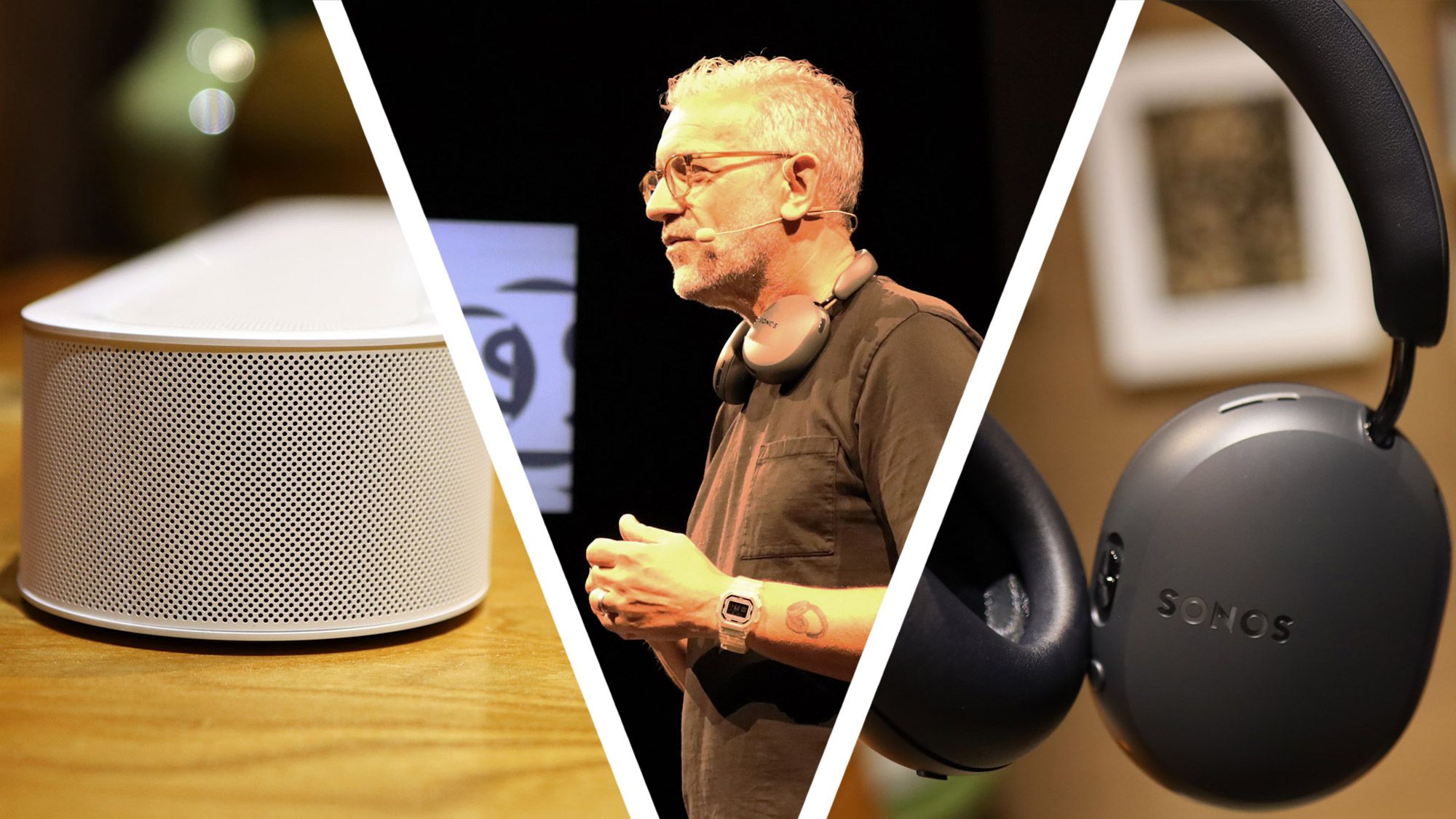
The new Ace Ultra headphones cost $449, include Sonos's Headphone Engine 2, and use Sonos Fabric to pick up audio from the Beam Ultra or any other member of the current Sonos audio family with one button press.
The original Sonos Ace headphones only connected to the Sonos Arc soundbar.
Sonos introduced a unifying software platform called Sonos 27, together with a connective layer it calls Sonos Fabric.
TechRadar's writer watched Sonos CEO Tom Conrad demonstrate the platform on Tuesday, moving between demo living-space setups.
Conrad carried a pair of Sonos Play speakers, placed them on a credenza opposite the new Sonos Beam Ultra, and without touching the Sonos app or the speakers turned the three audio sources into a unified surround system.
After the demo Conrad picked the Play speakers up and returned them to their original space, where they reconnected to the standard Sonos Wi-Fi network and resumed their regular roles.
Distinct publishers with included, body-backed reporting in this cluster.
Follow any of these and your For You feed starts watching them — no settings page required.
product
Sonos ships an operating system before it will say which speakers run it1 distinct publisher
product
Sonos rebrands its audio software as an annual operating system release2 distinct publishers
product
Sonos opens every app-compatible speaker to ChatGPT and Gemini on September 81 distinct publisher
product
Sonos's comeback rests on two FCC filings and one sentence about AI1 distinct publisher
Evidence-backed comparisons of source perspectives and observed adoption signals. Read the methodology
Which Builder, Operator, and Investor concerns the observed source mix emphasized—not a truth score.
Evidence, demonstrated adoption, hype gap, incentives, and confidence are assessed independently, each on its own current evidence. How these are measured.
One witness, one staged room
Every load-carrying detail — the ultrasonic handshake, the surround group forming untouched, the one-button headphone handoff — comes from one reporter watching Sonos demonstrate Sonos. The firsthand framing is a real strength: TechRadar says plainly what it saw and heard rather than paraphrasing a press kit. But the battery and charge figures are company promises passed through, the audio impressions come from a noisy demo space, and no measurement, teardown or second attendee corroborates any of it.
Pre-orders open, nothing in homes
The only usage facts available are a pre-order page and a September 29 ship date, plus Sonos's stated intent to release the software in waves. Nobody outside the demo has run Fabric in a real house with real walls and real legacy speakers. That is not weak adoption so much as pre-adoption, and the staged rollout means even shipping day will not tell us how widely the lift-and-join behaviour actually reaches.
Headline outruns the credenza
'Fully solved home audio' is a large sentence to hang on one afternoon with one pair of speakers and one soundbar. The specific observations underneath it are careful and mostly modest; the verdict on top is not, and it arrives before a single unit has shipped or a single unlisted legacy speaker has been tried. The distance between those two registers is the gap.
Sonos chose the room and the music
The staging is entirely the vendor's: darkened space, CEO as operator, Godzilla vs Kong on the 4K TV, demo speakers Sonos placed and Sonos moved. The reporter also volunteers that he owns and loves Play:1 speakers he still uses — honest, and exactly the affection that makes a turnaround narrative pleasant to write. Add a consumer-tech publication whose page invites readers to sign up for top tech deals, and the pressures pointing toward a warm verdict are easy to name; none of them are hidden.
Trustworthy narrator, untested claims
We can be fairly sure what TechRadar saw, and reasonably sure Sonos said what it is quoted as saying. We can be sure of very little about how any of it behaves outside that room. Confidence is capped less by the reporting's quality than by its singularity — no second account exists to disagree with, and the mechanism, the MCP layer and the battery numbers are all unrepeated.