Product1 distinct publisher3 min readPublished
The leaked mods that had people calling Nvidia's upscaler an AI filter were running without the engine data it feeds on, according to Tom's Guide, and the controls that shape the look sit on the developer's side.
The Product Desk · Product desk

Compiled by The Product DeskSomething wrong?How this is made
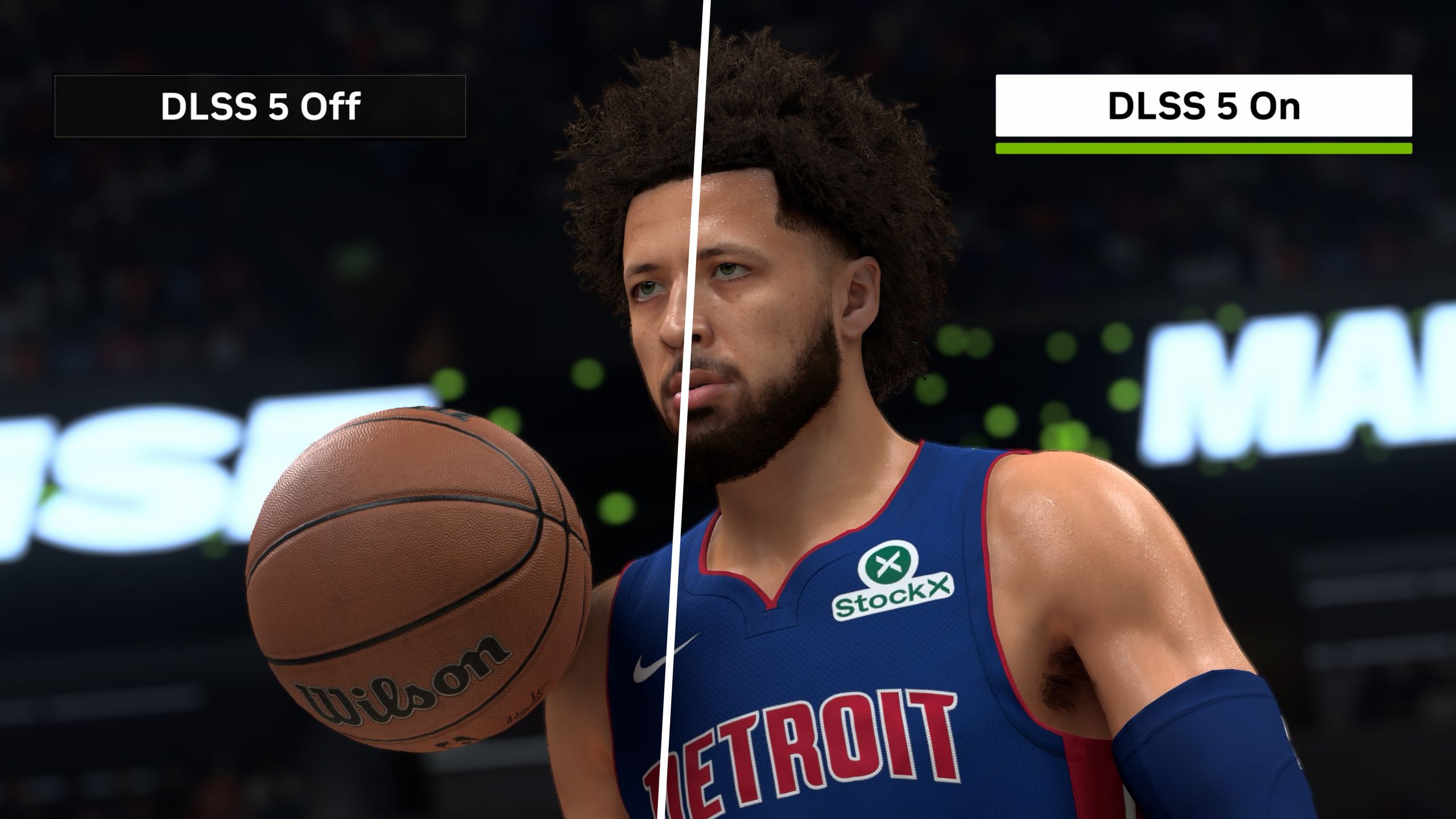
The plumbing is what explains the weekend's screenshots. A post-process filter takes one input, the finished frame, so it will bolt onto anything that draws pixels. Tom's Guide, briefed by Nvidia, reports that DLSS 5 instead reads geometry out of the engine: surface normals, the semantics of lighting, motion vectors, scene depth [3]. Asked directly whether this is just an AI filter, the publication's answer was technically no, because a filter works over a completed image [4]. The reviewer's description of injecting the file into a game with no engine-level hooks was hot-wiring a luxury car with missing spark plugs [6].
The other half of the mechanism is what Nvidia calls real-time determinism: every frame processed as it arrives to hold stability between frames, rather than the chunk-at-a-time guessing an offline video model does [5]. The payoff named in the briefing is unglamorous, which is a point in its favour. A face is supposed to stop redrawing itself at every scene change [5].
All of which puts the gain on a studio's calendar. There are three trained models, A leaning contrasty on lighting, C brightening faces and objects, B sitting between them [8]. That is three baseline looks to sign off per masked character before anyone touches tuning [15]. An art-direction review with a QA pass attached is a different kind of work item than a checkbox in a control panel.
Nvidia has already watched the cost of shipping the look before the tuning. It told Tom's Guide it should have communicated DLSS 5 better at GTC [11], after the early build's beautified characters landed badly in the publication's own gaming Slack and Digital Foundry's test was combed over for changes to lighting and atmosphere [12]. The masks and sliders are the answer to that complaint, and they are also the reason the next round of complaints arrives at the studio, which chose the values.
On performance, nobody outside has numbers. The demos ran with frame counters off and multi-frame generation switched on and ramped up, and what the reviewer could confirm was that play felt silky smooth with no noticeable latency [13]. That is not the same measurement as the modders' frame-rate complaint, so the two do not settle each other. What did move is the hardware floor: earlier demos wanted two RTX 5090s, and the same reviewer has now seen it on a single desktop GPU, on GeForce Now, and on an RTX 5060 laptop [7]. Call that a 2x cut in GPU count at the top of the range, with a mid-tier mobile part at the bottom [14].
Two questions sort this for anyone holding it as an integration ticket rather than a spec sheet. Does your engine already hand normals, depth, motion vectors and lighting semantics to a downstream consumer, or is exposing them a rendering-team project with its own schedule? And is there a named owner for character appearance who can pick a model, set the sliders, and defend both in a patch note? Yes to both, and this is a tuning exercise with a review attached. Anything else, and either the date is not September 3 or the build goes out carrying whatever default it happened to have, which is close to how the leaked mods earned their reputation.
Ranked by verification strength, evidence, and original report placement.
DLSS 5 is coming September 3 to NBA 2K27 first, and Tom's Guide received a full Nvidia breakdown of how it works plus hands-on time with NBA 2K27 on multiple systems before the embargo lifted.
Modders extracted the leaked DLSS 5 files from NBA 2K27 and put them into unsupported games; the online reaction split, with half praising the added detail and half declaring it an AI-filtered destroyer of frame rates.
Nvidia describes DLSS 5 as a 3D-guided neural rendering pipeline that ingests 3D geometry data including surface normals, the semantics of lighting, motion vectors and scene depth, so it works within the physical rules of the game engine rather than hallucinating.
AI filters slap a 2D post-processing effect over a completed image; asked whether DLSS 5 is just an AI filter, Tom's Guide's answer was that technically it is not.
Nvidia calls the approach real-time determinism: DLSS 5 processes every single frame in real time to maintain stability between frames, unlike offline video generation models that process chunks probabilistically, so a face does not change with every scene change.
The Tom's Guide reviewer says brute-forcing a neural rendering file into a game without engine-level hooks is like judging a luxury car after hot-wiring it with missing spark plugs, and that the mods miss the point.
Distinct publishers with included, body-backed reporting in this cluster.
Follow any of these and your For You feed starts watching them — no settings page required.
build
DLSS 5 spends half the frame budget on a pass the engine has to feed3 distinct publishers
product
Nvidia's DLSS 5 turns character skin into a slider someone has to own1 distinct publisher
product
Nvidia circles Rebellions because the low-power inference tier is not optional2 distinct publishers
build
Epic confirms a native Linux launcher, but the anti-cheat job posting is the real tell1 distinct publisher
Evidence-backed comparisons of source perspectives and observed adoption signals. Read the methodology
Which Builder, Operator, and Investor concerns the observed source mix emphasized—not a truth score.
Evidence, demonstrated adoption, hype gap, incentives, and confidence are assessed independently, each on its own current evidence. How these are measured.
One vendor-arranged session, no counters
Every load carrying detail here — the geometry inputs, the determinism argument, the three models, the shrink from two RTX 5090s — reaches us through a single Nvidia briefing that Tom's Guide attended, on hardware and settings Nvidia chose. The reviewer is candid that frame counters were off and that he can offer no figures beyond Nvidia's, which is honest and also the reason nothing about performance is independently checkable. What holds up unaided is the shape of the architecture: developer-side sliders, masks and model choice are described concretely enough to be tested on September 3.
One title, one date, plus leaked files
Real deployment amounts to NBA 2K27 on September 3. Everything else in circulation is stolen goods — files pulled from that build and injected into games with no hooks to feed them, which is adoption of a sort but the kind Nvidia would rather not be judged on. Breadth of hardware is genuinely new (desktop, GeForce Now, a 5060 laptop), yet breadth of software is a single sports sim in a technique Nvidia says stylized games should skip.
Game-changer language, unmeasured frames
The headline promises a photorealistic game-changer; the performance section admits no numbers were collectable and that frame generation was carrying part of the smoothness. That gap is what pushes this positive. It is not a large gap, because the same piece does the deflating work too — it says stylized games will look wrong, notes developers can decline, and refuses to extrapolate beyond Nvidia's figures. The overstatement lives in the adjectives, not the reporting.
Access granted to fix a first impression
Nvidia told Tom's Guide outright that it should have communicated DLSS 5 better at GTC — and then supplied the breakdown, the machines and the embargo window in which to publish it. That is a company buying a second first impression, days after leaked files had the internet calling its upscaler an AI filter. The outlet's incentive runs the same direction: it had covered the backlash internally, and a hands-on reversal is the natural follow-up. None of this makes the technical detail wrong; it does mean the framing was co-produced.
Architecture credible, performance unsettled
Confidence splits by claim type. That DLSS 5 consumes engine geometry and exposes model, slider and mask controls to developers is specific, falsifiable on launch day, and unlikely to be wrong. That it delivers photorealism at playable frame rates on a 5060 laptop is, for now, one person's eyes on a vendor rig with frame generation enabled. A second independent test of the September 3 build would move this figure a long way in either direction.