Science1 publisher3 min readPublished
Psilocybin's 'oneness' now has a brain-network correlate, and it was found by sorting people on self-report
A Nature study of 62 psychedelic-naive adults reports that the feeling of dissolved self-world boundaries tracks integration between self-referential and sensory networks.
The Scientist · Science desk
Drafted by a language model from the sources cited here and checked against its claim ledger before publication. How we use AISend a correction
What happened
- Results published in Nature show that taking psilocybin causes brain networks that typically process the self and the outside world separately to become integrated.
- Lead author Devon Stoliker, a computational neuroscientist at Monash University in Australia, says the work "reframes our understanding of the psychedelic experience by providing a biological basis for some of the meaning and coherence people report."
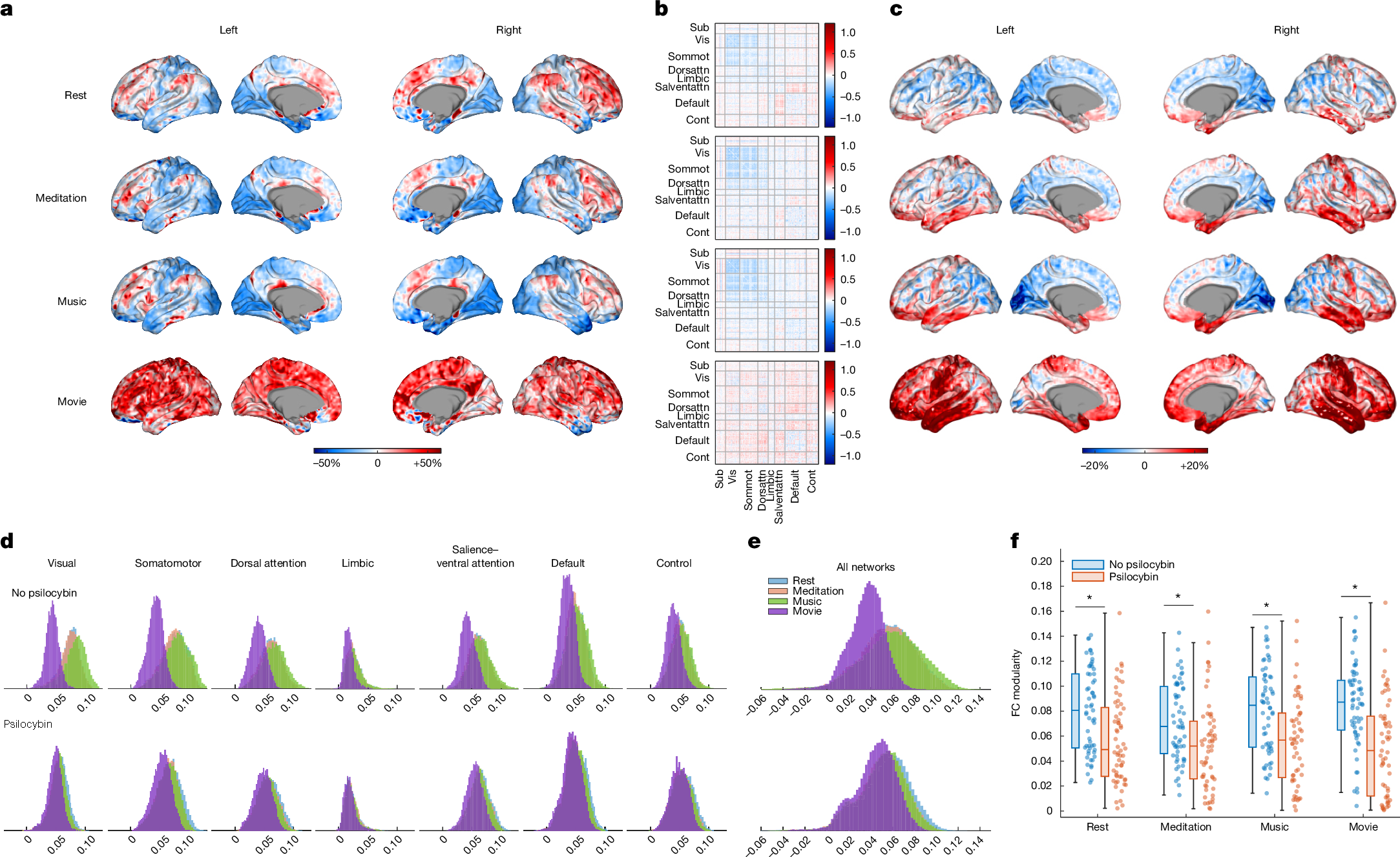
- The researchers gave 62 healthy adults with no psychedelic experience a dose of psilocybin, then scanned their brains while resting, meditating and listening to music (all with eyes closed) and while watching a movie.
- Many participants experienced a blissful state of oneness, which the researchers call "embeddedness."
- One participant reported, "I melded with the MRI machine, floor, walls, air. It was like nothing existed except for me, or me as part of something bigger."
Compiled by The ScientistSomething wrong?How this is made
Why it matters
Researchers reported in Nature that psilocybin drives brain networks which normally process the self and the outside world separately into an integrated state, and that the clearest signal appeared in the people whose conscious experience was most strongly altered [1][12]. That is a candidate physical correlate of the psychedelic field's central subjective claim, an effect currently argued about on the basis of what participants report [16][5].
The design was 62 healthy adults with no prior psychedelic experience, dosed and then scanned in four contexts: resting, meditating and listening to music with eyes closed, and watching a movie [3][17]. Many reported a blissful state of oneness that the authors call "embeddedness" [4]. One participant described it as melding with the MRI machine, floor, walls and air, "like nothing existed except for me, or me as part of something bigger" [5].
Two measurements matter. First, the connectivity direction: systems handling sensory input from outside became less connected to the rest of the brain, while higher-level systems became more connected, which lead author Devon Stoliker of Monash University describes as a shift in the balance between internally generated and sensory processing [6][7]. Second, and more interesting, the machine-learning result. Participants with less profound experiences showed widely variable brain activity even when doing the same task as their peers, whereas people who felt a strong sense of oneness converged: key dimensions of their activity resembled each other's, forming distinct patterns per activity [8]. Stoliker's summary is that "network activity became more similar when participants experienced less separation between self and world" [9].
That runs against the standard account, in which a trip makes brain activity more random, desynchronises networks that usually fire together, and forms new connections, a shake-up thought to underlie therapeutic effects [10]. Stoliker frames the puzzle plainly: if the brain becomes more disorganised, why do some people have highly meaningful and coherent experiences [11]. His group's answer is a hidden order inside the chaos [12].
Note the direction of inference. The convergent pattern was identified by grouping people according to how strongly they said their sense of self had dissolved [8][12]. A measure calibrated against self-report is a correlate of self-report, not yet a replacement for it, and these were healthy volunteers rather than patients [3]. Lorenzo Pasquini of the University of California, San Francisco, who was not involved, says the field remains split on whether benefits come from the conscious experience of tripping or from the underlying connectivity changes, and that this study does not resolve it, though it hints at the importance of the experience [16].
The operational consequence is about setting, not molecules. The findings give a neurobiological reason why where a trip happens and what someone does during it shapes the experience [13]. Nico Dosenbach, a neurologist at Washington University in St Louis, who was not involved, calls that context sensitivity a double-edged sword, and says the results argue for a controlled, positive setting, which would make therapy more expensive and harder to deliver but not unrealistic [14].
Watch whether the individual-level modelling holds up out of sample, and whether it predicts anything: senior author Adeel Razi says studying individual brains during a trip with machine learning could help explain why the same drug produces such different experiences in different people [15]. Until that prediction is tested in patients, the questionnaire is still the instrument of record.