Science1 publisher2 min readPublished
Structures of RhoBAST catch one guanosine flipping outward to make room for the dye
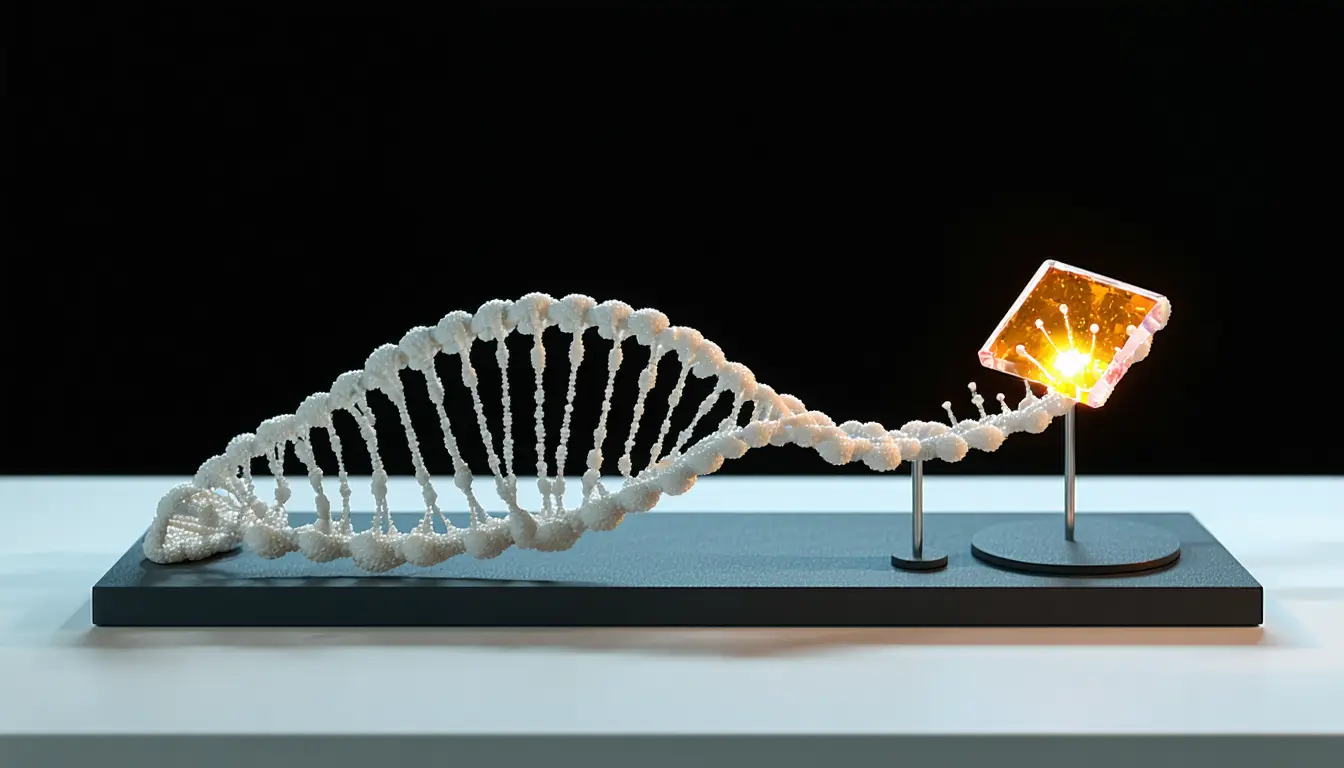
Ronald Micura's group in Innsbruck and Aiming Ren's in Zhejiang solved the RNA imaging tag with and without dye bound, and the residue that moves, G38, is what lets the dye leave again fast enough to blink.
The Scientist · Science desk
What happened
- Groups led by Ronald Micura at the University of Innsbruck and Aiming Ren at Zhejiang University solved RhoBAST both with no dye bound and in complex with TMR-DN and related dyes.
- The aptamer takes an inverted V shape and holds the dye between two RNA loops, and the guanosine at position 38 flips from inward-facing to outward-facing when the dye arrives.
- Light-up aptamers work because the dye fluoresces only weakly until the RNA binds it, which is what keeps background low and allows RNA tagging without a protein fusion marker.
- The work appears in Nature Communications, first-authored by Xiaoqing Tai.
Compiled by The ScientistSomething wrong?How this is made
Why it matters
- capability Exchange rate becomes something a designer can attack at a known position instead of a property you accept from whichever sequence a selection round returned.
- constraint One motion does two jobs, opening the pocket and letting the dye out again, so a variant that holds the dye more tightly is a variant that may blink less.
- decision A lab choosing an RNA tag this month still chooses among the same reagents; the value here accrues to whoever builds the next aptamer.
Solving the aptamer with no dye bound is the informative half. A complex on its own shows where the dye sits; only the unbound form shows what had to move to let it in, and the two structures together put that motion at guanosine 38 [2][4].
The paper by Xiaoqing Tai and colleagues in Nature Communications is titled "Nucleotide flipping correlates with fluorescence activation in the RhoBAST imaging platform" [3]. The summary from the University of Innsbruck says the flip controls fluorescence activation [10][12]. The team did more than watch: structure-guided mutagenesis, fluorescence spectroscopy, surface plasmon resonance and 2-aminopurine kinetics were used to tie the flipping to rapid dye exchange and to the blinking that super-resolution methods depend on [5].
"The flipping of a single nucleotide enables the rapid exchange of the dye and thus the characteristic blinking that is essential for super-resolution microscopy," Micura said [9].
If the exchange rate depends on how readily G38 leaves its inward-facing position, then position 38 and the bases stacked around it are where you would start mutating [4][5]. Micura's group describes the work as a foundation for a new generation of live-cell RNA imaging tools [11]. The phys.org account does not name the mutants tested or give the measured rate constants [13].
These measurements say nothing about performance in a cell. Fluorescence spectroscopy, surface plasmon resonance and 2-aminopurine kinetics report on binding and on local base dynamics in purified samples [5]. How bright a tagged transcript looks under a microscope is a different quantity, and the low background that makes these systems useful comes from the dye being only weakly fluorescent until it binds the RNA [6].
RhoBAST sits in a family that already includes Spinach, Broccoli, Mango and Pepper, and it is the one that images individual RNA molecules in living cells [7]. In my view the mutagenesis plus the kinetics is enough to treat the flip as causal for fast dye exchange, and the blinking argument follows from that; I take the title's hedge to be caution about the fluorescence step [5][3]. Whether the same flip governs the other aptamers is untested here.
What to watch
- A variant at position 38 with a measured change in dye exchange rate and in blinking, which would turn the correlation into a design rule.
- Dye-free structures of Pepper or Mango, to test whether a similar local flip governs the rest of the aptamer family.
- A super-resolution dataset showing that a tuned exchange rate changes single-molecule localisation counts, not just in vitro kinetics.