Science1 publisher2 min readPublished
Histone readers MLLT1 and MLLT3 decide which genes AID mutates
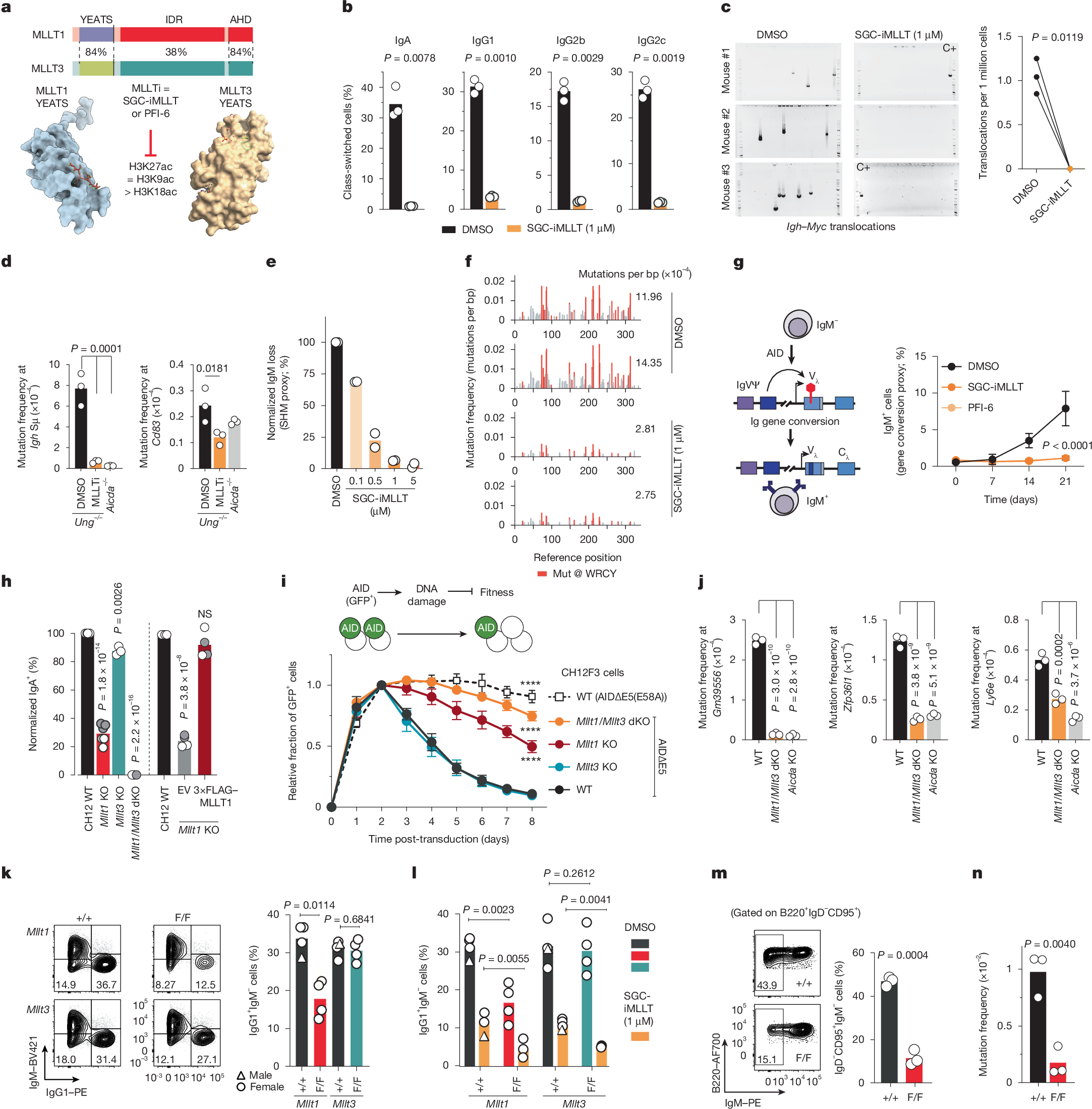
Deleting the histone readers MLLT1 and MLLT3 abolished every AID-driven mutation in B cells, a Nature study reports. The same reader-marked regions are where AID's off-target mutations help drive B cell lymphoma.
The Scientist · Science desk
Drafted by a language model from the sources cited here and checked against its claim ledger before publication. How we use AISend a correction
What happened
- Transcription is necessary for AID but does not choose its targets: most transcribed genes are never mutated, and the enzyme sits on far more of the genome than it ever changes.
- The readers are not needed to get AID onto chromatin in the first place; what they add is a local build-up of the enzyme just downstream of gene promoters.
- Both proteins bind AID and can cover for each other, but in mice MLLT1 does most of the work through a disordered region that forms droplet-like condensates.
- Fusing AID directly onto either reader was enough to restore class-switch recombination and hypermutation in cells that had lost both.
- Transcription barely moved after both readers were deleted, far too little to explain why AID's mutating collapsed.
Compiled by The ScientistSomething wrong?How this is made
Why it matters
- constraint Transcription has anchored explanations of where AID mutates, but expression is only a precondition, so a model that predicts off-target mutation from a gene's activity alone under-calls where AID strikes.
- capability Because concentrating AID at a spot is enough to switch its mutating on, its targeting can in principle be redirected by moving the reader it binds, a control researchers did not have.
- precedent Reader occupancy becomes a testable predictor for lymphoma genomics: whether the genes at risk of AID's off-target damage can be identified by where MLLT1 and MLLT3 sit.
MLLT1 and MLLT3 are histone readers carried by the super elongation complex, the machinery that travels along with actively transcribed genes [5]. AID targets the immunoglobulin genes and a narrow set of others, but how it tells those apart from the thousands of transcribed genes it leaves untouched had been unresolved [3]. The paper's answer is about place: the authors describe a licensing step in which local reader enrichment confines AID to a restricted subset of the genome and concentrates its activity there [13]. On that reading, what selects a target is how much reader protein has gathered at the site [13].
The experiments run in the mouse B cell line CH12F3 and the human line Ramos, with reanalysis of already-published datasets [15]. To reach past cultured cells, the group set its reader-occupancy maps against a curated catalogue of regions hit by aberrant somatic hypermutation in human B cell lymphoma [14]. That catalogue comes from human tumours, so the link is not only a cell-line finding [14].
This work maps a mechanism. Antibody diversification depends on the same AID activity these two proteins concentrate [1], so removing the readers would take out the useful mutation along with the harmful kind. Whether that boundary can be moved to block off-target damage without disarming a normal antibody response is not something these cell experiments can test [1].
What to watch
- Whether disrupting MLLT1's condensates lowers AID off-target mutation in an actual lymphoma model, which would show the mechanism is a drug target and not only a marker.
- Whether reader-occupancy maps predict which genes pick up aberrant hypermutation across human lymphoma subtypes, in patient sequencing rather than cell lines.
- Whether off-target damage can be suppressed without also blocking the protective antibody diversification the readers enable.