Invest1 distinct publisher3 min readPublished
China supplies close to 30% of some transformer and switchgear categories and more than 40% of US battery imports, so the Energy Department's new power to condition those purchases lands on a buildout planning to go from 62 GW to 152 GW.
The Investor · Invest desk

Compiled by The InvestorSomething wrong?How this is made
The operative phrase in the order is the authority to prohibit or impose conditions on certain transactions involving components used in the grid and in data centers [2], and a conditioning power behaves differently from a duty. A duty gives you a number you can finance. A condition gives you a date nobody can forecast. The source material does not say which transactions the Energy Department will actually reach, which is the whole question for anyone with substation transformers on order.
Now the arithmetic, because it is what makes the sourcing share bite. S&P Global's June forecast has US data center capacity going from 62 GW in March 2026 to 152 GW by 2030 [8], which is 90 GW of addition and roughly 2.45 times the starting base [15], or about 22.5 GW a year across those four years [16]. Grid connectors scale with the new megawatts rather than the installed ones, and Yury Dvorkin of Johns Hopkins puts China near 30% of certain transformer and switchgear categories and above 40% of US battery imports [4]. Counterpoint's figure on optics is the harder one: if Chinese firms supply roughly two-thirds of global optical transceiver units [7], the non-Chinese third would have to triple its output just to hold today's unit demand flat [17], and demand is not flat.
The gaps in these numbers matter just as much as the numbers themselves. "Certain categories" is doing real work in Dvorkin's 30% [4], the transceiver share is global units rather than US data-center purchases [7], and nothing in the material attaches a dollar of exposure to a named buyer. CNBC says it approached the Chinese embassy in the UK for comment [13].
Here is how this could play out. The narrow version: the Energy Department applies its authority to utility bulk-power transactions, data-center equipment behind the meter is largely left alone, and the cost is filings. The broad version: conditions land on the on-site substation transformers Ben Boucher of Wood Mackenzie flags as the most notable dependency [10], and megawatts sit finished but unenergised. The third and more interesting version is upstream, where Dvorkin locates deeper exposure in copper, electrical steel and battery cathode materials [5]; reshored assembly still buys those, and the tariff leg of the reshoring agenda the White House describes [14] prices them higher for the domestic plant that is supposed to be the answer.
My read, and it may be wrong: the binding constraint is the roughly 30% share in exactly the grid-connector categories Dvorkin names as the mid-term exposure [6], because those items sit on the critical path to energising a building that is otherwise complete. Laveena Iyer of The Economist Group dates the shift in scrutiny from the compute stack to the power stack to about the last eight months [9], which is brief next to the time a 90 GW build takes [15].
What would prove it wrong: a first round of Energy Department conditions that exempts customer-side equipment, or evidence that the near-30% share concentrates in transformer classes hyperscalers do not buy. Either would turn this into a compliance line item on a supply chain that was already tight. The April determination naming transformers, substations and high-voltage circuit breakers essential to the national defense [11] suggests the administration is not aiming narrowly, and Trump's own framing ties the urgency to the growth of data centers and AI [12].
Ranked by verification strength, evidence, and original report placement.
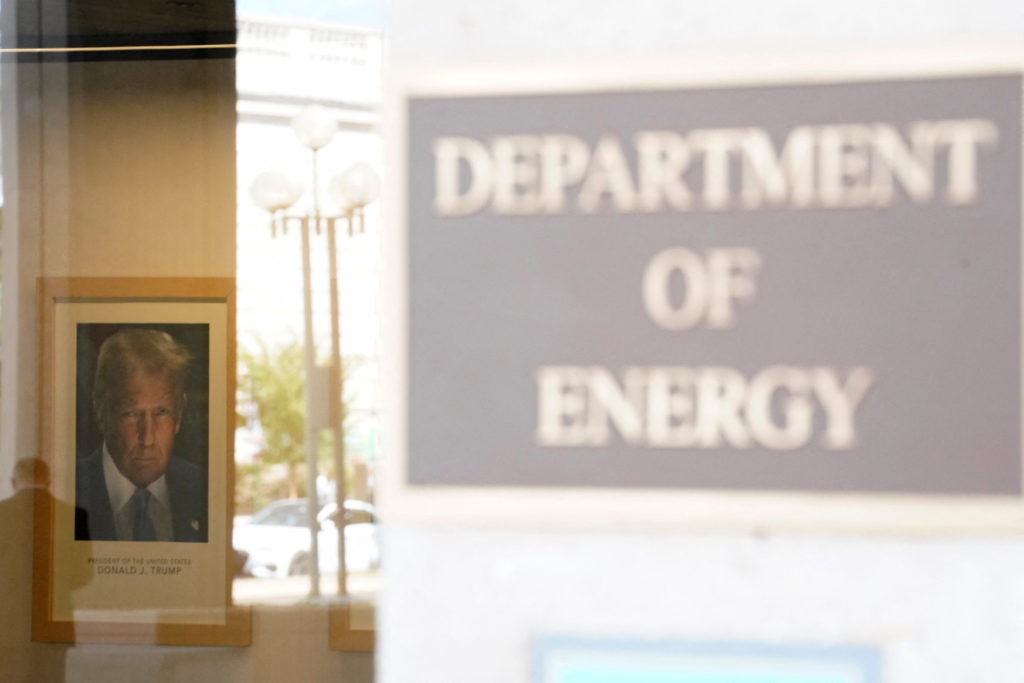
President Donald Trump signed an executive order last week declaring a national emergency around the "extraordinary foreign threat" to the US involving bulk-power system equipment produced abroad.
The order authorized the Energy Department to prohibit or impose conditions on certain transactions involving some components used in the grid and data centers.
Chinese firms supply large portions of the parts needed to develop US AI data centers, including transformers, switchgear, batteries and optical technology, analysts told CNBC.
Yury Dvorkin, associate professor at Johns Hopkins University, told CNBC that China's share of certain transformer and switchgear categories runs near 30% and that it accounts for over 40% of US battery imports.
Dvorkin said the mid-term exposure is concentrated in grid connectors: transformers, switchgear and batteries.
According to research firm Counterpoint, Zhongji Innolight and Eoptolink lead global data center optical transceiver revenue, with Chinese firms collectively accounting for roughly two-thirds of global unit supply.
Distinct publishers with included, body-backed reporting in this cluster.
1 article · September 3, 2026
Follow any of these and your For You feed starts watching them — no settings page required.
product
Washington's secret AI test is coming for open weights, and release dates go with it2 distinct publishers
security
Grid supply-chain risk becomes a prohibition, and the inventory bill lands on utilities6 distinct publishers
product
New drone tariffs set to take effect in September, with more component tariffs in 20271 distinct publisher
product
Unitree's 'Superman' clip is a prospectus: 6.1bn yuan raised before a STAR Market debut3 distinct publishers
Evidence-backed comparisons of source perspectives and observed adoption signals. Read the methodology
Which Builder, Operator, and Investor concerns the observed source mix emphasized—not a truth score.
Evidence, demonstrated adoption, hype gap, incentives, and confidence are assessed independently, each on its own current evidence. How these are measured.
Firm on the order, thin under the percentages
The legal facts are solid — the order, its Energy Department authority and Trump's own words are quoted directly, and the April defense determination is quoted too. The share figures are softer than they look. Near-30% for transformers and switchgear and 40%-plus of battery imports come from one Johns Hopkins researcher with no category definition or dataset attached, and the upstream copper and cathode exposure he cites rests on analysis the reader cannot see. Counterpoint's two-thirds optical figure at least carries a named research house behind it.
Authority granted, replacement capacity still pouring concrete
What has actually happened is administrative: an order signed, an April defense designation, inverters added to the FCC's Covered List. What has not happened is substitution. Hitachi Energy's $457 million transformer plant and Siemens Energy's $1 billion commitment are announcements against a base S&P Global expects to grow by roughly 90 GW, and CNBC reports no instance of the Energy Department blocking or conditioning a single transaction yet. The optical arithmetic shows the size of the hole: the non-Chinese third would need to roughly triple.
Headline promises hidden risk; body delivers known dependence
Modest overstatement, concentrated in the framing. "Hidden China risks" and the warning of higher costs and worse shortages open a piece that then supplies no price, no lead time and no conditioned transaction — while the analyst it quotes says this scrutiny has been building for eight months, which makes the risk tracked rather than hidden. The underlying reporting is careful; the packaging runs ahead of it.
Every named voice has a position in the outcome
Read the sourcing as a cap table. The White House uses its answer to advertise tax cuts, tariffs and deregulation. Two of the three analysts sell supply-chain research to the industries affected. Hitachi Energy and Siemens Energy are building the plants that restrictions would fill, and Nvidia holds $2 billion in each of Lumentum and Coherent, the American firms most directly advantaged by the optical transceiver ban CNBC reports is being drafted. The one party with an interest in disputing the numbers, China's embassy, is silent.
One newsroom, no duplication
Cap this at what a single account can bear. CNBC's reporting is internally consistent and its documentary claims are quotable, but nothing here has been reproduced elsewhere in our coverage, and the two figures a reader is most likely to repeat came from one interview each. Verification, not plausibility, is what is missing.