Science1 publisher3 min readPublished
Head-mounted datalogger takes closed-loop neural recording outdoors in mice
A wireless device worn on the animal combines flexible probes, optogenetics, motion sensing, an ultrasonic microphone and a head camera, and runs its event detection onboard so it can intervene while a mouse is still moving.
The Scientist · Science desk
What happened
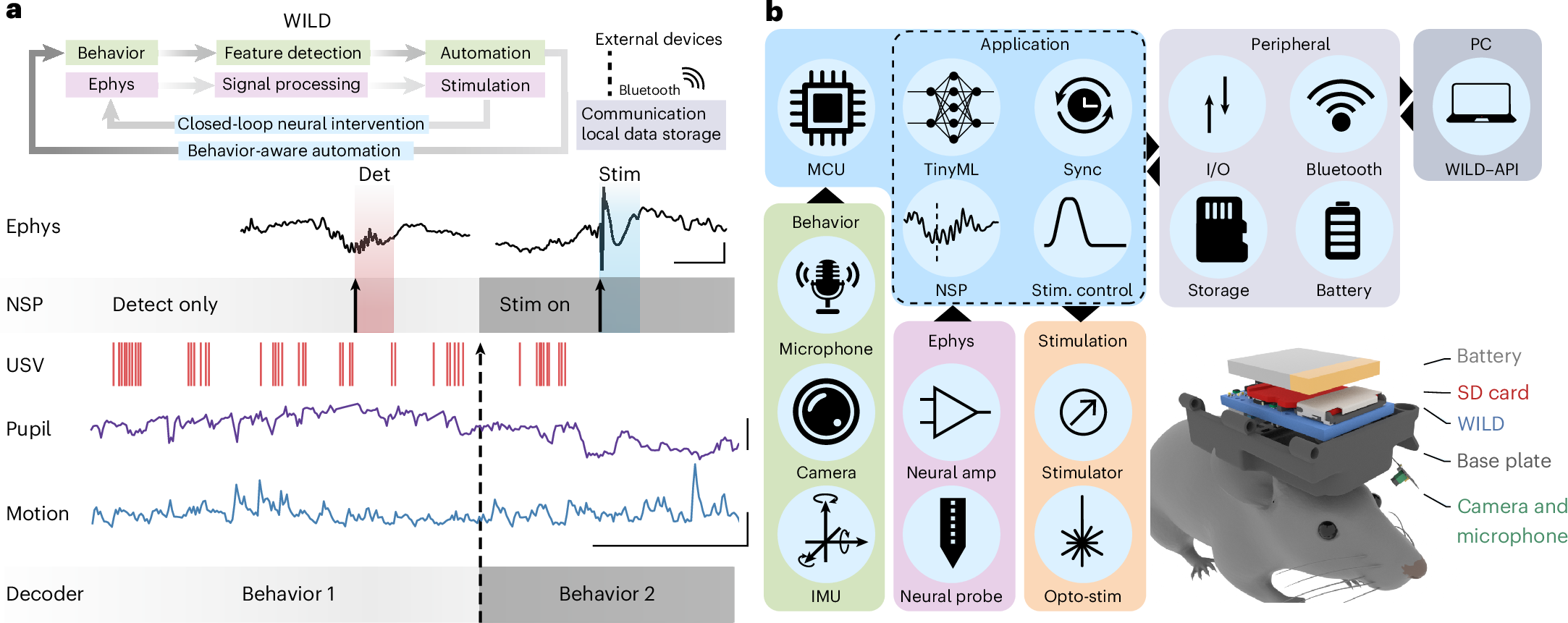
- A paper on nature.com describes WILD, a wireless head-mounted datalogger that integrates flexible neural probes, optogenetics, an inertial measurement unit, an ultrasonic microphone and a camera.
- The authors report recording neural activity, locomotor variables, vocalizations and eye movements at the same time and over long sessions from groups of freely moving mice, in the lab and outdoors.
- Model-based signal processing running on the device picks out specific neural events and behavioral motifs and uses them to fire closed-loop interventions while the animal behaves.
Compiled by The ScientistSomething wrong?How this is made
Why it matters
- capability Experiments a cable forecloses become instrumentable: several animals interacting in one space, each carrying its own recorder, and sessions run in outdoor terrain rather than a rig.
- constraint Because the intervention decision is made by a model riding on the animal's head, the science is bounded by the compute and power that fit there, not by the lab's workstation.
- decision A lab that wants one now chooses between fabricating and validating flexible probes plus an onboard detector itself, or waiting for a commercial version, because open files transfer a design and not a yield.
Cables set the boundary of what a rodent experiment can ask. Animals on leads in a shared arena constrain each other, and a commutator does not follow a mouse into a field, which is why the behaviors ethologists care most about have mostly been studied without simultaneous neural data. The authors say as much: tethered systems are incompatible with many naturalistic behaviors, and the wireless options for animals this small have traded away weight, bandwidth, recording duration or closed-loop control [2].
A logger and a transmitter fail in different places. Writing to memory on the head avoids the radio bandwidth ceiling that limits telemetry [2], but it also means nothing off the animal is watching the signal as it happens, which is the design reason the detection has to be model-based and onboard [4]. Whatever compute and power fit on a mouse becomes the ceiling on what events can be caught and how quickly optogenetic light can follow them.
Closed-loop work in naturalistic settings is not new in itself; the paper's own reference list includes EthoLoop, which did automated closed-loop neuroethology in naturalistic environments in 2020 [11]. The claim here is about consolidation: probes, light delivery, an inertial measurement unit, an ultrasonic microphone and a camera in one wearable package [1], logging neural activity, locomotor variables, vocalizations and eye movements at once from groups of freely moving mice indoors and out [3].
The abstract leaves out the mass in grams, channel count, sampling bandwidth, and maximum continuous logging hours needed to judge whether this works in your rig [7]. The paper describes the device as "lightweight" and the recordings as "long-term," but neither adjective comes with a measurement [1][3]. The abstract likewise leaves out detection latency and false-positive rate for the onboard detector, and a closed-loop finding can be no stronger than those two figures. Nor is there any effect size here; the abstract reports what the platform can record and trigger, not what an intervention did to behavior.
The openness is real and lopsided. Design files, source code, compiled binaries and the device manual are on GitHub under GPL-3.0, analysis scripts and data on Zenodo, with the original binary recordings from the corresponding authors on request because of their size [5]. So the buildable half is free while the validation write-up costs USD 39.95, about seven dollars more than thirty days of Nature+ access at USD 32.99 [8][9][1].
This is a mouse instrument. The outdoor claim is a claim about mice outdoors [3]. If it survives a build in a lab that did not design it, the consequence is a different question list: whether a neural event that precedes a social approach can be perturbed at the moment it appears, in an animal free to walk away [4].
What to watch
- Whether the full text reports device mass in grams, channel count and continuous logging hours, and whether those hold across a multi-animal outdoor session.
- An independent build from the GitHub design files by a lab with no ties to the originating group.
- Published latency and false-positive figures for the onboard event and motif detector, which bound any closed-loop result obtained with it.